Why Double Opt-In is Essential for Email Deliverability
Imagine you’re hosting a massive party, and you want to fill your guest list as fast as possible. You throw open the doors, and everyone who walks by and scribbles their name down is instantly on the list. No questions asked.
This “open door” policy? That’s essentially how many marketers approach email list growth with a single opt-in (SOI) process. The idea is simple: the quicker you add subscribers, the faster you can turn them into paying customers. A user enters their email, and bam, they’re in. It feels like winning a race.
Treating double opt-in (DOI) as an optional step is a recipe for disaster. Major mailbox providers like Gmail and Outlook are intensifying their fight against spam. They now scrutinize sender reputations more than ever before.
The result is predictable: your emails get blocked, your sender reputation is damaged, and your entire marketing operation is put at risk.
This guide will explain why DOI is no longer just a best practice but a non-negotiable necessity for modern email marketing. We will explore how it safeguards your deliverability, ensures legal compliance, and ultimately drives more sustainable growth.
What is Double Opt-In (DOI)?
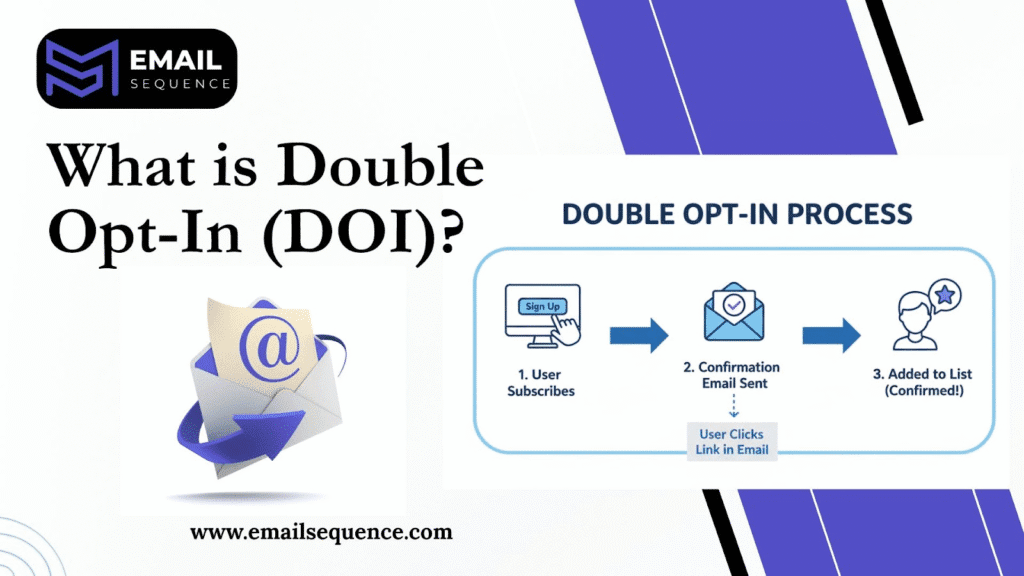
Double opt-in is a two-step verification process for subscribing to an email list. First, a user signs up through a form on your website. Second, they receive an automated confirmation email and must click a link inside it to verify their email address and confirm their subscription.
Only after they complete this second step are they officially added to your mailing list. This process ensures that every subscriber has not only provided a valid email address but also explicitly confirmed their desire to receive your communications.
The Core Thesis: A Non-Negotiable for 2025
For any serious email marketer aiming for success in 2025 and beyond, double opt-in is a foundational requirement.
- It is the most effective method for ensuring both technical deliverability and legal compliance.
- By verifying each subscriber, you build a high-quality list of engaged users who genuinely want to hear from you.
- This practice is your strongest defense against being flagged as spam and is essential for maintaining a healthy sender reputation, which is the bedrock of any successful email program.
Quality Over Quantity: Why Slow List Growth Is Actually Faster Growth
The temptation of rapid list growth through single opt-in is powerful, but it often leads to a list filled with low-quality contacts. How does this compare to the more measured approach of double opt-in? Let’s examine the trade-off.
The Trade-Off
- A single opt-in process delivers immediate list growth, but this speed comes at a cost. Your list becomes susceptible to typos, fake addresses, spam traps, and users who have little genuine interest in your brand.
- Conversely, a double opt-in process grows your list more slowly. Some users will not complete the second confirmation step. However, the subscribers you do acquire are validated, engaged, and have explicitly consented to receive your emails, making them far more valuable in the long run.
The Engagement Benefit
A high-quality list built directly to better performance and a stronger return on investment. How does this happen? Confirmed subscribers demonstrate a higher level of intent, leading to significantly better engagement metrics.
- You will see higher open rates because users expect your emails.
- Click-through rates increase because your content reaches an interested audience.
- Most importantly, conversion rates improve because you are communicating with people who have actively confirmed their interest in your products or services.
- This elevated engagement proves that focusing on list quality, not just size, drives real business results.
Pillar 1: The Deliverability Secret (Stopping Spam Traps)
For your emails to reach the inbox, Internet Service Providers (ISPs) like Gmail and Outlook must trust you as a sender. It is the most direct way to earn and maintain that trust.
It functions as a verification system that proves you are a responsible marketer who respects user consent and prioritizes list hygiene.
How DOI Instantly Eliminates Spam Traps
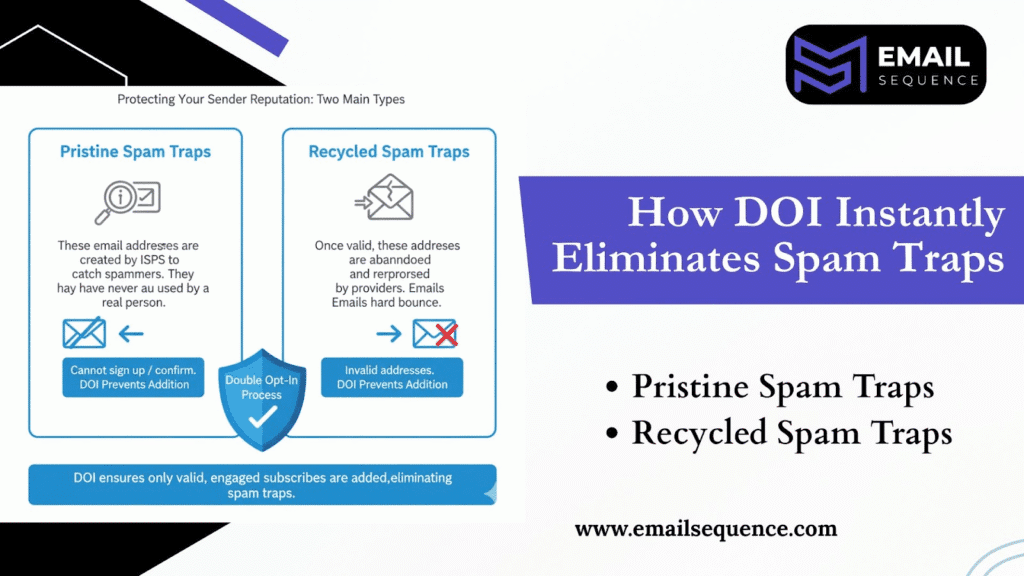
Spam traps are a sender’s worst nightmare, and hitting them is one of the fastest ways to destroy your sender reputation. How does it protect you from them? Let’s look at the two main types.
Pristine Spam Traps:
These are email addresses created by ISPs and blocklist operators that have never been used by a real person. Their only purpose is to identify and catch spammers who scrape or purchase email lists.
Since these addresses cannot sign up for a list, they will never confirm a subscription, so DOI prevents them from ever being added.
Recycled Spam Traps:
These are email addresses that were once valid but have been abandoned by the user and repurposed by the provider to catch marketers sending to outdated lists. An email sent to one of these addresses will hard bounce.
The DOI confirmation process ensures these invalid addresses are never added to your active list in the first place.
Protecting Your IP Reputation: The Bounce Rate Defense
ISPs use bounce rates as a primary indicator of list quality. A hard bounce occurs when you send an email to an address that is invalid, closed, or nonexistent. A high hard bounce rate signals to mailbox providers that you are not managing your list properly, which severely damages your sender score.
How does DOI serve as a defense?
- By requiring users to click a confirmation link, you verify that their email address is valid and active before they are added to your list.
- This simple step prevents invalid addresses from ever being mailed, drastically reducing your hard bounce rate and protecting your crucial sender reputation.
Pillar 2: Your Global Legal Shield (Compliance & Proof)
In an era of increasing data privacy regulation, maintaining documented proof of consent is not just a best practice; it is a legal necessity. Your legal and compliance teams understand that a failure to do so can result in severe financial penalties and reputational damage.
Are You GDPR/CCPA Compliant? Why DOI Is Your Best Proof
Data privacy laws like the General Data Protection Regulation (GDPR) and the California Consumer Privacy Act (CCPA) require businesses to demonstrate that they have received clear and unambiguous consent from individuals before sending them marketing communications.
But how do you prove it?
- A single opt-in process leaves you vulnerable, as there is no definitive record that a specific user intended to subscribe.
- Double opt-in solves this problem by creating an undeniable audit trail.
- It provides a timestamped, digital record that proves a user not only signed up but also took a second, explicit action to confirm their consent, offering powerful protection in the event of an audit or complaint.
Global Safety: Where DOI is a Legal or De Facto Requirement
The need for it extends far beyond a single region. Which countries make it the safest standard to follow? Let’s consider the global landscape.
- Germany: Following court precedents, it is a legal requirement for email marketing in Germany. Businesses that fail to use it face significant legal risks.
- European Union: While not explicitly mandated by the text of the GDPR, the law’s emphasis on explicit and verifiable consent has made double opt-in the de facto standard for compliance across the EU.
- Canada: Canada’s Anti-Spam Legislation (CASL) requires implied or express consent. DOI is the strongest way to secure and document express consent.
Adopting it as your default standard ensures you are aligned with the strictest global privacy regulations, providing a legal shield for your marketing operations worldwide.
How to Improve Your Double Opt-in Rate
Successfully implementing double opt-in requires optimizing the process to ensure users complete the crucial confirmation step. Think of it as a mini-conversion funnel. Here is how to guide users through it effectively.
Step 1: The “Nearly There” Page: Setting Expectations
After a user submits your sign-up form, do not just show a generic “Success!” message. Instead, redirect them to a dedicated page that sets clear expectations. The message should be direct: “Thank You, but you are not done yet.
To complete your subscription, please check your inbox now and click the confirmation link in the email we just sent.” This simple instruction clarifies the next step and creates a sense of urgency, significantly increasing the likelihood that users will follow through immediately.
Step 2: The Confirmation Email: Guaranteeing Delivery
The confirmation email is the most critical part of the process. If it does not arrive or gets lost in a spam folder, the subscription fails. What is the key to ensuring it gets delivered? Use a dedicated transactional email stream.
Crucial Technical Tip: The confirmation email must be sent via a Transactional Email Stream (high-priority, dedicated IP) to ensure it bypasses spam filters.
Transactional emails (like password resets and receipts) have the highest delivery priority and are sent through high-reputation channels.
Routing your DOI confirmation email through this stream signals to ISPs that it is a critical, user-requested message, virtually guaranteeing it lands in the inbox.
Subject Line Best Practices
Your subject line needs to command attention and inspire action. Which titles work best? Use clear, direct phrases that communicate what is required.
- Action Required: Confirm Your Email Address
- Please Confirm Your Subscription to [Your Brand]
- One Last Step: Activate Your [Your Brand] Subscription
Designing the Perfect Confirmation Button
The design of your confirmation email should focus on a single, clear action. How can you ensure users click?
- Use a large, high-contrast, and mobile-friendly call-to-action (CTA) button.
- The button text should be unambiguous, such as “Confirm My Subscription” or “Activate My Account.“
- Eliminate all other distractions, links, or competing calls to action from the email. Make the desired action obvious and easy to complete.
How to set up double opt-in verification
Setting up a reliable can be complex, involving separate configurations for transactional email streams and manual record-keeping for compliance. This is where automation platforms can transform a challenging process into a seamless one.
The “Easy Button”: AI Automation with EmailSequence
Competitor platforms often require users to navigate complicated manual setups to configure transactional email routing for their confirmation messages.
However, EmailSequence replaces this complexity with a fully integrated and automated process. Our AI-powered platform simplifies the entire workflow, allowing you to implement a robust system with just a few clicks.
Automated Guarantee: No More Transactional Email Headaches
With EmailSequence, you no longer need to worry about manual configurations or the risk of your confirmation emails going to spam. How do we ensure this? Our system automatically routes the critical confirmation email through our high-reputation transactional stream.
This built-in feature eliminates deliverability risk and ensures your new subscribers receive their confirmation message instantly, maximizing your opt-in rate without any technical effort on your part.
Instant Legal Record Keeping
Maintaining compliance requires meticulous record-keeping, but doing it manually is tedious and prone to error. EmailSequence automates this entire process.
The platform automatically captures and securely stores the timestamped consent record for every new subscriber. This provides you with an instant, accessible audit trail, protecting you from future legal challenges with zero manual effort.
Conclusion
The choice facing modern email marketers is clear. You can pursue the illusion of rapid growth with single opt-in and risk deliverability issues, legal penalties, and a disengaged audience.
Or, you can choose the path of sustainable, long-term success by embracing double opt-in. By prioritizing list quality and compliance over fleeting list size, you build a foundation of trust with both subscribers and mailbox providers.
This strategic choice leads to a highly engaged email list, superior campaign performance, and a resilient marketing program built for the future. Stop managing deliverability and compliance manually. It is time to automate your success.
Start building a high-engagement, spam-proof, and compliant email list today with EmailSequence.com.
Frequently Asked Questions
Is double opt-in required under GDPR?
No, double opt-in is not explicitly required by the GDPR. However, GDPR does require that consent be freely given, specific, informed, and unambiguous, and that you are able to prove the user gave that consent.
Double opt-in provides a clear audit trail with a timestamped record of the user’s action, making it one of the most effective ways to demonstrate compliance. As a result, it is widely considered a best practice for GDPR compliance.
What are the benefits of using double opt-in?
Double opt-in improves list quality, deliverability, and legal compliance. It helps you confirm that the subscriber genuinely wants to receive your emails, reducing spam complaints and hard bounces.
It also protects your brand by preventing fake or mistyped email addresses from entering your list, and offers stronger proof of consent in case of regulatory scrutiny.
What is the ideal open rate for a confirmation email?
A well-optimized confirmation email should achieve an open rate of 60% to 80%, or even higher.
If you’re seeing significantly lower open rates, it could indicate deliverability issues, a weak subject line, or a delay in sending the confirmation message—any of which can hurt your opt-in conversion rate.
How soon should the confirmation email be sent after sign-up?
The confirmation email should be sent immediately—within seconds of the user submitting the sign-up form.
Delays reduce the chance that users will complete the opt-in process. Real-time delivery helps maintain user intent and dramatically improves your confirmation rates.
What should be included in a double opt-in confirmation email?
A double opt-in email should be clear, concise, and action-focused. Include:
- A brief message thanking the user for signing up
- A prominent call-to-action (e.g., “Confirm your subscription”)
- A reminder of what they signed up for
- Your brand name and contact information
- Optional: a note about why this extra step is for their security and privacy
Keeping the email focused on confirmation helps drive higher click-through and confirmation rates.