Building Your 2026 Email Automation Roadmap for Growth
Static, “set-and-forget” email campaigns are dead. If you’re still using outdated drip campaigns, you’ve probably watched your engagement rates dive as buyer behavior and technology rapidly change. In a world of AI, strict privacy rules, and demands for hyper-personalization, an effective email automation roadmap is the only thing that can guide you through the chaos.
Turning casual subscribers into loyal brand advocates requires strategic foresight. Organizations must move beyond open rates and adopt a holistic approach that ties data integrity to customer lifecycle stages, shifting from reactive tactics to proactive strategies.
This guide provides a comprehensive framework for success in the coming years. You will learn how to plan, prioritize, and execute a strategy that aligns with 2026 standards. We will cover:
- Why a structured roadmap is non-negotiable.
- How to prepare your data infrastructure.
- The high-impact workflows you must prioritize.
- A phased timeline for implementation and optimization.
What an Email Automation Roadmap Actually Is
Many businesses mistake a list of software features for a plan, but a true roadmap is a strategic document that links technology to business outcomes. It serves as a visual and logistical guide that outlines exactly how automated communications will evolve to meet specific revenue and engagement targets.
This document bridges the gap between high-level goals and daily operations. A well-defined roadmap provides clarity on:
- Sequence: The specific order in which you will launch campaigns.
- Resources: The data, content, and personnel required for each stage.
- Milestones: The key performance indicators that signal success.
Difference Between Automation Tools and Automation Strategy
Owning a Ferrari does not make someone a racecar driver, and subscribing to an enterprise marketing platform does not guarantee revenue. Tools provide the capability to send messages, but strategy planning provides the intelligence regarding who receives what message and when they receive it.
Organizations often fail when they prioritize tool selection over roadmap creation. You must distinguish between the vehicle and the map:
- Tools: The software is the vehicle. It handles the mechanics of message delivery, audience segmentation, and data collection, enabling you to execute your campaigns efficiently.
- Strategy: The strategy is the map. It defines the “why” behind the “what,” dictating the messaging logic, timing, and psychological triggers that guide the customer journey toward a specific goal.
How a Roadmap Aligns Business Goals
A robust roadmap resolves this by directly tying automation efforts to overarching business objectives, ensuring that every automated workflow serves a measurable purpose.
Alignment is critical for securing budget and stakeholder buy-in. When you present a clear vision, you demonstrate how specific actions lead to results:
- Revenue Goals: Aligning cart recovery workflows with quarterly sales targets to boost revenue and reduce lost opportunities. Highlighting how even small improvements in recovery rates can drive significant financial impact.
- Data Usage: Demonstrating the value of data collection by showing how it powers hyper-personalized customer experiences, leading to increased engagement and loyalty.
- Timeline: Establishing clear, realistic timelines for ROI, while tracking interim progress to keep stakeholders informed. Providing benchmarks to measure success and maintain momentum throughout the process.
Phase 1: Foundation Planning (Data, Goals, and Readiness)
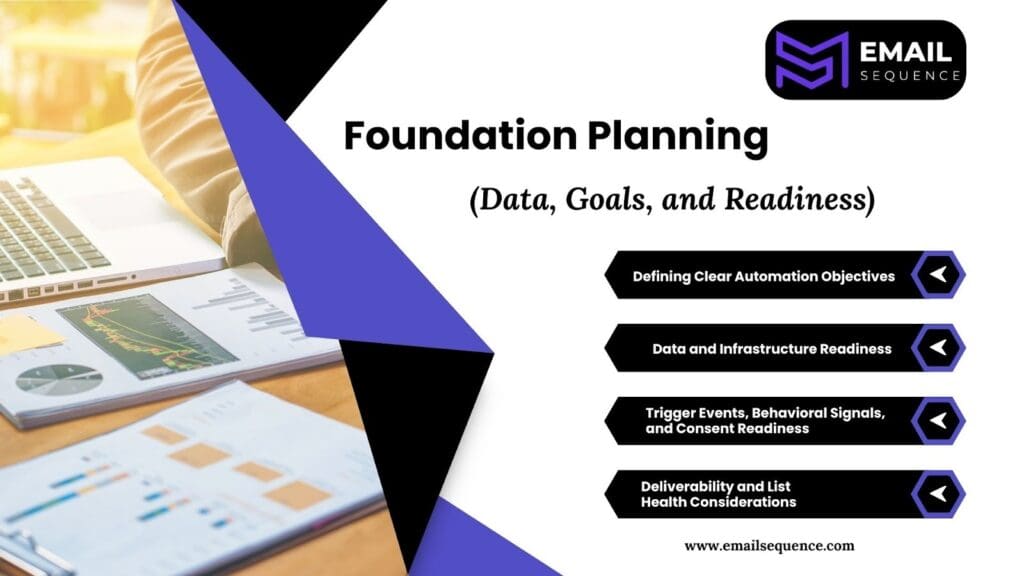
Defining Clear Automation Objectives
You cannot hit a target that you have not defined. Before building a single workflow, you must decide exactly what problem the automation solves for the business, whether it is maximizing customer lifetime value or reducing the manual workload on your sales team.
- Growth: Focusing on converting leads into first-time buyers.
- Retention: Prioritizing workflows that reduce churn and encourage repeat purchases.
- Efficiency: Automating administrative updates to free up team bandwidth.
Mapping Automation Goals to Funnel Stages
A common mistake involves front-loading automation at the top of the funnel while neglecting existing customers. You must map your objectives across the entire customer journey to ensure a consistent experience from awareness to advocacy.
Visualizing the funnel helps identify gaps in your current communication strategy. Your email automation roadmap should address:
- Top of Funnel: Educational content that builds trust.
- Middle of Funnel: Case studies and comparisons that aid decision-making.
- Bottom of Funnel: Incentives and reassurance that drive the final purchase.
Data and Infrastructure Readiness
Third-party cookies are obsolete, making your own data your most valuable asset. You must audit your current database to ensure you possess clean, structured, and accessible first-party data that can trigger the sophisticated automations required in 2026.
Data quality determines the success or failure of your automation. Ask these questions to assess your readiness:
- Accuracy: Is the contact information current and valid?
- Depth: Do you have behavioral data beyond just email addresses?
- Integration: Does your data flow seamlessly between your CRM and email platform?
Trigger Events, Behavioral Signals, and Consent Readiness
Static lists are less effective than dynamic segments based on real-time user actions. Your infrastructure must be capable of capturing specific behaviors—such as page visits, abandoned forms, or specific clicks—and using them as immediate triggers for communication.
Future planning requires a strict adherence to evolving privacy standards. Ensure your tracking mechanisms are robust and compliant:
- Signal Capture: Can you track a user’s activity across mobile and desktop?
- Consent Management: Do you have explicit permission to market to these users based on their behavior?
- Latency: Can the system trigger an email within seconds of the action?
Deliverability and List Health Considerations
Even the most persuasive email fails if it lands in the spam folder. Technical preparation regarding sender reputation, domain authentication (SPF, DKIM, DMARC), and list hygiene is a prerequisite for launching any new automation program.
Protecting your sender reputation is an ongoing process. You must establish protocols for:
- Validation: Removing invalid addresses before they bounce.
- Sunset Policies: Automatically removing unengaged subscribers to keep engagement rates high.
- Authentication: Ensuring all technical records verify your identity to ISPs.
Phase 2: Priority Automation Use Cases for 2026
High-Impact Automation Workflows to Start With
First impressions dictate the longevity of the customer relationship. A robust onboarding series does more than say “hello”; it educates the user on how to extract value from your product or service, thereby reducing early-stage churn.
This workflow sets the tone for all future interactions. Your strategic planning for onboarding should focus on:
- Value Delivery: Showcasing key features or products immediately.
- Expectation Setting: Telling subscribers how often you will email them.
- Data Enrichment: Asking for preferences to tailor future emails.
Lead Nurturing and Qualification Sequences
Not every subscriber is ready to buy immediately. Nurturing sequences keep your brand top-of-mind by providing relevant value over time, slowly guiding the prospect toward a purchase decision without being overly aggressive.
Effective nurturing utilizes behavioral scoring to gauge intent. These sequences should prioritize:
- Education: Solving prospect pain points with content.
- Social Proof: Sharing testimonials and success stories.
- Qualification: Identifying when a lead is “sales-ready” based on engagement.
Re-engagement and Lifecycle-based Campaigns
It is far cheaper to retain an existing customer than to acquire a new one. Lifecycle campaigns acknowledge customer milestones, celebrate anniversaries, and intervene when a formerly active user begins to show signs of disengagement.
Your email automation roadmap must include safety nets for retention. These campaigns work to:
- Win Back: Incentivize users who have stopped opening emails.
- Upsell: Recommend complementary products based on purchase history.
- Loyalty: Reward your best customers to encourage advocacy.
Phase 3: Building the 2026 Automation Timeline
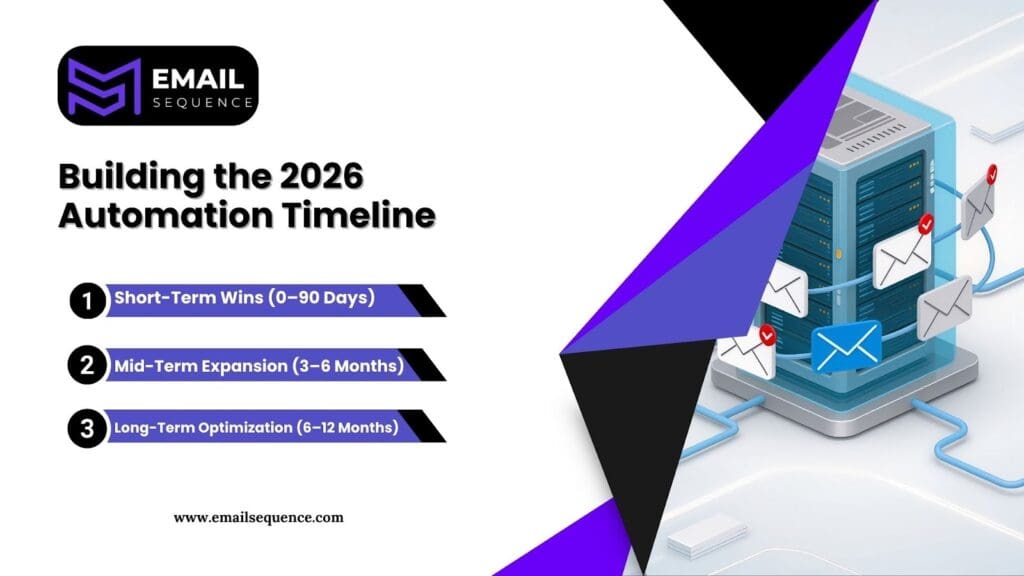
Short-Term Wins (0–90 Days)
Momentum is crucial in the early stages of roadmap execution. Focus on launching one or two high-confidence workflows that are relatively easy to implement but offer significant returns, such as a welcome series or an abandoned cart flow.
Securing early wins validates your implementation schedule to stakeholders. During this phase, you should:
- Launch: Activate the foundational workflows identified in Phase 2.
- Monitor: Watch deliverability metrics closely.
- Validate: Ensure data is flowing correctly between systems.
Testing Triggers, Messaging, and Timing
The first 90 days are for gathering baseline performance data. You must experiment with different delay times between emails and test various subject lines to understand what resonates best with your specific audience segments.
Optimization begins immediately after launch. Your initial testing should cover:
- Delays: Does a 1-hour or 24-hour delay work better for abandonment emails?
- Subject Lines: Do questions perform better than statements?
- Content: Does plain text outperform HTML templates?
Mid-Term Expansion (3–6 Months)
Once the basics are running smoothly, you move toward deeper sophistication. This involves breaking your broad audience into smaller, more specific micro-segments based on the behavioral data you have collected during the first phase.
Roadmap creation enters a more complex stage here. You will start to:
- Segment: Group users by purchase frequency or content interest.
- Personalize: Insert dynamic content blocks that change based on the user’s segment.
- Expand: Launch secondary workflows for specific product lines.
Introducing Predictive and Behavior-based Automation
At this stage, you begin to leverage AI and machine learning capabilities. Predictive modeling can help you determine the optimal send time for each individual and predict which product a customer is most likely to buy next.
This is where your strategy becomes proactive. You will implement:
- Send Time Optimization: Emailing users when they are most likely to open.
- Churn Prediction: Triggering offers before a customer leaves.
- Next Best Action: Automating recommendations based on predictive algorithms.
Long-Term Optimization (6–12 Months)
Automation is never truly “finished.” The long-term phase focuses on rigorous, iterative A/B testing to squeeze every percentage point of performance out of your workflows.
Your implementation schedule shifts from building to refining. Key activities include:
- Multivariate Testing: Testing multiple variables simultaneously.
- Control Groups: Measuring the true lift of automation against a non-emailed group.
- Auditing: Reviewing all content to ensure it remains accurate and relevant.
Automation Performance Reviews and Refinements
Markets change, and so does your business. You must schedule regular reviews to ensure your automation strategy still aligns with company goals and that your technology stack is still performing as expected.
This final step ensures the longevity of your email automation roadmap. You should conduct:
- Quarterly Reviews: Assessing performance against KPIs.
- Tech Audits: Ensuring integrations remain stable.
- Strategy Updates: Adjusting the roadmap based on new product launches or market shifts.
Conclusion
An effective email automation roadmap is more than a convenience; it’s a strategic asset for scaling customer communication and driving business growth. By moving through the phases of setting clear goals and KPIs to conducting regular performance reviews, you can transform your email marketing from a manual chore into a powerful, self-optimizing engine.
A well-executed strategy ensures every message is relevant, timely, and effective, fostering stronger customer relationships and boosting your bottom line.
Ready to build an email automation roadmap that delivers real results? Visit EmailSequence.com to see how our platform can streamline your efforts and help you achieve your goals today.
Frequently Asked Questions
What is an email automation roadmap?
An email automation roadmap is a strategic plan that outlines how automated emails will be used to achieve business goals. It covers every stage from onboarding to retention and ensures campaigns are structured, timely, and effective.
What are the first steps to plan automation?
Start by defining clear business objectives and key metrics. Audit your data for accuracy and completeness, set up behavioral triggers, and ensure consent and deliverability compliance.
How should automation differ for B2B vs B2C?
B2B automation focuses on long nurture cycles, multi-touch engagement, and decision-maker influence. B2C automation emphasizes quick, personalized messages, dynamic content, and urgency-driven campaigns.
How can automation improve customer experience?
Sending relevant content at the right time, avoiding over-messaging, and responding to engagement signals ensures automation supports the customer journey.