How to Handle Email Rejections and Turn Them into Opportunities
Learning how to handle email rejections is essential for long-term cold outreach success. Most prospects do not reject offers because the product is bad; they reject timing, relevance, trust, or urgency. A smart outreach strategy uses professional replies, strategic follow-ups, and effective objection handling to keep conversations alive without damaging relationships.
Strong rejection responses, personalized communication, and a calculated persistence strategy help sales teams maintain credibility, improve reply quality, and turn rejected prospects into future opportunities through consistent relationship building.
Why Cold Email Rejections Are Normal in Modern Outreach
Why Most Prospects Ignore or Reject Cold Emails
Modern decision-makers receive hundreds of sales pitches every week, leading to severe inbox overload and decision fatigue. They scan messages, searching for reasons to delete emails rather than read them.
Knowing these common barriers helps you refine your targeting and messaging. The most useful points include:
- Inbox overload: Executives receive too many generic pitches daily.
- Lack of trust: Prospects do not buy from strangers without established credibility.
- Poor timing: Your offer arrives when the prospect has other urgent priorities.
- Generic outreach: Automated templates fail to address the specific pain points of the buyer.
Rejection Does Not Always Mean “Not Interested”
Sales professionals often mistake bad timing for a permanent refusal. A prospect who declines a meeting today might desperately need your solution six months from now. You need to identify the hidden reasons behind a negative reply to formulate effective rejection responses.
Evaluating the context of a rejection prevents you from abandoning warm leads. The most useful points include:
- Timing-based rejection: The prospect likes the product but lacks the current bandwidth to implement it.
- Budget limitations: The company froze spending for the current quarter but will renew budgets later.
- Priority conflicts: The team focuses on a different major project right now.
- Stakeholder blocks: The person you emailed lacks the authority to approve the purchase.
The Different Types of Cold Email Rejections
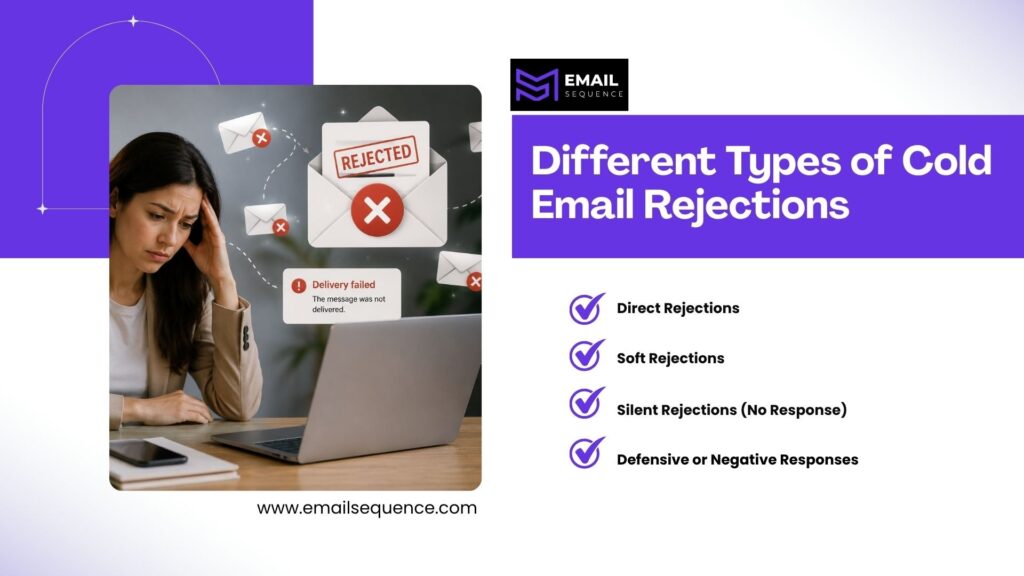
Direct Rejections
A direct rejection provides clear, unmistakable feedback that the prospect does not want your offer. They might say “Not interested” or “We already use another solution.” You must learn to categorize these replies to craft appropriate professional replies.
Handling direct rejections calmly protects your brand reputation and leaves a positive impression. The most useful points include:
- Competitor alignment: The prospect actively uses a rival product and feels satisfied.
- Hard “No”: The buyer explicitly asks you to stop contacting them.
- Mismatched targeting: Your product does not fit their specific business model.
- Tone evaluation: A polite direct rejection leaves room for future networking.
Soft Rejections
Soft rejections sound polite but effectively stall the sales process. Prospects use phrases like “Maybe later” or “Circle back next quarter” to avoid conflict. You need a structured persistence strategy to convert these delays into firm commitments.
Silent Rejections (No Response)
Ghosting remains the most common form of rejection in cold email outreach. Prospects open your email, read the first line, and archive it without replying. You must rely on behavioral data to determine if you should continue sending messages.
Defensive or Negative Responses
Sometimes prospects react with hostility or frustration to cold outreach. They might send angry replies, criticize your messaging, or threaten to report you for spam. You must handle these situations with absolute professionalism to prevent reputational damage.
Responding to hostility requires emotional control and clear, polite communication. The most useful points include:
- Aggressive language: The prospect uses hostile words to express frustration.
- Spam accusations: The buyer falsely labels your compliant cold email as illegal spam.
- Unsubscribe demands: The prospect aggressively demands removal from your database.
- Feedback criticism: They reply specifically to mock or critique your email template.
Why Most Sales Teams Handle Rejections Incorrectly
Many sales teams lose opportunities after the first rejection because they respond from emotion instead of strategy. They either push too hard, disappear too quickly, or send a weak apology.
A better process helps teams stay professional and consistent.
Sending Emotional or Defensive Replies
Defensive replies destroy credibility. When a salesperson argues with a rejection, the prospect feels even less interested.
A calm reply shows maturity and respect. It also keeps the brand image clean.
Poor replies often include:
- Arguing with the prospect: This makes the sender look insecure.
- Overexplaining the offer: Long replies increase pressure.
- Using guilt language: This damages trust quickly.
- Sounding offended: Emotional replies reduce professionalism.
- Pushing for a call again: This ignores the prospect’s boundary.
Good sales teams control tone before they control pipeline.
Giving Up Too Early
Some prospects need several touchpoints before they engage. A quick no may only reflect timing. This does not mean you should keep chasing every lead. It means you should use a smart persistence strategy for soft rejections and future-fit prospects.
Using Aggressive Persistence Strategies
While giving up early is a mistake, annoying a prospect with aggressive follow-ups is equally damaging. Sending emails every single day crosses the line between persistence and spam. You must space out your communication to respect the buyer’s inbox.
Failing to Build Long-Term Relationships
Sales teams often view cold outreach purely as a transactional numbers game. They ignore the networking potential that exists even when a prospect declines a purchase. You must prioritize relationship building to generate referrals and future opportunities.
How to Handle Email Rejections Professionally

Acknowledge the Prospect Respectfully
When a prospect replies to decline your offer, you must acknowledge their time and decision gracefully. Showing respect validates their authority and demonstrates high emotional intelligence. You must craft professional replies that leave a lasting positive impression.
A respectful acknowledgment disarms the prospect and reduces any lingering tension. The most useful points include:
- Expressing gratitude: Thank the prospect explicitly for taking the time to respond.
- Validating their stance: Agree that their current priorities make sense for their business.
- Maintaining professionalism: Keep the tone polite, regardless of how brief their rejection was.
- Avoiding arguments: Never try to convince them they made the wrong choice in that moment.
Keep Responses Short and Professional
Long replies after rejection usually feel defensive. Keep your answer simple and easy to read.
A short message can protect trust better than a detailed explanation.
Example:
“Thanks for letting me know. I completely understand. I will step back for now, but I would be happy to reconnect if this becomes relevant later.”
Leave the Door Open for Future Communication
You should always position yourself as a helpful resource for the future. Markets change, employees switch jobs, and company priorities shift constantly. You must practice proactive relationship building by inviting them to reach out later.
Focus on Relationship Preservation
Your primary goal after a rejection shifts from selling to preserving the connection. A prospect who trusts you might refer you to a colleague at a different company. You must prioritize relationship building above short-term metrics.
Objection Handling Strategies That Actually Work
“We Already Have a Provider”
When a prospect mentions an existing competitor, they are actually qualifying themselves as a buyer of your category. You must use smart objection handling to highlight your unique differentiation.
Positioning yourself as a specialized alternative opens the door for a future switch. The most useful points include:
- Acknowledge the competitor: Compliment the rival tool to show you understand the market.
- Highlight one differentiator: Mention one specific feature the competitor historically lacks.
- Suggest a backup role: Offer to be a secondary option if their current provider fails.
- Ask about contract timing: Politely inquire when their current vendor contract expires.
“We Don’t Have a Budget Right Now.”
A budget objection usually means the prospect lacks the authority to spend or does not see enough urgent value. You must implement a timing-based persistence strategy to stay visible. You must use relationship building to nurture the lead until funding becomes available.
Tracking budget cycles allows you to strike exactly when new funds open up. The most useful points include:
- Identify budget cycles: Ask when their financial planning period typically occurs.
- Offer free value: Provide a free audit or template they can use immediately.
- Schedule follow-ups: Set a CRM reminder to contact them 30 days before their new quarter.
- Reduce risk: Offer a pilot program that requires minimal initial investment.
“Send Me More Information”
This response acts as a classic brush-off, but it also provides a small window of opportunity. Controlling the information flow prevents the prospect from ignoring your follow-up. The most useful points include:
- Ask a clarifying question: Ask what specific feature they want to learn more about.
- Send targeted assets: Provide a one-page document instead of a massive slide deck.
- Suggest a micro-meeting: Ask for a five-minute chat just to walk through the document.
- Track document engagement: Use tracking links to see exactly when they open the PDF.
Rejection Responses That Maintain Credibility
How to Reply Without Sounding Desperate
Desperation repels buyers instantly. If you beg for a meeting after a rejection, you lose all professional leverage. You must ensure your rejection responses project confidence and abundance. You must handle email rejections like an expert consultant, not a starving salesperson.
The Best Structure for Professional Replies
A standardized framework helps you write effective replies quickly and consistently. You must use a reliable structure to ensure all professional replies hit the right psychological notes. You must combine appreciation, acknowledgment, and a low-pressure close.
Using a strict structure prevents emotional rambling and maintains your professional image. The most useful points include:
- Appreciation: Open by thanking them directly for their quick response.
- Acknowledgment: Confirm that you understand their specific reason for declining.
- Value reminder: Briefly mention the core problem you solve in one short phrase.
- Low-pressure closing: Wish them a great week and gracefully end the message.
Persistence Strategy: Following Up Without Becoming Annoying
The Difference Between Persistence and Spam
Persistence relies on adding new value; spam relies on repeating the exact same request. You must build a persistence strategy that educates the buyer over time.
Value-driven follow-ups build trust, while repetitive check-ins destroy it. The most useful points include:
- Value-driven messaging: Every follow-up must contain a new insight, tip, or resource.
- Spacing out emails: Wait at least 4 to 7 days before sending a second email.
- Changing the angle: If a financial pitch fails, try an operational efficiency pitch next time.
- Avoiding guilt trips: Never complain that the prospect ignored your previous emails.
Ideal Follow-Up Timing After Rejection
Timing dictates the success of any follow-up campaign. You must align your persistence strategy with the buyer’s natural business cycles. You must track these timelines in your CRM to ensure accurate relationship building.
Calling a prospect at the exact moment their contract expires creates a massive competitive advantage. The most useful points include:
- 30-day window: Reach out after a month if they cited short-term project delays.
- Quarterly check-ins: Follow up every 90 days for budget-related objections.
- Trigger-based timing: Email them immediately if their company announces new funding.
- Contract renewal dates: Reach out 60 days before their current competitor contract ends.
Using Multi-Channel Follow-Ups
Email alone limits your visibility and engagement. You must expand your persistence strategy by incorporating social media and indirect touchpoints. You must use relationship building across multiple platforms to stay relevant.
A multi-channel approach makes your brand feel omnipresent without clogging their inbox. The most useful points include:
- LinkedIn engagement: Comment thoughtfully on their posts to build name recognition.
- Newsletter invitations: Ask if they want to join your high-value industry newsletter.
- Direct mail: Send a highly targeted physical book or report to their office.
- Social selling: Share relevant case studies on your own profile where they might see them.
Common Cold Email Rejection Mistakes
Many teams lose future deals because they handle rejection carelessly. The mistake often happens after the reply, not before it. A clear process helps teams avoid emotional decisions.
- Taking it personally: Don’t let a “no” hurt your confidence. The prospect rejected the email, not you.
- Following up too quickly: Spamming a prospect’s inbox after a rejection will get you blocked and damage your reputation.
- Ignoring intent signals: Read between the lines of a rejection. Addressing a hidden objection can often revive a dead deal.
- Using a one-size-fits-all approach: A “not interested” requires a different response than a “we use a competitor.” Customize your replies.
Cold Email Rejection Recovery Framework
Different rejections require completely different communication strategies. You must analyze the prospect’s intent to choose the right path. Use this framework to standardize your recovery process across your entire sales team.
| Rejection Type | Recommended Response | Follow-Up Timing | Strategic Goal | Example Message Strategy |
| No Response | Value-driven follow-up | 5–7 days | Re-engagement | Provide a free audit or new data point |
| Budget Objection | Educational nurture | 30–60 days | Future opportunity | Share a case study showing ROI |
| Existing Provider | Differentiation messaging | Quarterly | Competitive positioning | Highlight one feature the competitor lacks |
| Soft “Maybe Later” | Clarifying question | 14–21 days | Establish a timeline | Ask what month makes sense to reconnect |
| Hard Rejection | Respectful close | Stop outreach | Reputation protection | Thank them for their quick response |
Conclusion
Learning how to handle email rejections helps sales teams protect credibility, improve future conversations, and build a stronger cold outreach system. Rejection does not always mean permanent disinterest. It often reflects timing, budget, trust, or priority gaps that sales teams can manage with patience and strategy.
The best teams use smart objection handling, confident rejection responses, a balanced persistence strategy, and long-term relationship building instead of emotional reactions. This approach helps businesses maintain professionalism, nurture future opportunities, and improve cold email conversion rates over time. Ready to build an AI email campaign with effortless automation? Contact our team to get started on your email sequence.
Frequently Asked Questions
How should I respond to a cold email rejection?
Respond with respect, brevity, and confidence. Thank the prospect for replying, acknowledge their decision, and leave the door open if future timing changes. Avoid arguing, overexplaining, or asking again for a meeting immediately. A professional response protects your reputation and keeps future opportunities possible.
What is the best way to handle email rejections?
The best way to handle email rejections is to classify the rejection first. Direct rejection, budget objection, timing issue, and no response all need different actions. Use calm objection handling, useful follow-ups, and proper CRM tagging so you can respond strategically instead of emotionally.
Should I follow up after a prospect says no?
You should follow up only when the rejection leaves room for future contact. “Not now” or “circle back later” may deserve a delayed follow-up. A hard no or opt-out means you should stop. Respecting boundaries protects sender reputation and improves long-term trust.
How many times should I follow up after no response?
For no response, many teams send a few value-driven follow-ups spaced several days apart. Avoid sending repeated “checking in” messages. Each follow-up should add a new insight, useful resource, or different angle. If the prospect never engages, stop outreach or move them into long-term nurture.
How can objection handling improve cold email results?
Objection handling helps sales teams understand why prospects hesitate and respond with the right message. A budget objection needs different handling than an existing-provider objection. Better responses reduce pressure, preserve trust, and create future sales opportunities without damaging the relationship.