How to Re-Engage Inactive Subscribers: A 3-Phase Blueprint
You have poured hours into crafting the perfect email campaign, ready to hit send. But lurking in your subscriber list are hundreds, maybe thousands, of unengaged contacts. Think of them as silent saboteurs.
They interpret these unopened emails and ignored messages as a clear signal: “This sender isn’t providing value.” Suddenly, your carefully constructed emails start landing in spam folders, not just for the inactive, but for your active subscribers too. Sender reputation tanks, open rates plummet, and your email marketing ROI nosedives. This costly problem damages your bottom line and brand credibility.
To re-engage inactive subscribers effectively, you need to go beyond generic “we miss you” emails. The solution is a structured, automated system that segments your audience and gives them a clear path to either re-engage or be removed from your list.
In this blog post, we will provide a detailed, three-phase blueprint for building such a system. By following this structured approach, you can create an automated re-engagement sequence that cleans your list, improves deliverability, and converts dormant contacts back into active customers.
Phase 1: The Strategic Foundation – Defining & Segmenting Your Audience
A successful strategy to re-engage inactive subscribers starts with a solid foundation. Before drafting any emails, it’s crucial to define what inactivity means for your business and segment your audience based on their value.
This initial setup is crucial for sending personalized, relevant messages that have the highest chance of success. A one-size-fits-all approach will not work; segmentation is your most powerful tool.
A. Defining Inactivity: The 90/180 Day Rule
First, you must establish a clear, data-driven definition of an inactive subscriber. This is the trigger that will enroll a contact into your re-engagement sequence. How do you set this rule? A common best practice is to use a 90-day or 180-day window, but the right choice depends entirely on your business model and sales cycle.
What is the correct timeframe for your business? Consider these points.
- For businesses with short sales cycles (e.g., e-commerce, fast-moving consumer goods), a shorter inactivity window of 90 days is often appropriate. If a customer has not engaged in three months, they have likely lost interest.
- For businesses with long sales cycles (e.g., B2B SaaS, high-ticket services), a longer window of 180 days may be more suitable. The decision-making process is slower, so a lack of recent engagement is less alarming.
Once you have set your timeframe, define inactivity as a lack of both opens and clicks. The rule should be: No Opens OR No Clicks within your chosen period (e.g., 90 days). This ensures you are targeting subscribers who are truly unengaged with your content.
B. The Critical Value Segmentation
Not all inactive subscribers are created equal. When deciding how to re-engage inactive subscribers, remember that someone who has purchased from you in the past holds significantly more potential value than someone who only downloaded a free resource.
Treating them the same is a missed opportunity. How should you divide these contacts? Use value-based segmentation to tailor your re-engagement offers.
- Segment A: Past Buyers (High Value): These subscribers have already demonstrated a high level of commitment by spending money with your brand. They trust you enough to have made a purchase. For this segment, the goal is to win back their business with exclusive, personalized incentives.
- Segment B: Free Leads/Non-Buyers (Low Value): This segment includes individuals who signed up for a newsletter, downloaded a lead magnet, or registered for a webinar but have never made a purchase. The goal here is to re-establish value and gauge their current interests through content and simple preference polls.
This segmentation allows you to deploy your resources strategically. You can invest more in winning back high-value customers while using a lower-touch, content-focused approach for leads who have not yet converted.
C. The Inactive Subscriber Tiers -> How to Triage Your List
To refine your strategy further, you can layer your inactivity definition with a tiered system. This helps you triage your list and apply the right level of pressure at the right time. What are the different stages of inactivity? You can organize your contacts into three distinct tiers.
| Tier Name | Definition (Inactivity Window) | What It Means | Recommended Action (The Goal) |
| Dormant | 60-90 Days of No Opens/Clicks | Still interested, but busy/inbox is crowded. Needs a gentle nudge. | Soft Re-introduction: Highlight the best content or a new feature. No hard sell. |
| Lapsed | 91-180 Days of No Opens/Clicks | Likely forgot why they signed up. Needs a strong, tangible reason to come back. | Targeted Incentive: Strategic offer (e.g., 10% off, free shipping) personalized to past behavior. |
| Cold / Zombie | 180+ Days of No Opens/Clicks | Highly unlikely to engage and actively hurting deliverability. Expensive to keep. | Final Choice: Send the “Breakup Email” with a deadline before automated removal/unsubscription. |
This tiered structure gives you a clear, progressive path for managing inactive subscribers. It moves them from a gentle reintroduction to a direct incentive and finally to a clear decision point, ensuring that you do not prematurely remove potentially valuable contacts while still maintaining list hygiene.
Phase 2: The 3-Part Re-Engagement Architecture
With your strategic foundation in place, you can now build the automated email sequence. This three-part flow is designed to re-engage subscribers or remove them from your list systematically.
The entire process is triggered when a subscriber meets your definition of inactivity and is enrolled in the ‘Dormant’ or ‘Lapsed’ tier.
Trigger: Subscriber moves from Engaged to the ‘Dormant’ or ‘Lapsed’ tier.
Email 1: The Soft Re-Introduction (Value-First)
The first email should not be a sales pitch. Instead, focus on re-establishing the value you provide. How do you remind them why they subscribed? Send them a link to one of your most valuable resources.
Goal: Re-establish goodwill and value.
Content: Link to a top-performing resource, a popular blog post, a helpful guide, or an announcement about a significant brand update. Keep the tone light and helpful. The message is simple: “We are still here and providing great content.”
Exit Condition:
If the subscriber opens and clicks a link in the email, they are automatically removed from the inactive list and moved back to your main engaged segment. An open alone is not enough; a click demonstrates genuine interest.
Email 2: The Targeted Incentive (The Test)
If the first email fails to generate a click, it is time to present a more direct offer. This email is designed to test their intent with a tangible incentive. How can you create a compelling reason to act? Personalize the offer based on their value segment.
Goal: Force a conversion decision with a clear, segment-specific offer.
Content:
- For Past Buyers: Offer a personalized discount, such as 10% off their next purchase or free shipping. Reference their past buying history, if possible, to make the offer more relevant.
- For Free Leads: Send a simple preference poll. Ask them what kind of content they want to receive. This approach is low-friction and helps you gather data for future personalization.
Exit Condition:
If the subscriber clicks the call-to-action (CTA) button, either to claim the offer or to answer the poll, they are removed from the inactive list.
Email 3: The Final Choice (List Hygiene)
If a subscriber has ignored the first two emails, it is highly unlikely they will engage in the future. This final email is not about winning them back; it is about list hygiene. The goal is to give them one last, explicit chance to recommit.
- Goal: Secure explicit recommitment or finalize removal.
- Content: This is the “breakup email.” The language must be direct and unambiguous. State that you value their time and do not want to clutter their inbox. Provide a clear deadline for action.
- Exit Condition: The only way to remain on the list is to click a prominent “Yes, Keep Me Subscribed” button. Anyone who does not click this button will be automatically unsubscribed at the end of the specified period.
Phase 3: The Automation Payoff
The final phase of this blueprint is where you realize the full benefits of your automated system to re-engage inactive subscribers. This is about ensuring the workflow runs seamlessly, measuring your success, and continuously optimizing the sequence for even better results.
This is where automation truly pays off, saving you time and money while improving your key email marketing metrics.
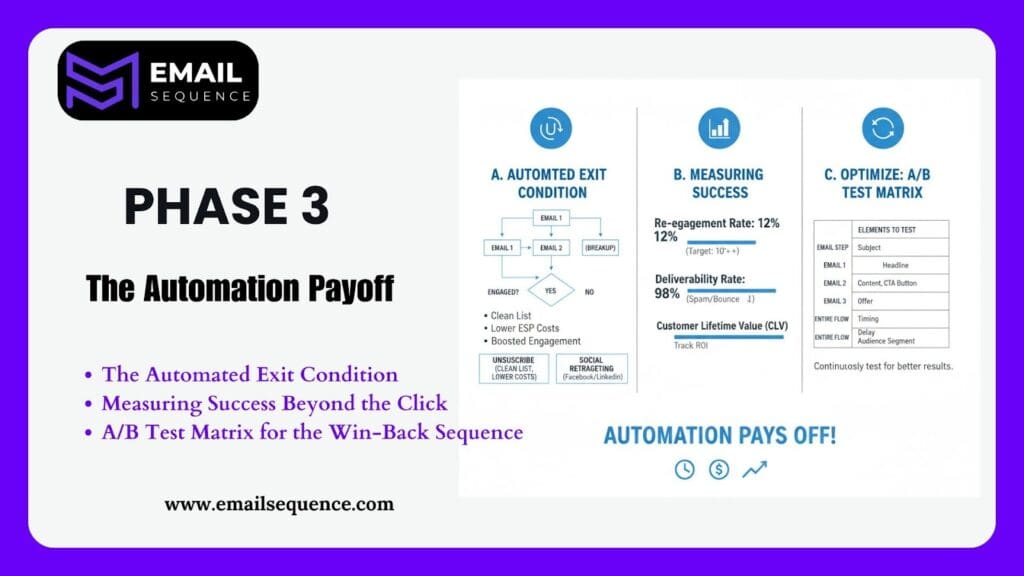
A. The Automated Exit Condition (The True Power of a Flow)
The most critical part of this entire architecture is the automated exit condition at the end of Email 3. What happens to subscribers who do not respond? Any subscriber who fails to engage with the final “breakup email” is automatically unsubscribed from your list.
What does this accomplish?
- A Clean List: Your email list will now consist almost entirely of engaged subscribers, which is exactly what ISPs want to see.
- Lower ESP Costs: You stop paying for contacts who provide no value, directly reducing your monthly expenses.
- Boosted Engagement Rates: With unengaged contacts removed, your future campaigns will see an immediate, measurable increase in open and click-through rates.
As an alternative, you can move these “deep cold” contacts to a separate list for social media retargeting campaigns on platforms like Facebook or LinkedIn, giving you one final way to reach them without further damaging your email deliverability.
B. Measuring Success Beyond the Click
To understand the full impact of your re-engagement sequence, you need to track the right metrics. How do you know if your efforts are working? Monitor these key performance indicators.
- Re-engagement Rate: This is the percentage of inactive subscribers who clicked a link in your sequence and were moved back to your engaged list. Aim for a re-engagement rate of 10% or higher.
- Deliverability Rate: Keep a close eye on your deliverability metrics. You should see a decrease in bounce rates and spam complaints over time as your list becomes cleaner.
- Customer Lifetime Value (CLV): For the subscribers you win back, track their subsequent purchasing behavior. Compare the CLV of these re-engaged contacts to that of newly acquired customers to quantify the long-term ROI of your sequence.
C. A/B Test Matrix for the Win-Back Sequence -> Optimize Every Step
Your re-engagement sequence should not be static. Continuously test different elements to optimize their performance. What are the most impactful elements to test? Use an A/B testing matrix to systematically improve each step of the flow.
| Flow Step | Element to Test | Option A (The Safe Bet) | Option B (The Aggressive Play) | Expected Outcome |
| Email 1 | Subject Line | “We Miss You: Here’s What’s New” | “Did We Make a Mistake? Update Your Settings.” | Higher Open Rate |
| Email 2 | Incentive | 10% Off Your Next Order | Free Shipping on $50+ Order | Higher CTR/Conversion |
| Email 3 | Exit CTA | “Yes, I Still Want to Hear From You” | “Keep Me Subscribed to Save 20% on My Next Order” | Higher Re-engagement Rate |
By testing subject lines, offers, and calls-to-action, you can identify what resonates most with your audience and steadily increase your win-back rate.
Conclusion
A healthy email list is the backbone of a successful digital marketing strategy. However, list decay is inevitable. The solution is not to endlessly acquire new leads but to implement a disciplined, automated system for managing the contacts you already have. Successful re-engagement requires architecture and discipline.
By implementing this three-phase blueprint, you can transform your approach to list management. Use tiered segmentation to understand your audience, deploy a strategic three-part email flow to re-engage inactive subscribers, and set clear, automated exit conditions to maintain impeccable list hygiene.
This system will not only help you achieve a 10%+ win-back rate but will also fortify your deliverability and maximize the ROI of your entire email program. Stop wasting money on dead contacts. Start building your re-engagement architecture today and turn inactive subscribers back into valuable customers. Visit emailsequence.com to get started!
Frequently Asked Question
What qualifies as an inactive subscriber?
An inactive subscriber is someone who hasn’t opened or clicked any of your emails within a defined period, typically 90 days for short sales cycles (like e-commerce) and 180 days for longer ones (like B2B or SaaS). The key metric is no opens and no clicks in that timeframe.
Why is it important to remove inactive subscribers?
Inactive subscribers hurt your sender reputation, lower deliverability rates, and increase email costs. Removing or segmenting them keeps your list clean, improves engagement metrics, and ensures your emails reach the inboxes of active contacts.
What metrics define a successful re-engagement campaign?
Key metrics include:
- Re-engagement rate: % of inactive contacts who click a link (target 10%+).
- Deliverability improvement: Fewer bounces and spam flags.
- Customer lifetime value (CLV): Higher for re-engaged vs. new contacts.
How do I reactivate an inactive customer?
To reactivate an inactive customer, identify why they disengaged, then send a personalized reactivation sequence that offers value or solves a specific pain point. Follow up with a clear CTA to re-purchase, renew, or re-subscribe.
How to re-engage lapsed customers?
Use a three-step reactivation flow:
- Reconnect with value (updates, product tips).
- Offer a tailored incentive (discount or loyalty reward).
- Follow up with urgency (limited-time offer or “we’ll miss you” email).
Personalization and timing are critical to win them back.