Email Frequency: How Often Should You Send Campaigns?
The answer to “How often should I send emails?” has long been “It depends.” That response is no longer sufficient for teams serious about email performance. High-performing email programs do not guess at frequency. They build a Dynamic Frequency Strategy that balances subscriber engagement with business objectives.
Meet Katherine. She loves your brand and eagerly signed up for your “weekly updates.” But soon, her inbox is flooded. A “can’t-miss” sale on Monday, a “new arrivals” alert on Tuesday, and a “mid-week special” on Wednesday.
By Friday, she’s overwhelmed. Instead of clicking “buy,” she clicks “unsubscribe.” Katherine didn’t convert. Why? Because even engaged subscribers have a limit. Overwhelming them is the fastest way to lose them.
In this blog post, we’ll dive into how to determine the right email frequency for your business, the factors that influence it, and how to strike a balance that keeps your audience engaged without overwhelming them.
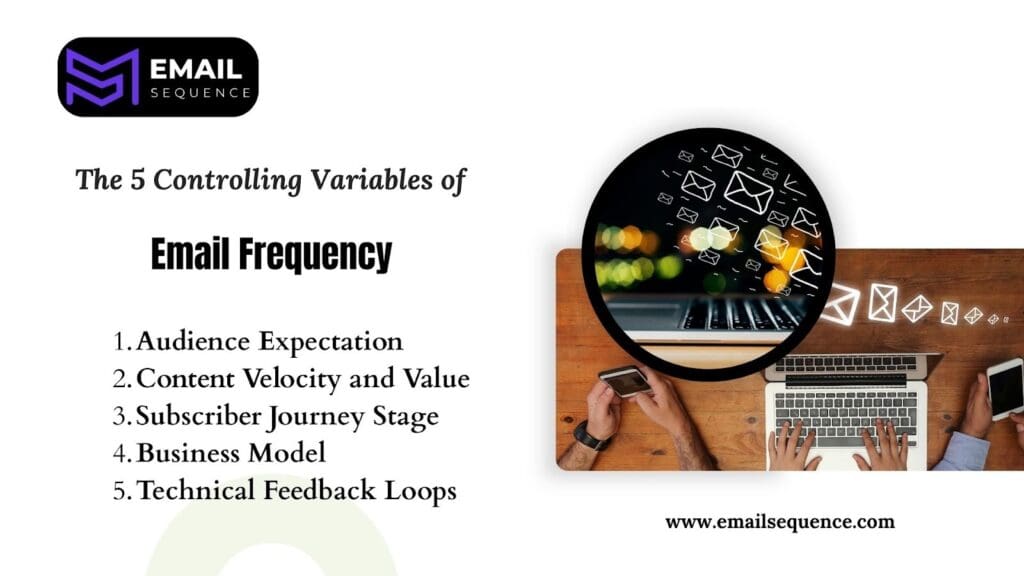
The 5 Controlling Variables of Email Frequency
Before you establish a sending schedule, you must understand the factors that govern it. These five variables form the foundation of any sustainable frequency strategy.
Audience Expectation (The Opt-In Contract)
The frequency you promise at sign-up is non-negotiable. If your subscription form states “weekly updates,” sending daily emails violates that agreement. Subscribers will mark you as spam or unsubscribe, damaging your sender reputation.
Always align your actual sending behavior with the expectation you set during opt-in. If you plan to increase frequency later, notify subscribers in advance and offer them control through a preference center.
Content Velocity and Value
Do you have enough high-quality, non-promotional content to justify your send volume? The value you deliver must exceed the attention you ask for.
Sending three emails per week works only if each message provides genuine utility: educational insights, actionable advice, case studies, or exclusive resources. If your content pipeline cannot support that standard, reduce your frequency until it can.
Subscriber Journey Stage
New subscribers and long-term customers have different tolerance levels for email volume. Someone who signed up yesterday expects onboarding content and may welcome daily messages during their first week. A customer who has been on your list for two years expects less frequent, more strategic communication.
Segment your list by lifecycle stage and adjust frequency accordingly. New leads often benefit from higher-touch sequences, while established customers respond better to value-driven newsletters and targeted offers.
- Send personalized welcome emails to new subscribers within 24 hours to set expectations.
- Create an onboarding email sequence for new leads, delivering value through tips, guides, or introductory offers.
Business Model
B2C ecommerce brands can often sustain higher frequencies than B2B SaaS companies. Fashion retailers may send daily promotional emails during peak seasons. Enterprise software providers typically send one to two emails per week focused on thought leadership and product education.
Your industry norms and sales cycle length dictate what subscribers expect. Study your competitors’ sending patterns and benchmark your performance against similar companies in your space.
- Competitor Analysis: Look at how often your main competitors send emails. Sign up for their newsletters to get a firsthand look at their cadence and content strategy.
- Industry Benchmarks: Research email frequency benchmarks for your specific industry. Marketing reports and analytics firms often publish this data. For example, B2C retail tends to have a much higher frequency than B2B SaaS.
Technical Feedback Loops
Unsubscribe rates and spam complaint rates are the ultimate speed limits for your email program. These metrics provide direct feedback on whether your frequency exceeds subscriber tolerance.
- If your unsubscribe rate trends toward 0.5% or higher, you are sending too often or delivering insufficient value.
- If your spam complaint rate approaches 0.1%, you risk deliverability penalties from major mailbox providers like Gmail and Outlook. Monitor these signals closely and reduce frequency immediately if they rise.
The Foundational 2x/Week Strategy (Your Starting Benchmark)
Most active email lists perform best with two emails per week. This frequency provides enough contact to maintain engagement without overwhelming subscribers or straining your content production capacity.
The Content Split
Not all emails serve the same purpose. Your weekly schedule should balance value delivery with direct business objectives.
Email 1 (Value-Driven): 75% Educational
This message focuses on helping your audience solve problems, learn something new, or gain actionable insights. Examples include:
- Case studies showing how customers achieved results
- Industry analysis and trend commentary
- How-to guides and tutorials
- Expert interviews and thought leadership
Email 2 (Action-Driven): 25% Promotional
This message includes a clear call to action tied to a business outcome. Examples include:
- Product launches and feature announcements
- Limited-time offers and discounts
- Event invitations and webinar registrations
- Free trial or demo requests
This ratio ensures you build trust and authority before making an ask. Subscribers stay engaged because most of your communication serves them, not just your sales goals.
Best Days and Times to Test
General wisdom suggests Tuesday and Thursday mornings between 9 am11 am and 11 am as optimal send times. These windows often see high open rates because they coincide with when professionals check email at the start of their workday.
However, these time slots also experience the highest inbox competition. Everyone sends during peak hours, which means your message competes with dozens of others for attention.
Expert Testing Tip:
- Test off-peak hours to find less crowded windows.
- Sunday evenings around 7 pm or mid-afternoon Wednesdays around 2 pm can yield strong engagement if your audience checks email during those times.
Advanced Frequency Management Through Segmentation
Once you establish a baseline frequency, segmentation allows you to safely increase volume for engaged subscribers while protecting deliverability by reducing sends to inactive contacts.
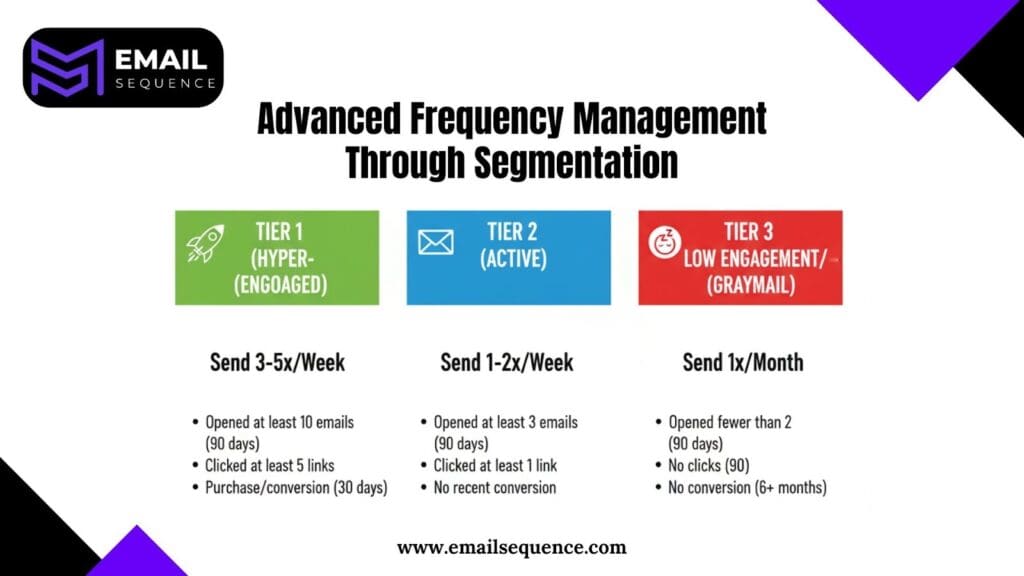
The Engagement Tier Model
Segment your list based on recent activity over the past 90 days. This creates three distinct tiers with different frequency tolerances.
Tier 1 (Hyper-Engaged): Send 3-5x/Week
These subscribers open or click nearly every email you send. They want more from you. Characteristics include:
- Opened at least 10 emails in the past 90 days
- Clicked at least 5 links in the past 90 days
- Made a purchase or conversion within the past 30 days
Increase frequency for this group. They have demonstrated a strong interest and will benefit from more content, updates, and offers.
Tier 2 (Active): Send 1-2x/Week
This is your baseline audience. They engage occasionally but not consistently. Characteristics include:
- Opened at least 3 emails in the past 90 days
- Clicked at least 1 link in the past 90 days
- No recent conversion, but still showing interest
Maintain your standard frequency for this group. They remain engaged but do not require increased volume.
Tier 3 (Low Engagement/Graymail): Send 1x/Month
These subscribers have gone cold. They rarely open your emails and may have forgotten they subscribed. Characteristics include:
- Opened fewer than 2 emails in the past 90 days
- No clicks in the past 90 days
- No conversion or meaningful interaction in 6+ months
Reduce frequency dramatically for this group. Send a re-engagement campaign once per month, designed to win them back. If they do not respond after 3-6 months, remove them from your list entirely to protect your sender reputation.
The Critical Role of the Preference Center
The most effective way to prevent unsubscribes is to let subscribers control their own frequency. A preference center allows users to choose how often they hear from you.
Offer options such as:
- Daily: For your most engaged subscribers
- Weekly: The standard baseline
- Monthly: For those who want to stay connected but prefer less frequent contact
- Promotional Only: For subscribers interested in offers but not educational content
Providing this level of control reduces unsubscribe rates and improves engagement because subscribers receive exactly what they want.
Deliverability and Sender Reputation: The Real Frequency Risk
Sending too often does not just annoy subscribers. It damages your technical standing with mailbox providers, causing even your best emails to land in spam.
The Unsubscribe Rate Danger Zone
- Unsubscribe rates provide early warning signals that your frequency exceeds subscriber tolerance. A healthy unsubscribe rate typically falls between 0.1% and 0.3% per campaign.
- If your unsubscribe rate trends toward 0.5% or higher, you are in the danger zone. This indicates that your frequency, content quality, or targeting needs immediate adjustment.
- Monitor unsubscribe rates closely for each campaign. If a specific email type or segment shows elevated unsubscribe activity, investigate why and adjust accordingly.
The Spam Complaint Threshold (The Hard Limit)
Spam complaints are far more damaging than unsubscribes. When a recipient marks your email as spam, mailbox providers interpret this as a signal that you are sending unwanted mail.
Major providers like Gmail and Outlook require spam complaint rates to remain below 0.1%. Exceeding this threshold triggers deliverability penalties, including:
- Automatic filtering of your emails to spam folders
- Temporary or permanent blocking of your sending domain
- Damage to your sender reputation that affects all future campaigns
The most common cause of elevated spam complaints is sending too frequently to unengaged subscribers. They do not remember opting in, so they mark you as spam instead of unsubscribing.
This is why Tier 3 segmentation is critical. Reduce frequency for inactive contacts and remove them entirely if they do not re-engage. Protecting your sender reputation must take priority over preserving list size.
Impact on Future Campaigns
High frequency to unengaged users does not just harm the current campaign. It damages your sender reputation over time, causing even your most important emails to land in spam.
Mailbox providers use algorithms that track your historical sending behavior. If you consistently send high volumes to low-engagement contacts, they classify you as a low-quality sender.
Maintaining a clean, engaged list is the most important factor in long-term email success. Always prioritize quality over quantity.
Conclusion
Email frequency is not a one-time decision. It is an ongoing process of testing, monitoring, and refining based on subscriber behavior and business goals.
Start with the foundational 2x/week strategy outlined in this guide. Use the 75/25 content split to balance value delivery with promotional asks. Test different send times to find the windows with the least inbox competition.
Once you establish baseline performance, implement the Engagement Tier Model. Segment your list by 90-day activity and adjust frequency accordingly. Create a preference center that gives subscribers control over how often they hear from you. Set communication limits in your ESP to prevent accidental over-mailing.
The most successful email programs do not send the same volume to everyone. They build dynamic systems that deliver the right frequency to the right subscribers at the right time.
Implement these strategies this week, and you will see measurable improvements in engagement, deliverability, and business outcomes. Ready to build your own email sequences? Visit emailsequence.com to get started.
Frequently Asked Questions
What is a safe starting benchmark for email frequency?
A good starting benchmark is about two emails per week for a typical audience, when you have sufficient value to deliver and you are building consistency.
What is the 0.1% spam complaint rule?
Spam complaints must stay below 0.1% per campaign to avoid deliverability penalties from email providers.
What are the signs that I am sending emails too often?
If your unsubscribe rate increases, spam complaints go up, open and click rates decline, you are very likely sending too many emails.
How can segmentation improve email frequency?
Segment subscribers into engagement tiers:
- Hyper-engaged → 3–5 emails/week
- Active → 1–2 emails/week
- Low engagement → 1 email/month
How do I balance value and promotional content?
Follow a 75/25 split: 75% educational/value-driven, 25% promotional/action-driven emails.