How To Nurture Leads with Drip Email Workflows?
Your marketing team is generating a steady flow of leads. They download ebooks, sign up for trials, and engage with your content. Yet, a staggering 80% of these marketing-qualified leads (MQLs) never become paying customers. This gap between initial interest and final sale is where most revenue is lost. The missing piece is effective lead nurturing.
The return on investment for mastering how to nurture leads is significant. Studies have consistently shown that nurtured leads make 47% larger purchases than those that aren’t nurtured. These leads don’t just make one-time purchases; they become more valuable, long-term customers.
This guide provides a comprehensive 5-step blueprint for building three high-impact drip workflows. By implementing this framework, you will create an automated engine that consistently nurtures leads, qualifies prospects, and hands them off to your sales team at the perfect moment.
The 5-Step Blueprint for Drip Workflow Success
This section provides the actionable framework for building any effective drip sequence.
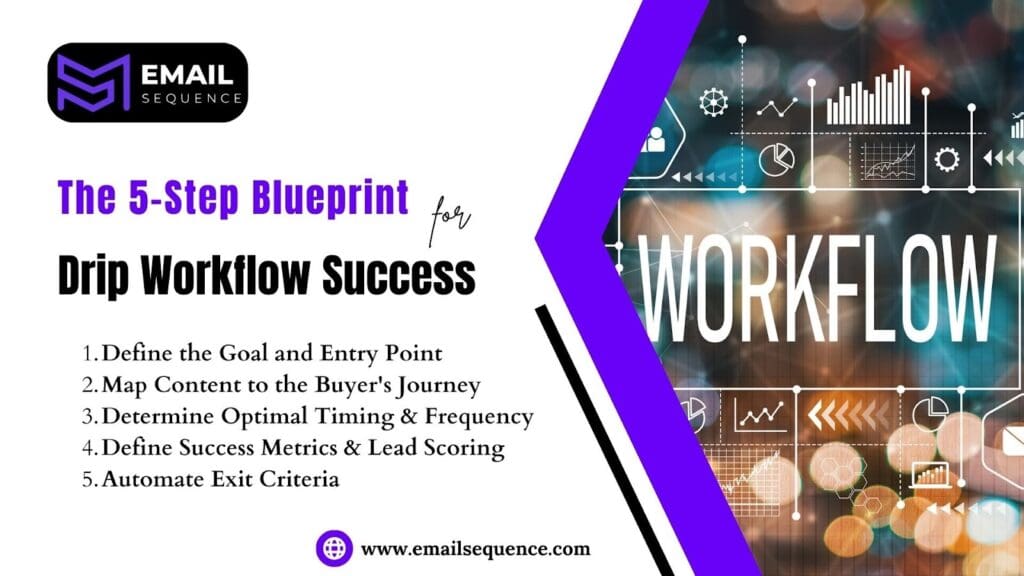
Step 1: Define the Goal and Entry Point
Every successful workflow begins with a clear objective. What do you want to achieve? The goal must be specific and measurable. For example, your goal might be to convert 10% of free trial sign-ups into paying customers.
The entry point is the specific action a user takes to trigger the workflow, such as submitting the form for a free trial. Clearly defining these two elements provides the foundation for the entire sequence.
Step 2: Map Content to the Buyer’s Journey
Once a lead enters your workflow, the content they receive must align with their current stage in the buyer’s journey to effectively nurture leads. Do you know what information they need at each phase?
- Awareness: At this stage, leads are identifying a problem. Your content should educate them, not sell to them. Share helpful blog posts, ebooks, or industry reports that address their pain points.
- Consideration: Now, leads are evaluating solutions. Provide content that showcases your expertise and positions your product as a viable option. Case studies, webinars, and detailed feature guides work well here.
- Decision: In the final stage, leads are ready to make a purchase. Offer content that removes any remaining friction, such as a product demo, a pricing comparison sheet, or a free trial.
Step 3: Determine Optimal Timing & Frequency
Timing is critical in a drip sequence. How often should you contact your leads without overwhelming them? A general rule is that a longer sales cycle allows for more time between emails. Bombarding leads with daily messages is almost always a mistake, as it can lead to unsubscribes and disengagement.
Start with a cadence of one email every two to three days and adjust based on performance data. Test different intervals to find the optimal frequency for your specific audience and product.
Step 4: Define Success Metrics & Lead Scoring
To measure the effectiveness of your workflow, you must track the right metrics. Which key performance indicators will signal success?
- Open Rate: This shows how compelling your subject lines are.
- Click-Through Rate (CTR): This indicates how well your email content resonates with the audience.
- Lead Score: This is a crucial metric that assigns points to leads based on their actions, signaling their sales-readiness.
A lead score threshold is the point total that a lead must reach to be considered sales-qualified. This metric is essential for knowing when to transition a lead from marketing to sales.
Step 5: Automate Exit Criteria
A drip workflow must have a clear endpoint. When does the automated sequence stop? You should establish technical rules for when a lead exits the workflow and the sales team takes over.
A lead might exit by reaching the lead score threshold, booking a demo, or making a purchase. Automating these exit criteria ensures a seamless handoff to your sales team, helping you effectively nurture leads and prevent them from falling through the cracks.
3 Essential Drip Workflow Templates
This section provides concrete examples to help the reader implement the blueprint.
Workflow 1: The Educational Welcome (Awareness → Consideration)
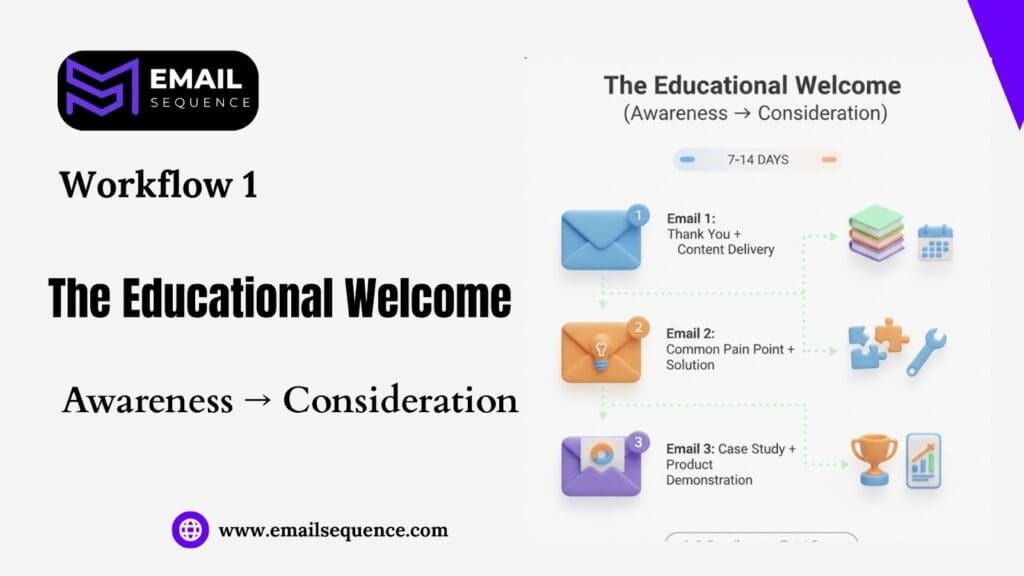
The goal of this workflow is to educate new subscribers who have shown initial interest, such as by downloading an ebook, and to qualify their level of interest further. This sequence typically consists of 3-5 emails sent over a period of 7-14 days.
- Email 1: Send an immediate thank-you email that delivers the requested content and sets expectations for what is to come.
- Email 2: Follow up with an email that addresses a common pain point related to the ebook’s topic and offers a practical solution.
- Email 3: Share a relevant case study or introduce a tool that demonstrates how your product solves this pain point effectively.
Workflow 2: The Free Trial/Demo Onboarding (Consideration → Decision)
This workflow is designed to gather leads who have signed up for a free trial or demo. By helping users overcome technical hurdles and driving feature adoption, this sequence aims to guide them from consideration to a final decision.
The sequence should run for the duration of the trial, typically with 5-7 emails over 14 days. Your emails should focus on helping users maximize the value of your product. Here’s what to include:
- Highlight key features
- Answer frequently asked questions (FAQs)
- Offer support for a smooth onboarding experience
Workflow 3: The 90-Day Re-engagement (Stalled Leads)
This workflow targets inactive leads who have not engaged with your content for an extended period, usually 90 days. The goal is to re-qualify their interest before removing them from your active mailing list.
This should be a concise and impactful sequence with a high-value offer. For example, you could offer a limited-time 15% discount or send a simple email asking them to update their communication preferences to ensure they only receive relevant content.
Here’s how to do it:
- Craft a compelling offer: Create a limited-time discount (e.g., 15% off) or exclusive content access to incentivize re-engagement.
- Personalize the message: Remind them of their previous interest and gently nudge them back.
- Provide an easy opt-down option: Include a clear link for them to update preferences or unsubscribe if they’re no longer interested.
Technical Mastery: Segmenting and Scoring
This section focuses on the technical precision needed to nurture leads effectively.
Segmentation by Intent (Crucial)
Effective lead nurturing requires precise segmentation. Do you know how to group your leads based on their signals of intent?
- Behavioral Segmentation: Group leads based on the content they consume. A lead who clicks on a “Pricing” page link shows higher intent than one who only clicks on a “Blog Post” link. This allows you to tailor your messaging accordingly.
- Source Segmentation: Treat leads differently based on where they came from. A lead from a high-intent source, like a LinkedIn Ad for a product demo, should receive a more direct, sales-focused sequence than a lead from a low-intent source, like a general giveaway.
Lead Scoring Automation
Lead scoring is the engine of a successful nurturing strategy. How do you assign value to a lead’s actions?
- Assign points for actions: Create a system that assigns numerical values to different engagements. For example, you could assign +5 points for an email open, +10 points for a click-through, and +25 points for visiting the pricing page.
- The Technical Hand-off: Define the specific lead score threshold (e.g., 100 points) that triggers the handoff. When a lead reaches this score, the drip workflow should automatically stop, and the lead should be assigned to a salesperson for direct follow-up. This automation ensures that your sales team engages with the most qualified leads at the most opportune time.
Final Thoughts
Effective drip workflows are the engine of modern sales and marketing. They provide a scalable, automated system for turning passive interest into active buying intent. Success, however, does not come from simply sending emails. It is found in the strategic mapping of content to the customer journey and the precise definition of automation rules for when a lead is ready for a sales conversation.
As you build and refine your workflows to nurture leads, shift your focus from vanity metrics. Instead of obsessing over open rates, concentrate on the conversion rate from a marketing-qualified lead (MQL) to a sales-qualified lead (SQL). This is the true measure of your lead nurturing success.
Take action this week. Implement the 5-Step Blueprint on your highest-intent workflow, such as your free trial or demo request sequence. Set up your first lead score threshold and start building the automated bridge between your marketing and sales. Get started now at emailsequence.com.
Frequently Asked Questions
What is a drip workflow in email marketing?
A drip workflow is an automated sequence of emails sent based on user behavior or timeline triggers. It helps nurture leads by delivering the right content at the right stage of the buyer’s journey without manual effort.
How many emails should be in a drip sequence?
Most high-performing drip workflows include 5–8 emails, depending on the buyer stage and campaign goal. Shorter nurturing typically underperforms because it doesn’t build adequate trust.
What triggers should be used to start a drip workflow?
Common triggers include newsletter sign-ups, free trial activations, lead magnet downloads, product page visits, demo requests, and cart abandonment.
When should a lead exit a drip sequence?
Leads should exit when they convert, request a demo, become inactive, or shift to a new intent segment. Automated exit rules prevent irrelevant messaging and improve user experience.