The Definitive Guide to Natural Language AI Email: Beyond the Bot
The modern inbox is a hostile environment for generic automated messages. Recipients have developed a keen sense of “Bot-Blindness.” If an email feels generated, the recipient deletes it immediately. The uncanny valley of email automation is real, and many businesses are falling into it.
The solution is not simply “more AI.” It is a better AI. Specifically, we are witnessing a shift toward Natural Language AI Email. This evolution moves away from generative text, simply creating words, to mimetic text, which replicates human nuance.
This guide explores how to achieve Authentic Messaging at scale. We will decode the science behind Conversational AI, bridge the gap between robotic and Human-like Writing, and provide actionable frameworks for your campaigns.
The Competitive Gap: Why Standard AI Is Not Enough
Most email tools on the market today focus on efficiency. They help you tag emails, schedule sends, and insert basic variables like a first name. However, efficiency does not equal effectiveness. There is a distinct difference between standard AI assistants and true Natural Language AI Email platforms like EmailSequence.
We must understand where the gaps lie to fix them.
Standard AI Assistants
- Primary Goal: Task efficiency and tagging.
- Writing Style: Formulaic structures (Intro-Body-Close).
- Tone: Often corporate, academic, or stiff.
- Personalization: Simple variable injection (e.g., “Hi {First_Name}”).
- Feedback Loop: Relies on user edits to fix mistakes.
Natural Language AI
- Primary Goal: Relationship building and conversion.
- Writing Style: Human-like writing with varied sentence lengths.
- Tone: Natural tone that is conversational and casual.
- Personalization: Contextual intelligence that synthesizes recent news or LinkedIn activity is a key aspect of AI Email Personalization.
- Feedback Loop: Learns your specific AI Voice DNA.
The difference is clear. Standard AI helps you work faster. Natural Language AI Email helps you connect deeper.
Decoding the “Natural” in Natural Language AI
To master AI Conversation, we must look at what makes human speech unique. It is rarely perfect. It is messy, contextual, and laden with subtext.
The Science of Conversational AI
Large Language Models (LLMs) have evolved. They are now trained on “Subsurface Context.” This means the AI understands what is not said. It picks up on sarcasm, urgency, and professional hesitation.
When a prospect replies with a short “Not right now,” a standard bot might treat this as a hard rejection. A Natural Language AI Email system understands the nuance of timing. It recognizes that “now” is the operative word, not “no.”
Breaking the “Perfect” Barrier
Humans make small stylistic choices that AI traditionally avoids. We start sentences with “And” or “But.” We use fragments. We break grammar rules for effect.
To achieve Authentic Messaging, you must prompt your AI to embrace these “human-isms.” A perfectly grammatically correct email often reads like a press release. A slightly imperfect email reads like a note from a friend. Transitioning from simple text generation to true conversation requires us to lower the polish and increase the personality.
Building an Authentic Messaging Framework
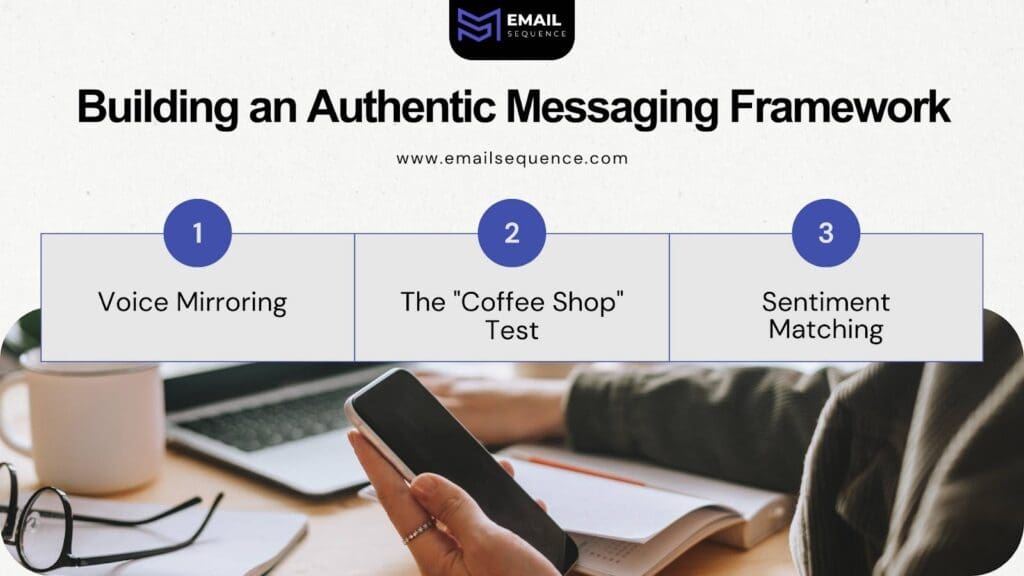
How do we systematize authenticity? You need a framework that ensures every automated email passes the human test.
Voice Mirroring
The most powerful tool in your arsenal is voice mirroring. You must feed the AI your “Sent” folder. This allows the model to analyze your specific syntax, vocabulary, and quirks. It adopts your unique way of speaking. The result is an email that sounds exactly like you because, digitally speaking, it is you.
The “Coffee Shop” Test
This is a simple yet effective litmus test for Natural Tone. Read your email draft out loud. Imagine you are sitting across from a colleague in a coffee shop.
If you would not say that sentence out loud to a human face, do not send it in an email. Humans rarely say “I hope this email finds you well” in casual conversation. They say, “Hope you are doing well,” or they skip the pleasantries entirely. If it sounds stiff in a coffee shop, it will sound robotic in an inbox.
Sentiment Matching
Conversational AI is dynamic. It adapts. If a prospect responds with frustration, you should not reply with a cheerful, long-winded sales pitch.
You must use AI to detect sentiment. Is the prospect busy? Curious? Annoyed?
- If they are busy, the AI adjusts to be brief and direct.
- If they are curious, the AI expands to provide more detail.
- If they are frustrated, the AI adopts an apologetic and empathetic tone.
This level of adaptation integrates deeply with broader strategies for personalized engagement.
Strategies for Natural Language AI Email Campaigns
Once you understand the voice, you must look at the campaign structure. The old way of managing AI Email Campaigns does not work anymore.
The Anti-Template Movement
Static templates are the enemy of Natural Language AI Email. When every recipient gets the same paragraph structure, spam filters and human brains notice the pattern.
We are moving toward “Dynamic Outlines.” Instead of a fixed script, you provide the AI with a goal and a set of key points. The AI then generates a unique email for each recipient that hits those points in a different order or using different phrasing.
Multi-Step Resonance
A common failure point in automation is the disconnect between emails. Step 1 sounds friendly. Step 4 sounds like a harassment campaign.
You must ensure that Step 4 feels like a natural progression of Step 1. It should reference the previous silence without being aggressive. It should feel like a “nudge,” not a “ping.” This concept of Authentic Messaging ensures the relationship builds over time, rather than deteriorating with every follow-up.
Technical Implementation & Best Practices
To get the best results, you must master the input. The quality of your output depends entirely on the quality of your prompt.
Prompt Engineering for Human-like Writing
Most users give generic commands and receive generic results.
Bad Prompt:
“Write a sales email for a CRM tool.”
This will result in a generic, fluffy, corporate email.
Natural Prompt:
“Write a short, casual email to a busy Sales VP. Use a self-deprecating tone, keep sentences under 15 words, and avoid using the word ‘comprehensive’.”
The “Pithy” Power
Natural Language AI Email favors brevity. Corporate blocks of text (200+ words) are rarely read. They are scanned and discarded.
Humans write short emails, especially from mobile devices. By constraining your AI to write less, you actually make it sound more human. Pithy, direct communication signals respect for the recipient’s time.
Comparison Matrix: Natural Language AI Capabilities
| Capability | Description | User Benefit |
| Syntax Variability | Mixes short, punchy sentences with longer ones. | Prevents “rhythmic fatigue” for the reader. |
| Dynamic Empathy | Adjusts tone based on the recipient’s last reply. | Creates a seamless, responsive AI conversation. |
| Slang/Jargon Integration | Correctly uses industry shorthand (e.g., “SaaS,” “ROI“). | Establishes instant authority and “Natural” belonging. |
| Structural Fluidity | Abandons the rigid 3-paragraph structure. | Looks like a hand-typed note on a mobile device. |
The Future of Natural Language AI
We are only scratching the surface of what is possible with AI Conversation.
Zero-Drafting
Imagine a world where you do not even have to prompt the AI. Future systems will read your calendar and meeting notes. The AI will understand that you just finished a demo with a client. Before you even open your laptop, the AI will have “Zero-Drafted” a follow-up email that references specific points from the meeting. It waits in your drafts folder, ready for a quick review.
Ethical AI
As these tools become more powerful, transparency is key. We use Conversational AI to build rapport, not to deceive. The goal is to amplify human connection, not replace it. We must maintain ethical standards, ensuring that while the drafting is automated, the intent and the approval remain human.
Conclusion: The Survival of the Most Human
The rise of AI in email marketing does not mean the end of the human writer. It means the evolution of the writer.
AI should not replace you; it should amplify your “Human-ness.” The winners in the next era of email marketing will be those who use technology to be more personal, not less. By leveraging Natural Language AI Email, you escape the bot trap and build genuine relationships at scale.
If you are ready to transform your outreach, consider tools like EmailSequence’s Natural Language toolkit. It is time to go beyond the bot.
Frequently Asked Question
What is Natural Language AI for Email?
Natural Language AI for Email uses advanced AI to craft human-like, conversational, and personalized email messages that resonate with recipients.
How does Natural Language AI improve email marketing?
It enhances email campaigns by creating authentic messaging, adapting tone, and building stronger connections through conversational AI.
Can Natural Language AI write human-like emails?
Yes, it mimics human writing styles, including natural tone and varied sentence structures, making emails feel personal and engaging.
What makes Natural Language AI different from standard AI?
Unlike standard AI, it focuses on contextual intelligence, dynamic empathy, and authentic messaging rather than formulaic responses.
How can businesses benefit from Natural Language AI for Email?
Businesses can scale personalized communication, improve engagement, and build trust with recipients through authentic, human-like email interactions.