Email List Cleaning: A Guide for Better Deliverability
Email list cleaning is the process of removing invalid, inactive subscribers, and unengaged users to improve deliverability and engagement. A clean list reduces bounce rates, spam complaints, and sender reputation damage, ensuring your emails land in the inbox instead of the spam folder.
Effective list hygiene involves identifying hard bounces, segmenting inactive users, running re-engagement campaigns, and validating emails regularly. Since email lists naturally decay by up to 20 to 30 percent annually, ongoing list maintenance and email validation are essential for maintaining high performance and maximizing your return on investment.
Why Email List Cleaning Is Critical (Not Optional)
Most deliverability problems start directly with the list rather than the content. Marketers often ignore database degradation, which leads to catastrophic performance drops. Understanding the exact mechanisms of list decay allows you to take corrective action before permanent damage occurs.
Consider these critical factors that impact your campaigns:
- Annual database decay rates: Email lists naturally degrade by 20 to 30 percent every single year as users change jobs, abandon old addresses, or opt out.
- Reduced inbox placement: Poor list hygiene signals to inbox providers that your content lacks relevance, causing algorithms to route your messages straight to the spam folder.
- Sender reputation damage: High bounce rates alert Internet Service Providers (ISPs) that you practice poor data collection methods, which permanently tarnish your sending domain.
A consistently clean list guarantees higher return on investment and superior inbox placement.
What Happens If You Don’t Clean Your Email List
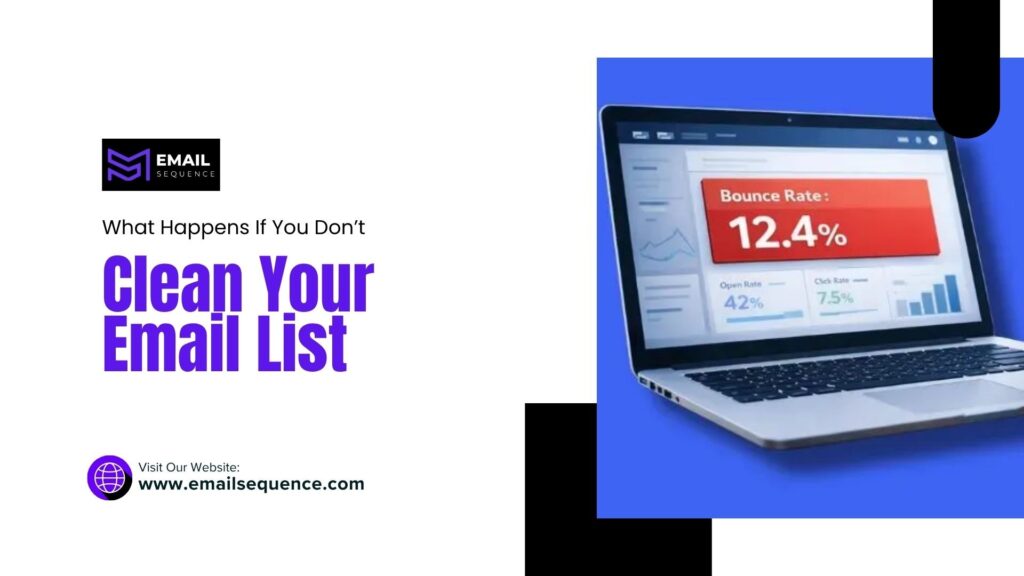
Ignoring list health creates a compounding problem that eventually ruins your entire email marketing channel. A neglected database transforms from an asset into a massive liability. Watch for these severe consequences when you skip regular maintenance:
- Escalating bounce rates: Sending to abandoned or fake addresses triggers immediate bounces, which ISPs monitor closely to evaluate your trustworthiness as a sender.
- Surging spam complaints: Unengaged users who cannot easily find an unsubscribe link will simply mark your message as spam, severely damaging your sender score.
- Automatic spam routing: Once your reputation drops below a certain threshold, major providers like Gmail and Yahoo automatically filter all your future emails into the junk folder.
Inbox placement drops significantly when you fail to execute a comprehensive email list cleaning strategy.
Step 1: Audit Your Email List (Before Cleaning)
Before starting the email list cleaning process, never start deleting contacts blindly from your database. You must analyze the data first to understand the exact health of your current audience.
Reviewing these specific metrics prevents you from accidentally removing valuable leads:
- Bounce rate evaluation: Isolate the exact campaigns and sources generating high bounce rates to identify the root cause of invalid data.
- Inactive subscriber identification: Pinpoint exactly which users stopped opening your emails and determine the exact date of their last interaction.
- Engagement metric reviews: Analyze your average open rates, click-through rates, and conversion rates across different segments to establish a baseline for your current list health.
Data-driven cleaning prevents costly mistakes and ensures you only remove truly worthless contacts.
Step 2: Remove High-Risk Contacts Immediately
Some contacts present an immediate threat to your deliverability and require instant removal. Keeping these toxic records in your database guarantees severe reputation damage.
Eliminate these hazardous entries without hesitation:
- Hard bounces: These represent permanently invalid or non-existent email addresses that immediately damage your sender’s reputation upon delivery failure.
- Spam traps: ISPs use these hidden, monitor-only email addresses to catch careless senders; hitting even one can cause immediate blacklisting.
- Duplicate emails: Multiple identical records frustrate users who receive the same email twice and unnecessarily inflate your email service provider costs.
Executing immediate bounce removal directly protects your sender reputation from permanent algorithmic penalties.
Step 3: Segment Inactive Subscribers (Don’t Delete Yet)
Inactive users still hold potential value. Deleting them immediately means losing revenue opportunities. Proper email list cleaning involves careful segmentation, not just deletion. Group these subscribers together based on these specific behavioral patterns:
- Sixty to ninety-day dormancy: Segment users who have not opened a single email in the last two to three months into a dedicated “cooling off” list.
- Consistent non-clickers: Group subscribers who open your emails but have failed to click any links across your last ten campaigns.
- Low-engagement cohorts: Identify users who only engage with major sales or specific product announcements, separating them from your daily or weekly send lists.
Not all unengaged users require immediate deletion, as strategic segmentation preserves valuable future leads.
Step 4: Run a Re-Engagement Campaign
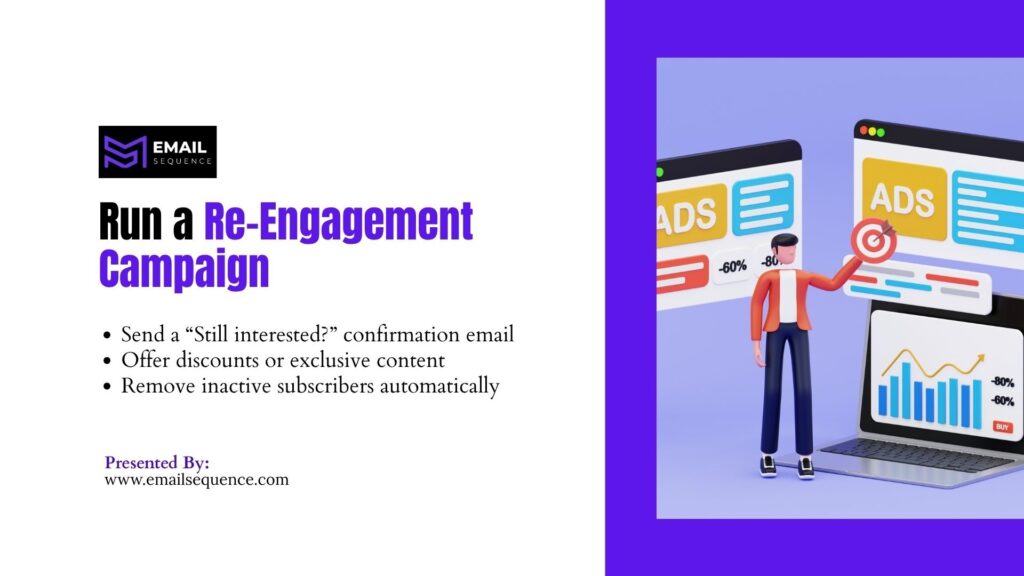
You must give dormant subscribers a final chance to interact before executing a permanent removal. A targeted re-engagement sequence acts as a powerful filter to separate distracted buyers from completely dead leads.
Deploy these specific tactics to win back your audience:
- Explicit opt-in requests: Send a clear “Do you still want to hear from us?” message that forces the user to actively click a button to remain on the list.
- High-value incentives: Offer an exclusive discount code, a free resource, or a highly requested piece of content to tempt dormant users back into the active fold.
- Automated removal triggers: Configure your system to automatically delete any subscriber who fails to open or click within the final re-engagement sequence.
Step 5: Use Email Validation Tools
Manual cleaning simply cannot catch hidden syntax errors or sophisticated spam traps. You must leverage specialized software to analyze the technical validity of your database.
Utilize dedicated validation platforms to perform these critical checks:
- Syntax and formatting validation: The software automatically detects and removes addresses with missing “at” symbols, invalid characters, or misspelled domains.
- Domain verification: Validation tools ping the receiving server to confirm that the specific domain actually exists and currently accepts incoming mail.
- Mailbox existence checks: The system communicates directly with the mail server to verify that the specific user inbox remains active and accessible.
Proper email list cleaning with these validation steps prevents future bounce issues and instantly elevates your sender trustworthiness.
Step 6: Remove or Suppress Unengaged Users
This final cleanup step occurs only after you conclude your re-engagement efforts. You must ruthlessly prune the remaining unresponsive contacts to protect the deliverability of your core audience.
Execute these final actions to purify your database:
- Long-term inactive removal: Permanently delete subscribers who have ignored your re-engagement campaign and have shown zero activity for over six months.
- Low-engagement suppression: Move semi-active users into a suppressed segment, ensuring they only receive major quarterly announcements rather than weekly broadcasts.
- Cold contact avoidance: Stop sending any promotional material to users who never opened their initial welcome email, as these often indicate bot signups.
A smaller, highly engaged list always produces better results than a massive, unengaged database.
Email List Cleaning Decision Framework
Use this structured framework to decide exactly what action you must take with each specific contact type. Applying these rules ensures consistent and safe database management.
| Contact Type | Action | Why It Matters |
| Hard bounce | Remove immediately | Protects sender reputation |
| Inactive (60–90d) | Re-engage | Recovers potential subscribers |
| No response | Remove/suppress | Improves engagement rates |
| Duplicate emails | Remove | Avoids redundancy |
| New subscribers | Validate | Prevents future issues |
How Often Should You Clean Your Email List?
Database maintenance requires a consistent schedule based on your specific sending volume. Neglecting this schedule allows bad data to accumulate and threaten your upcoming campaigns. Follow these precise intervals to guarantee optimal performance:
- Monthly maintenance: High-volume senders who dispatch daily or weekly campaigns must perform comprehensive cleaning every thirty days.
- Pre-campaign sweeps: Always scrub your database immediately before launching massive holiday promotions or critical product releases to ensure maximum inbox placement.
- Post-import verification: Run validation protocols every single time you import new contacts from trade shows, webinars, or cross-promotional events.
Email lists degrade rapidly, making regular email list cleaning a strict requirement for modern digital marketing.
Proactive Strategies for a Pristine Email List
Top marketers do not just clean their databases; they engineer systems to prevent toxic data from ever entering. Building a defensive data strategy minimizes your future workload and maximizes your daily deliverability. Implement these advanced protocols to secure your infrastructure:
- Double opt-in requirements: Force new subscribers to click a confirmation link sent to their inbox, which absolutely guarantees the validity of the submitted address.
- Real-time API validation: Connect an email verification tool directly to your signup forms to block typos and fake addresses at the exact moment of entry.
- Engagement-based tiering: Automatically shift subscribers between high-frequency and low-frequency sending lists based on their real-time interaction scores.
- Purchased list prohibition: Never buy or rent email databases, as these lists contain high concentrations of spam traps and trigger immediate algorithmic penalties.
Preventative measures drastically reduce the amount of reactive cleaning you must perform in the future.
Email List Cleaning Mistakes That Are Destroying Your Metrics
Amateur marketers frequently execute data purges incorrectly, which paradoxically destroys the exact metrics they want to improve. You must recognize these dangerous pitfalls to protect your digital assets.
Avoid these destructive behaviors during your next audit:
- Over-aggressive deletion: Purging contacts based on a mere thirty days of inactivity often removes valid buyers who simply operate on longer purchasing cycles.
- Inactive user neglect: Allowing dormant accounts to sit on your primary sending list inevitably drags down your overall engagement ratios.
- Skipping new email validation: Accepting raw data from lead magnets without running it through a verification tool guarantees immediate hard bounces.
- One-time cleaning mentality: Treating database hygiene as an annual chore allows toxic data to poison your reputation during the other eleven months of the year.
Final Thoughts
A smaller, highly engaged audience consistently outperforms a massive, unverified database in generating revenue. While effective email list cleaning demands consistent effort, it is the essential groundwork for successful digital marketing. By focusing on prompt bounce removal and proactively managing inactive subscribers, you establish a strong foundation.
Committing to routine list maintenance is not just a best practice; it is crucial for protecting your sender reputation and maximizing your overall return on investment. This ensures your messages reach interested subscribers, driving better results and fostering long-term relationships.
Ready to build a high-performing email list? Visit EmailSequence today to refine your strategy.
Frequently Asked Questions
What is email list cleaning?
Email list cleaning involves systematically removing invalid, inactive, or unengaged email addresses from your subscriber list. This process improves email deliverability, lowers bounce rates, and helps maintain a positive sender reputation.
How often should I clean my email list?
It’s recommended to clean your email list quarterly, or monthly if you send campaigns frequently. You should also always clean your list after importing new contacts or before launching a major campaign.
Should I delete inactive subscribers?
Instead of immediately deleting inactive subscribers, first attempt to win them back with a targeted re-engagement campaign. If they don’t respond after several tries, you should remove them to protect your engagement metrics.
What tools are used for email list cleaning?
You can use dedicated email validation services to verify addresses in bulk and identify invalid or risky contacts. Many email service providers (ESPs) also offer built-in tools for managing list hygiene.
Does email list cleaning improve deliverability?
Yes, by removing bad email addresses and unengaged subscribers, you significantly reduce your bounce rates and spam complaints. This signals to internet service providers that you are a reputable sender, improving your inbox placement.