AI Response Handling: Automating Reply Management & Follow-ups
Customer expectations have shifted dramatically. If a customer sends a query and waits days for a response, they will likely move to a competitor. Manual response management cannot scale to meet this demand without hiring an army of support staff. This is where AI response handling becomes essential.
It is not just about sending instant acknowledgments. It combines automated replies with intelligent follow-up automation to manage the entire conversation lifecycle. This technology ensures that every message receives a timely, context-aware response, regardless of the volume.
By implementing a robust response system, businesses save countless hours and significantly improve response quality. This guide explores how AI response handling works, its core components, and how to implement it effectively to transform your customer engagement strategy.
What Is AI Response Handling?
AI response handling refers to the use of artificial intelligence to manage inbound and outbound communications autonomously. Unlike basic autoresponders that send a static “we received your message” email, AI systems analyze the content of the message to understand intent.
These systems distinguish between a support ticket, a sales inquiry, and a complaint. They then generate a specific, relevant reply or route the message to the correct department. This process goes beyond simple rules-based automation, which often fails when a query does not fit a pre-defined keyword.
AI utilizes natural language processing (NLP) to understand nuance and context. This capability allows the system to draft personalized responses that sound human. Consequently, accuracy improves, and customers feel heard rather than processed.
Basic Components of an AI Response System
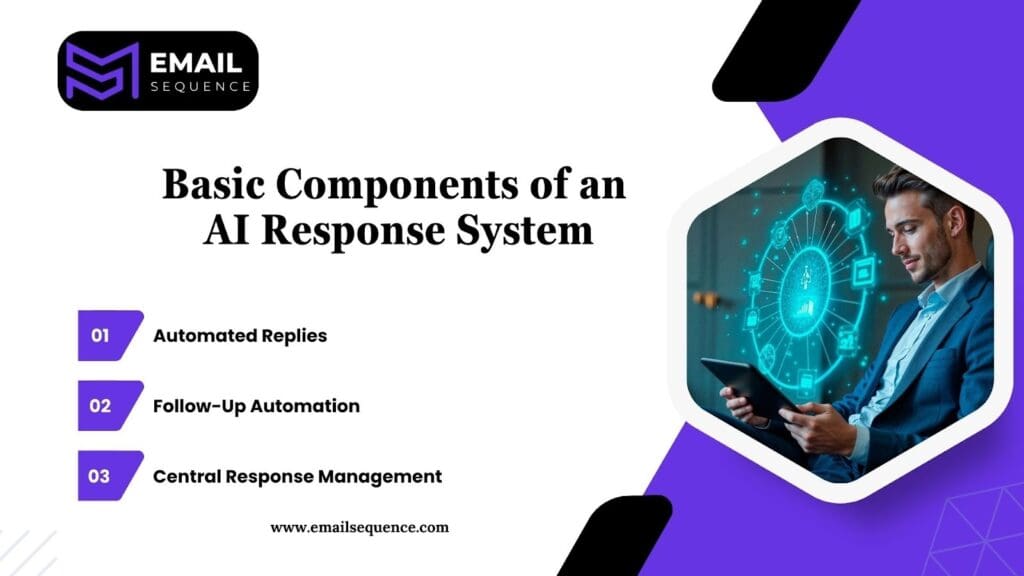
An effective system relies on several moving parts working in harmony. Do you know what makes up a sophisticated reply engine? It involves three critical pillars that ensure smooth communication.
Automated Replies
Speed is the primary advantage of AI in communication. How does the system ensure the customer feels acknowledged immediately? It uses advanced algorithms to generate context-aware answers instantly.
- Contextual Generation: The AI scans the incoming text to draft a response that directly addresses the specific question asked, rather than sending a generic template.
- Scalability: Automated replies handle thousands of simultaneous inquiries, ensuring zero downtime even during peak hours.
Follow-Up Automation
Sending the first reply is easy, but what happens if the customer does not respond? The system must persist intelligently to close the loop.
- Sequence Timing: The AI determines the optimal time to send a follow-up message based on user behavior and historical data.
- Contextual Nudges: Follow-up automation ensures that reminders sound natural and helpful, rather than spammy or aggressive.
Central Response Management
A unified view is crucial for maintaining control over automated communications. How do teams keep track of what the AI is saying? They use a central dashboard to monitor performance.
- Unified Logging: The system records every inbound message and outbound AI reply in a single interface for transparency.
- Human Intervention: Managers can step in and override the AI if a conversation becomes too complex or sensitive.
| Component | What It Does | Example Use |
| Automated Replies | Responds instantly to inbound messages | Chat support initial reply |
| Follow-Up Automation | Sequences response after initial contact | Reminder emails |
| Response Management System | Tracks and optimizes all reply flow | Dashboard for human override |
How AI Response Handling Works (Step-by-Step)
Understanding the technical workflow helps in implementing the right solution. What happens from the moment a message arrives until the issue is resolved? The process follows a logical sequence of intelligent actions.
Data Capture
The first step involves gathering information from various sources. Does your system listen to every channel? An effective AI response system integrates with multiple communication platforms, such as email, social media DMs, and website chat widgets. This ensures that no customer message is missed, regardless of where it originates.
- Multi-Channel Ingestion: The system pulls in messages from email, live chat, SMS, and social media platforms into a centralized processing hub.
- Format Standardization: It converts different message formats into a unified structure that the AI can process effectively.
Intent Recognition
Once the data is captured, the AI must decode the user’s intent and emotional state. Is the customer frustrated by a delay, curious about a new feature, or ready to finalize a purchase? By identifying these signals through Natural Language Processing (NLP), the system can prioritize urgent tickets and choose the most appropriate tone for the reply.
- Classification: The AI engine analyzes keywords and sentiment to classify the message intent, such as “Product Question,” “Billing Issue,” or “Feature Request.”
- Priority Tagging: Urgent issues, like technical outages, receive a high-priority tag to ensure immediate attention.
Response Generation
This is where generative AI and large language models (LLMs) come into play. The AI references a knowledge base that includes past successful interactions, brand voice guidelines, and customer history.
It uses this information to craft a response that is not only accurate but also mirrors the appropriate tone—whether it’s empathetic for a complaint or enthusiastic for positive feedback.
- Knowledge Base Retrieval: The system pulls accurate, up-to-date information from company documentation to answer factual queries instantly.
- Natural Language Generation: It constructs a coherent, grammatically correct response that aligns perfectly with your specific brand voice.
- Personalization Engine: The AI integrates customer-specific data, such as purchase history or loyalty status, to make every interaction feel tailored and high-touch.
- Multi-Turn Context: The system remembers previous messages within the conversation, ensuring continuity and preventing the customer from having to repeat themselves.
Follow-Up Scheduling
The conversation rarely ends with just one message. A good AI ensures engagement continues by asking follow-up questions, providing contextually relevant responses, and adapting to the user’s tone and intent. It focuses on creating a natural flow, keeping the interaction meaningful and personalized to the user’s needs. experience.
- Decision Logic: If the user does not reply within a set timeframe, the system triggers a pre-determined follow-up sequence.
- Adaptive Timing: The AI schedules these nudges during hours when the user is most likely to be active.
- Sentiment-Driven Re-engagement: The system detects shifts in user sentiment, adjusting the follow-up tone to either provide extra support or capitalize on high purchase intent.
Human-in-the-Loop
AI cannot handle every edge case perfectly, making a seamless escalation path essential. To maintain trust, define clear “handoff triggers” for complex technical issues or high-stakes emotional situations that require human empathy. Establishing this balance ensures your customers feel supported by technology without ever feeling trapped by it.
- Confidence Scoring: If the AI’s confidence in its answer falls below a certain threshold, it flags the conversation for human review.
- Seamless Handoff: The system transfers the full chat history to a live agent so they can pick up right where the AI left off.
Why You Should Automate Reply Management
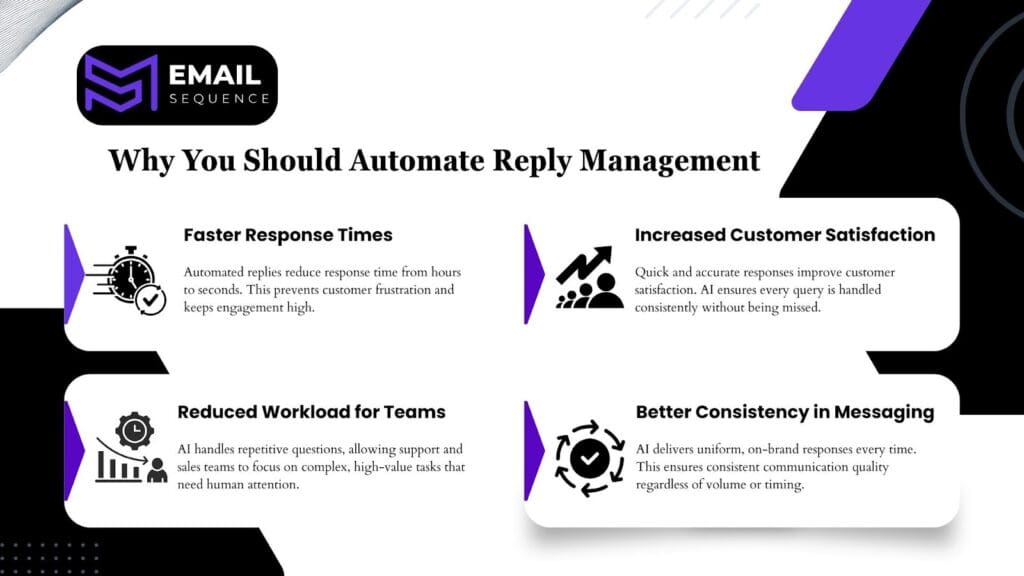
Faster Response Times
Customers expect nearly instant gratification. Automated reply handling reduces wait times from hours to seconds. This immediacy prevents frustration and keeps the customer engaged with the brand.
Increased Customer Satisfaction
When customers receive accurate answers quickly, their satisfaction scores rise. AI ensures that no query falls through the cracks, which builds trust and loyalty over time.
Reduced Workload for Teams
Support and sales teams often drown in repetitive questions. By automating routine inquiries, the AI frees up human agents to focus on complex, high-value interactions that require empathy and strategic thinking.
Better Consistency in Messaging
Humans have bad days; AI does not. An automated response system ensures that every customer receives the same high standard of communication, adhering strictly to brand guidelines and tone.
4 Powerful Ways to Use AI Response Handling for Your Business
This technology is versatile and applies to various business functions. Where can you deploy AI to see the biggest impact? Organizations use it across several departments to streamline workflows.
Customer Support
Support teams use AI to manage the deluge of incoming tickets.
- First-Touch Resolution: AI handles common questions like password resets or shipping status immediately.
- Issue Routing: It automatically assigns complex technical tickets to specialized engineers.
Sales & Lead Qualification
Sales teams use AI to nurture leads without manual effort.
- Instant Engagement: The system replies to lead forms instantly, capitalizing on the prospect’s interest while it is high.
- Qualification: AI asks preliminary questions to determine if a lead is qualified before passing it to a sales representative.
Marketing Engagement
Marketing departments use reply handling to manage campaign interactions.
- Campaign Replies: AI manages responses to large email blasts, answering questions about promotions or events.
- Post-Purchase Check-ins: It automates follow-ups to ask for reviews or suggest complementary products.
Internal Team Messaging
AI even helps with internal corporate communication.
- IT Desk Automation: It answers employee questions about software access or hardware requests.
- HR Queries: AI handles routine questions about benefits, leave policies, and payroll.
Best Practices for AI Reply Automation
Implementing AI requires a strategic approach to ensure effective AI Response Handling and avoid alienating users. How do you make sure your automation adds value rather than causing frustration? Follow these guidelines to maintain a high standard of service.
- Use Clear Tone Aligned with Brand: Ensure the AI speaks in a voice that reflects your company identity, whether that is professional, friendly, or quirky.
- Add Safeguards for Sensitive Queries: Configure the system to detect sensitive topics like legal threats or severe complaints and route them immediately to humans.
- Always Provide Human Override: Give the user an easy option to speak to a real person if the AI fails to resolve their issue.
- Use Analytics to Refine Models: Regularly review the performance data to identify where the AI misunderstands queries and retrain it.
- A/B Test Follow-Up Timings: Experiment with different delays between follow-up messages to find the cadence that yields the highest response rate.
Metrics to Measure Success
You cannot improve what you do not measure. Which Key Performance Indicators (KPIs) signal that your AI strategy is working? Tracking these metrics will prove the ROI of your investment.
| Metric | What It Means | Why It Matters |
| Response Time | Time from message to reply | Faster replies = happier users |
| Follow-Up Completion | % of automated follow-ups finished | Indicates workflow accuracy |
| Engagement Rate | % who interact after AI reply | Shows relevance of AI response |
| Escalation Rate | % passed to humans | Helps fine-tune AI logic |
Tools & Technologies Used for AI Response Handling
Choosing the right technology stack is vital for success. What features should you look for when selecting a vendor? Focus on capabilities that enable seamless integration and intelligent processing.
- Natural Language Processing Engines: These are the brains of the operation, allowing the software to understand and interpret human speech and text.
- Automated Response Generation Modules: Look for tools that can dynamically construct sentences rather than just pasting pre-written paragraphs.
- Integration with CRM / Inbox Systems: The AI must connect with your existing tools like Salesforce, HubSpot, or Gmail to access customer history.
- Analytics Dashboards: A comprehensive reporting suite is essential for tracking the metrics mentioned above.
- Human Escalation Workflows: The software must have built-in triggers that hand off conversations to agents smoothly.
Future Trends in AI Response Automation
The field of AI is advancing rapidly, and AI Response Handling is evolving along with it. What does the next generation of response handling look like? Expect these trends to shape the future of customer communication.
- Smarter Context Retention: Future systems will remember details from conversations that happened months ago, providing a truly continuous relationship.
- Conversational Memory: AI will track the flow of a multi-turn conversation better, reducing the need for customers to repeat themselves.
- Cross-Platform Response Systems: AI will manage a single conversation that spans across email, WhatsApp, and social media seamlessly.
- Better Escalation Prediction: Predictive models will identify frustration before the customer complains, preemptively alerting a human agent.
Conclusion
AI response handling has transformed from a futuristic concept into a business necessity. It enables organizations to scale their communication efforts without sacrificing quality or personal touch. By mastering automated replies and intelligent follow-up automation, businesses ensure that every customer feels valued and heard.
The benefits are clear: reduced costs, higher satisfaction, and more efficient teams. The technology is available now, and the barrier to entry is lower than ever. Do not let manual processes slow down your growth.
Are you ready to revolutionize how you interact with your customers? Explore how automated reply management can streamline your workflows at EmailSequence.com.
Frequently Asked Questions
What is AI response handling?
AI response handling is the use of artificial intelligence to automate the process of receiving, analyzing, and replying to digital messages. It includes managing initial automated replies and scheduling intelligent follow-ups.
How does AI manage follow-ups automatically?
The AI monitors the conversation status. If it detects that a user has not responded to an initial message within a specific timeframe, it automatically triggers a pre-scheduled, context-aware follow-up message to re-engage them.
Can AI replace human support?
No, AI is designed to augment human support, not replace it. It handles repetitive, low-level tasks, which allows human agents to focus on complex, sensitive, or high-value interactions that require emotional intelligence.
What data does the AI need to work well?
To function effectively, the AI needs access to historical conversation logs, knowledge base articles, and customer data from your CRM. This information helps it understand context and generate accurate responses.
How do we measure AI response success?
You measure success by tracking metrics such as average response time, customer satisfaction scores (CSAT), resolution rates, and the percentage of conversations that require human escalation.