AI Subject Lines: Boost Open Rates with Machine Learning
Your inbox is a battleground. With over 100 emails arriving daily, your message is fighting for survival. How do you win the war for attention? Old-school marketing tactics and guesswork won’t cut it anymore. It’s time to bring in the big guns: artificial intelligence.
This shift marks a move from traditional copywriting to a more precise, analytical approach. AI subject lines, powered by machine learning, analyze vast datasets to predict what will capture a reader’s attention. These intelligent subject lines are not just randomly generated; they are crafted based on user behavior, emotional sentiment, and predictive performance scores.
In this blog post, we’ll teach you everything you need to know about using AI to create high-performing subject lines. We will explore how machine learning works, discover its benefits for B2B marketing, and provide a step-by-step process for generating and optimizing your own AI-generated titles.
What Are AI Subject Lines?
AI subject lines are email titles created by artificial intelligence algorithms. Unlike titles written by humans, which rely on intuition and past experience, AI-generated titles are built on data. These systems analyze patterns from millions of emails to determine what makes a subject line effective.
How Machine Learning Boosts Open Rates with AI Subject Lines
Machine learning offers a systematic approach to open rate optimization. It replaces assumptions with data-backed predictions, giving marketers a significant advantage. How does it achieve this?
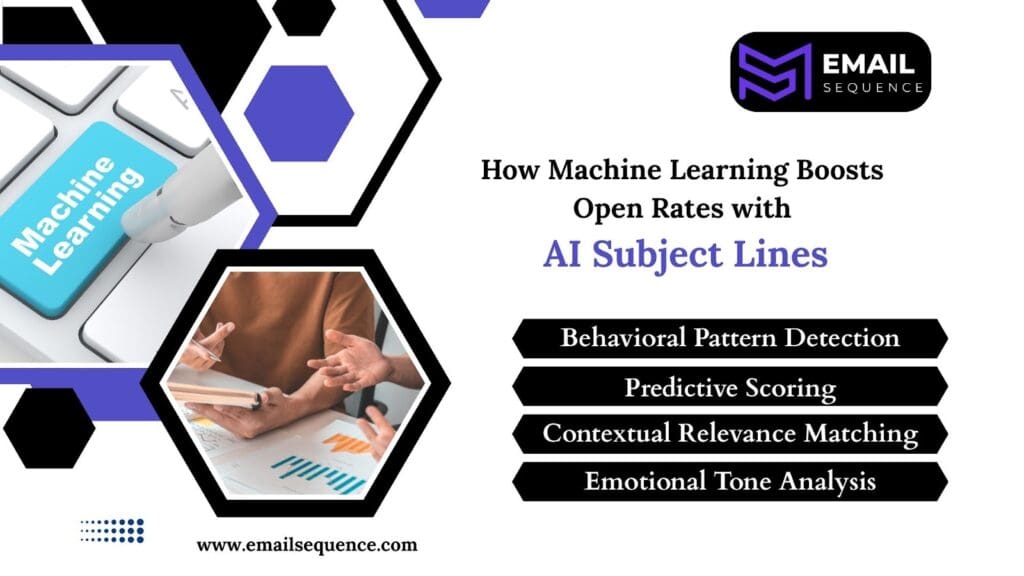
Behavioral Pattern Detection:
Machine learning models analyze past interactions to understand what resonates with specific audience segments. They adapt and improve over time, making predictions more accurate. By personalizing content, they create more meaningful connections with users, driving better engagement and results.
- Tracks email open rates and timing for each user.
- Identifies the type of content users interact with most.
- Helps segment audiences for tailored marketing strategies.
- Continuously learns to improve recommendations over time.
- Saves time by automating data analysis and targeting.
Predictive Scoring:
Before you even send an email, AI can score potential subject lines based on their predicted open rate, helping you craft messages that truly resonate with your audience. It analyzes factors like length, tone, and word choice to ensure your subject line grabs attention.
This allows you to choose the most effective option without extensive manual testing, saving you time and boosting email engagement.
Contextual Relevance Matching:
- AI analyzes user behavior and past interactions to tailor messages for maximum relevance.
- It generates subject lines that align with the recipient’s current preferences, increasing engagement.
- By understanding timing, AI ensures messages are delivered when they’re most likely to be opened.
Emotional Tone Analysis:
The AI can analyze and recommend specific emotional tones such as curiosity, urgency, or excitement that are most likely to resonate with your audience and drive action.
These machine learning email techniques consistently outperform manual copywriting because they are dynamic and adaptive. They learn from every interaction, ensuring continuous improvement and higher engagement over time.
Machine Learning in Action: The Technology Behind Boosting Open Rates
The power of AI-generated titles comes from sophisticated machine learning models. How are these models trained? They learn from massive datasets containing millions of subject lines and their corresponding performance metrics.
Several types of models are used. What are the key technologies involved?
- Natural Language Processing (NLP): This allows the AI to understand and interpret human language, recognizing grammar, sentiment, and context.
- Neural Networks: Inspired by the human brain, these complex algorithms identify intricate patterns in data that would be impossible for a person to see.
- Transformers: This is an advanced neural network architecture that excels at understanding context and relationships between words, making it ideal for generating coherent and relevant text.
A key component is reinforcement learning, which helps the system improve over time. With each campaign, the model receives feedback on what worked and what did not, refining its future suggestions..
Benefits of Using AI Subject Lines in B2B Email Marketing
Integrating AI into your B2B email marketing offers more than just better open rates. It provides a suite of advantages that streamline workflows and drive measurable results. What are the main benefits?
Higher Open Rates:
By analyzing past performance data, AI can predict which subject lines are most likely to resonate with your audience. This data-driven approach allows the AI to craft compelling, attention-grabbing subject lines that stand out in a crowded inbox and significantly boost your open rates.
Increased Personalization:
AI analyzes individual user behavior, purchase history, and engagement patterns to generate highly personalized subject lines. This level of customization makes each email feel uniquely relevant to the recipient, moving beyond simple name tokenization.
For example, AI could generate subject lines like:
- For an abandoned cart: “Still thinking about the [Product Name]?”
- Based on browsing history: “We saw you checking out our running shoes, [Name]!”
- For a repeat customer: “A special offer on your favorite [Product Category].”
Less A/B Testing Time:
AI-powered tools can analyze vast datasets of past email performance to predict which subject lines are most likely to achieve high open rates and engagement. This predictive scoring allows you to identify the winning subject line before you even hit send, significantly reducing the need for lengthy and costly A/B tests.
For example, an AI tool might analyze three potential subject lines and provide a performance score for each:
- “Your Weekly Deals Inside” – Predicted Open Rate: 15%
- “Sarah, Don’t Miss These Exclusive Offers” – Predicted Open Rate: 22%
- “25% Off Just For You, Sarah! “ – Predicted Open Rate: 28%
Based on these scores, you can immediately choose the third option, saving time and maximizing your campaign’s initial impact.
Consistent Tone Across Campaigns:
AI helps maintain a consistent brand voice across all your email communications, ensuring your messaging aligns with your brand identity and builds trust with your audience. By leveraging AI, you can streamline content creation and enhance professionalism in every email. Here’s how AI can add value:
- Personalized greetings: Tailor each email with names or preferences to create a more engaging experience.
- Tone adjustments: Automatically adjust the tone to match your brand, whether it’s formal, friendly, or playful.
- Error-free content: AI detects and corrects grammar mistakes or inconsistencies, ensuring polished communication.
- Template suggestions: Generate on-brand email templates for marketing campaigns or customer service responses.
How to Create AI-Powered Subject Lines
Ready to craft subject lines that not only get opened but also drive action? With the right AI tools and a clear strategy, you can move beyond guesswork and start creating data-driven subject lines that resonate with your audience. Here’s a structured approach to help you get the most out of AI.
Step 1: Analyze Audience Behavior
Begin by understanding your audience. Look at historical data to identify which subject lines have performed well in the past. Analyze open times, click-through rates, and engagement patterns to inform the AI.
Step 2: Choose the Right Machine Learning Tool
Choosing the right tool can make a big difference; it saves time, improves efficiency, and delivers better results. Here’s what to look for:
- Predictive Scoring: A feature that ranks subject lines based on their potential performance.
- Emotional Tone Analysis: Tools that evaluate and suggest improvements to the emotional impact of your messaging.
- Integration Capabilities: Ensure the tool integrates smoothly with your current email service provider.
- Feedback Loops: A system that adapts and improves based on your campaign results.
By focusing on these features, you’ll find a tool that fits your specific needs and helps you achieve your goals efficiently.
Step 3: Generate Intelligent Subject Lines
To get the most out of your AI subject line generator, it’s important to provide clear and detailed context. Whether you’re using tools like Jasper, Copy.ai, or dedicated subject line generators, the quality of your input directly impacts the output.
Explain the purpose of your email, the target audience, and the key message you want to convey.
Use the tool to generate a list of subject lines for different scenarios. For example:
- Promotional Campaigns: “Generate 5 subject lines for a 20% off flash sale on summer dresses.”
- Weekly Newsletters: “Create engaging subject lines for a newsletter about the latest marketing trends.”
- Cold Outreach: “Write 3 curiosity-driven subject lines for an outreach email to potential B2B clients.”
Step 4: Score & Rank Your AI Subject Lines
Review the generated options and their predictive scores. The tool should provide a probability of success for each subject line, helping you understand why certain options are ranked higher than others.
By analyzing these scores, you can make data-driven decisions to optimize your campaigns and improve engagement rates. The insights offered will also guide you in crafting better subject lines in the future.
For example:
- “Unlock Your Exclusive Offer – Limited Time Only” (87% probability)
- “Don’t Miss Out: Special Savings Inside” (81% probability)
- “Hi [Name], Exciting News Just for You!” (78% probability)
Use this feedback to test, refine, and create subject lines that truly resonate with your audience.
Step 5: Optimize Through Machine Learning Feedback Loops
After sending your campaign, feed the performance data back into the AI tool. This completes the feedback loop, allowing the machine learning model to refine its algorithm for even better predictions in the future.
Best Practices: Writing Smarter, High-Performing AI-Generated Titles
While AI provides powerful suggestions, human oversight is essential for crafting the perfect subject line. Combining AI’s efficiency with a human touch ensures creativity and relevance. Focus on clarity, keep it concise, and make sure it resonates with your audience. What are some best practices to follow?
Adding Personalization:
Personalizing your subject line can significantly boost open rates. Use the recipient’s name, company, or reference a past interaction to make the subject line feel tailored to them.
For example, instead of a generic “New Whitepaper Available,” try “John, here’s the marketing whitepaper you requested.” This simple touch shows you see them as an individual, not just another contact on a list.
Keeping Subject Lines Short & Scan-Friendly:
Try to write in 40–50 characters. Most people scan their inboxes, especially on mobile devices, where screen space is limited. A concise subject line ensures your message is fully visible without being cut off.
Using Curiosity Without Clickbait:
Pique interest without being misleading. Ask a question or hint at a valuable insight inside the email. A strong subject line can set the tone for the entire message and significantly boost your open rates.
Here are a few tips to craft an effective subject line:
- Use numbers or data to grab attention (e.g., “5 ways to improve your workflow”).
- Personalize it to make the recipient feel seen and valued.
- Keep it short and to the point for better readability.
Ensuring Clarity & Emotional Resonance:
The subject line should clearly communicate the email’s value while tapping into an appropriate emotion, like excitement or urgency. It should be concise yet engaging, instantly grabbing the reader’s attention.
Use action-oriented language and highlight a key benefit to make the recipient want to open the email right away.
Avoiding Spam Triggers:
Avoid excessive capitalization, multiple exclamation points, or spammy words like “free” or “guaranteed,” as they can seem unprofessional and trigger spam filters. Focus on clear, concise, and genuine content to build trust with your audience.
Spam trigger words to avoid:
- Free
- Buy now
- Limited offer
- Act now
- Guarantee
- Winner
- Risk-free
Top Proven AI Frameworks to Write High-Performing Subject Lines
Frameworks provide structure for your AI-generated subject lines, ensuring they align with proven marketing principles. Here are some of the most effective frameworks to use.
Emotion-Driven Framework
This framework leverages core human emotions to drive opens. Can you use emotion to connect with your audience?
- Curiosity: Example: “The one marketing mistake you might be making..“
- Reward: Example: “Your exclusive guide to Q4 planning is inside..“
- Fear of Loss (FOMO): Example: “Last chance: 24 hours left on your offer”
- Satisfaction: Example: “Your problem, solved: A new approach to data analysis.”
PAS (Problem–Agitate–Solve) for Subject Lines
This classic formula is highly effective for subject lines. First, state a problem the reader has, then agitate it to highlight the pain point, and finally offer the solution.
The agitation step is key; it intensifies the problem’s emotional impact, making the solution feel more urgent and valuable. This structure grabs attention by speaking directly to a reader’s challenges and promising relief.
- Example: “Low open rates? Your audience might be ignoring you. Here’s why.”
“Value First” Framework
This framework immediately communicates the benefit the reader will get from opening the email. It answers the question, “What’s in it for me?” right away, which is crucial for grabbing attention in a crowded inbox. It’s direct, compelling, and sets clear expectations for the content inside.
- Example: “Save 10 hours this week with our new automation tool.”
“Hyper-Personalized” Framework
Go beyond just using a name. This framework incorporates specific details about the user’s behavior, company, or recent activities. Tailoring your approach with these insights shows genuine understanding and builds stronger connections. Personalization at this level increases engagement and boosts overall results.
- Example: “John, saw your team is hiring developers. This might help.”
Final Checklist: What a Perfect AI-Optimized Subject Line Includes
Is your subject line ready to send? A great AI-optimized subject line is a blend of data science and marketing art. Use this final checklist to ensure you have covered all the bases.
- Is it Short and Personalized? It should be concise and address the reader directly.
- Is it Emotionally Relevant and Curiosity-Driven? It needs to spark interest and connect on a human level.
- Is it backed by ML Scoring? It should be chosen based on a predictive performance score.
- Is it Matched to User Intent? The promise of the subject line must align with the email’s content.
- Is it Tested and Reinforced for Continuous Learning? The results should feed back into the system to improve future campaigns.
A Smarter Future for Email Marketing
The future of email marketing is about blending human creativity with AI-powered tools to craft smarter, more impactful campaigns. AI and machine learning are no longer futuristic; they are available now to optimize your email strategy. From generating AI-driven subject lines to delivering personalized content, these tools improve open rates, boost engagement, and streamline your efforts.
By using AI, marketers can connect with their audience more deeply while saving time and resources. This blog explores how using AI in email marketing, from generating compelling AI subject lines to personalizing content, can give you a competitive edge and lead to more effective communication.
Start using AI to unlock the full potential of your campaigns today. Visit emailsequence.com to learn more and get started!
Frequently Asked Questions
Is AI better than A/B testing for subject lines?
AI significantly reduces the need for traditional A/B testing. Instead of testing two options manually, AI predicts winning subject lines using historical data, emotional scoring, and pattern recognition. A/B testing can still be useful, but AI makes the process faster and more accurate.
Will AI replace human copywriters for email marketing?
No, AI enhances copywriting but doesn’t replace human judgment. Marketers still need to review, refine, and ensure the subject line matches brand voice and context. The best results come from combining AI insights with human creativity.
How short should an AI-written subject line be?
Aim for 40–50 characters. This ensures visibility on mobile devices and keeps the message punchy. AI tools often recommend shorter lines because they perform better in crowded inboxes.
How can I start using AI to improve my email subject lines?
Start by choosing an AI tool with predictive scoring, feed it audience data, generate 5–10 subject lines, compare the scores, select the top one, launch your campaign, and feed back performance data for continuous improvement.