How to Improve Email Deliverability in 2026
To improve email deliverability in 2026, authenticate emails with SPF, DKIM, and DMARC protocols, maintain a spam complaint rate under 0.1%, and align your “From” address with authentication domains.
Boost engagement by encouraging replies and clicks, and clean your list by suppressing inactive users. Double opt-in prevents spam traps, ensuring better inbox placement and campaign success. Focus on these strategies to optimize email deliverability and maximize ROI.
We will guide you through the exact requirements you must implement to achieve elite inbox placement.
The New Rules: Gmail and Yahoo Requirements
Major inbox providers recently introduced strict mandates for senders. You cannot ignore these updates if you want your emails to land safely.
- The 5,000-Email Threshold: The new “Bulk Sender” rules apply to almost everyone. If you send 5,000 messages in a single day, you trigger advanced scrutiny. You must comply with stricter authentication protocols immediately.
- Mandatory One-Click Unsubscribe: The “Unsubscribe Header” is no longer optional. It is a pass-or-fail requirement for inboxing. Users must have the ability to opt out with a single click.
- The 0.3% Spam Complaint Rule: You must manage the hard ceiling on spam complaints. If your complaint rate exceeds 0.3%, providers will block your domain. Your actual target should remain below 0.1% to guarantee delivery success.
The Technical Trinity: Bulletproofing Your Authentication
Authentication acts as your digital passport. Mailbox providers use these protocols to verify your identity and protect users from fraud.
- SPF and DKIM: These protocols serve as your digital signature. Sender Policy Framework (SPF) authorizes specific servers to send mail on your behalf. DomainKeys Identified Mail (DKIM) adds a cryptographic signature to prove the email was not altered in transit.
- DMARC Enforcement: You must move your DMARC policy from “p=none” to “p=reject.” This prevents domain spoofing and builds elite sender status.
- Domain Alignment: Alignment is critical. You must ensure your “From” address domain matches your DKIM and SPF domains exactly. This remains a common failure point in deliverability optimization.
- Brand Indicators for Message Identification (BIMI): BIMI allows you to display your verified logo next to your messages. This acts as a visual trust signal and can boost open rates by 10 percent or more.
Strategic Table: The Deliverability Health Matrix
You must track specific benchmarks to maintain a healthy sender reputation. Use the matrix below to audit your performance.
| Metric | “At Risk” (Danger) | “Healthy” (Target) | “Elite” (Goal) |
| Inbox Placement | Under 85% | 92% – 97% | Over 98% |
| Spam Complaint Rate | Over 0.3% | Under 0.1% | Under 0.05% |
| Hard Bounce Rate | Over 1.0% | Under 0.5% | Under 0.1% |
| Authentication Status | Missing or Partial | SPF + DKIM Pass | Full DMARC Alignment |
| Engagement (CTOR) | Under 5% | 10% – 15% | Over 20% |
Beyond DNS: Managing Behavioral Deliverability
Technical setup only gets you to the front door. Behavioral signals determine whether you reach the primary inbox or the promotions tab.
Mailbox providers use artificial intelligence to monitor the “Engagement Loop.” When users move your message to the inbox or mark it as important, your domain ranking increases.
Prompting a simple reply in your welcome sequence remains the strongest deliverability hack available. When a user replies to you, providers instantly categorize you as a trusted contact.
You must also guard against template fatigue. Sending the same HTML structure to millions of recipients triggers automated bot filters. You should rotate your layouts and keep your code clean to maintain high inbox rates.
List Hygiene as a Growth Strategy
A massive email list holds no value if those subscribers do not engage. Good email hygiene directly influences your delivery success.

- The 90-Day Sunset Policy: You should automatically suppress inactive users. Removing subscribers who have not opened an email in 90 days protects your global sender score.
- Double Opt-In (DOI): Double opt-in serves as the most effective shield against bot-driven spam traps. It ensures every address on your list belongs to a real, engaged human.
- Predictive Scrubbing: You can use artificial intelligence to identify emotional unsubscribes. Remove these unengaged users before they hit the dreaded spam button and damage your reputation.
Advanced Tactics: Warm-up and Infrastructure
New sending environments require patience and strategic planning. You cannot send massive volumes on day one.
You must navigate the “sandbox” period carefully. IP warm-up establishes trust for a specific server address. Domain warm-up builds the reputation of your actual brand name. Both require a gradual increase in sending volume over several weeks.
If you send more than 50,000 emails per month, you must choose between dedicated and shared IPs. A dedicated IP gives you total control over your reputation, while a shared IP relies on the behavior of others.
Finally, implement a strict subdomain strategy. You should separate your transactional emails, such as invoices and receipts, from your marketing campaigns. This isolates your sender reputation and protects critical business mail.
Common Deliverability Myths Debunked
False information ruins the sender’s reputation. We must clear up two persistent myths.
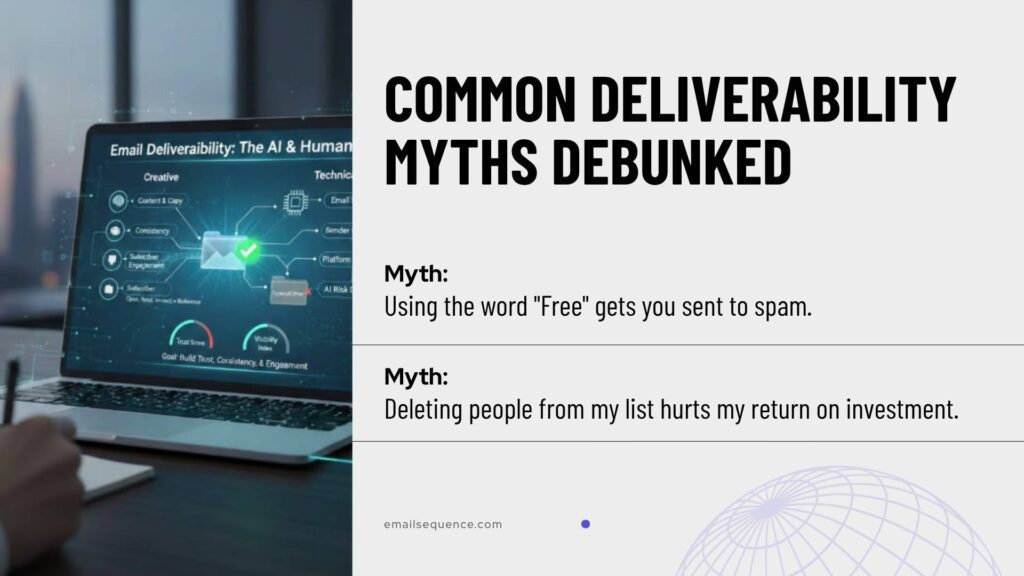
Myth: Using the word “Free” gets you sent to spam.
This is entirely false. Context and overall sender reputation matter significantly more than isolated vocabulary. If your technical alignment is perfect and engagement is high, you can use promotional language safely.
Myth: Deleting people from my list hurts my return on investment.
This is also false. Keeping unengaged users destroys your inboxing rates for the people who actually want to buy. Pruning your list increases your overall revenue.
Conclusion: Owning the Inbox
Email Deliverability serves as the vital bridge between a great campaign and a closed sale. If you fail to maintain your technical infrastructure, your brilliant copywriting will never see the light of day.
We built the EmailSequence platform for an “Inboxing First” methodology. We ensure your carefully crafted sequences actually get read by your target audience.
Is your sender reputation at risk? You cannot afford to guess. Use the EmailSequence Deliverability Diagnostic to uncover the hidden technical gaps in your DNS records. Scan your domain now and secure your place in the primary inbox.
Frequently Asked Questions
What is email deliverability, and why is it important?
Email deliverability refers to the ability of your emails to land in recipients’ primary inboxes rather than spam folders. It is crucial because poor deliverability reduces open rates, engagement, and ROI. Factors like sender reputation, authentication protocols (SPF, DKIM, DMARC), and user engagement directly impact deliverability. Optimizing these ensures your campaigns reach the right audience effectively.
How can I improve my email sender reputation?
To improve sender reputation, focus on list hygiene, engagement, and authentication. Use double opt-in to prevent spam traps, suppress inactive users, and maintain a low spam complaint rate (below 0.1%). Implement SPF, DKIM, and DMARC protocols for authentication. Encourage replies and clicks to boost engagement signals, which mailbox providers prioritize for inbox placement.
What are Gmail’s 2026 email deliverability requirements?
Gmail’s 2026 rules emphasize technical compliance and user experience. Key requirements include a mandatory one-click unsubscribe option, maintaining a spam complaint rate below 0.3%, and adhering to the 5,000-email threshold for bulk senders. Additionally, alignment between your “From” address and authentication domains (SPF/DKIM) is critical for inbox placement.
Why is DMARC alignment essential for email deliverability?
DMARC alignment prevents domain spoofing and builds trust with mailbox providers. It ensures your “From” address matches SPF and DKIM domains, a common failure point in 2026. Moving from “p=none” to “p=reject” strengthens your domain’s reputation, reducing phishing risks and improving inbox placement rates.
How does engagement affect email deliverability?
Mailbox providers use engagement metrics like opens, clicks, and replies to rank your domain. High engagement signals trust, improving inbox placement. Encourage replies in welcome emails, rotate templates to avoid bot filters, and suppress inactive users to maintain a strong sender reputation. Engagement is now as critical as technical compliance for deliverability success.