The Guide to Email Link Building: From Outreach to Backlink
Tired of sending outreach emails that go straight to the trash? Let’s fix that. While many marketers are busy spamming generic templates, we’re here to show you how a strategic, quality-over-quantity approach can transform your link-building game. Forget the numbers, successful outreach is about building genuine relationships and delivering real value.
This comprehensive guide serves as your expert playbook for crafting a successful email link building campaign. We’ll walk you through every step, from creating compelling, link-worthy assets to executing highly personalized outreach strategies.
You’ll also learn how to ensure strong email deliverability, accurately measure your campaign’s success, and build lasting editorial relationships that drive long-term impact.
By the end, you will have a clear framework for building high-quality backlinks that drive meaningful SEO growth and a strong link-building strategy.
Why Email Link Building Still Works (When It’s Done Right)
Email link building remains effective because it facilitates direct, human-to-human connections. Unlike automated link schemes, a well-crafted outreach email provides editorial context, builds trust, and allows you to present a curated linking opportunity to a real person. This personal touch is what converts a simple pitch into a valuable backlink.
Remember that successful backlink outreach is relationship-driven, not purely transactional. Your primary goal should be to build value first. When you offer something genuinely useful to another website’s editor and audience, you earn links that search engines and users respect.
Types of Email Link Building
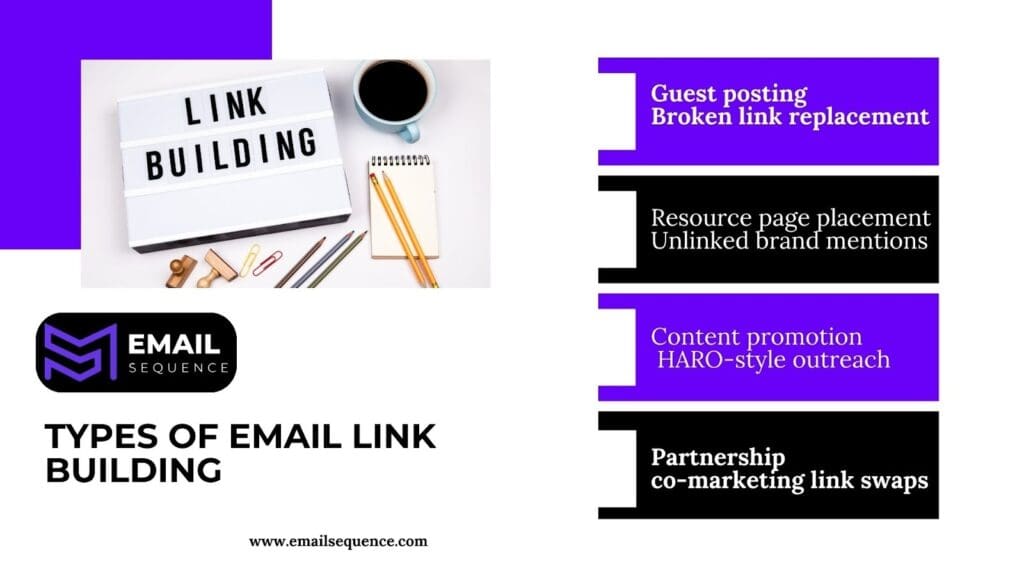
Ready to build some links? The right outreach strategy depends on two things: the type of content you have and the specific opportunity you’ve found. Let’s explore some of the most common and effective email link-building methods to help you choose the best approach.
Guest posting / contributed content:
Reach out to reputable sites within your niche and offer to create a high-quality, valuable article tailored to their audience. In return, include an author bio with a backlink to your website, driving targeted traffic and improving your SEO.
Broken link replacement:
Identify broken external links on high-authority websites using seo tools like Ahrefs or Check My Links. Reach out to the website owner and suggest your content as a replacement, highlighting how it better serves their audience’s needs.
Resource page placement:
Research relevant resource pages or roundup articles in your industry. Reach out to the page owner and pitch your guide, tool, or study as an addition to their list.
Unlinked brand mentions → link reclamation:
Use tools like Google Alerts or Mention to track instances where your brand is mentioned online without a link. Contact the site owner or author, thank them for the mention, and politely request that they add a link to your website.
Content promotion (data, research, infographics):
Develop unique, data-driven assets such as research studies, infographics, and surveys that offer fresh insights or useful information. Share these assets with journalists, bloggers, and industry influencers who may find them valuable for their own articles, providing you with credit and a backlink.
Expert quotes / HARO-style outreach:
Actively participate in platforms like HARO (Help a Reporter Out) or respond to journalist requests on social media. Provide expert insights or commentary on niche topics, ensuring your responses are thoughtful and authoritative. In exchange, you’ll often receive credit and a backlink in the published content.
Partnership / co-marketing link swaps (mutual value):
Collaborate with complementary businesses on joint projects such as webinars, eBooks, or campaigns. As part of the partnership, we agree to link to each other’s content, offering mutual value. This not only builds backlinks but also fosters long-term relationships within your industry.
By focusing on these methods, you’ll not only build high-quality backlinks but also establish your authority, improve your brand visibility, and attract a targeted audience to your website.
The 7-Step Outreach Strategy
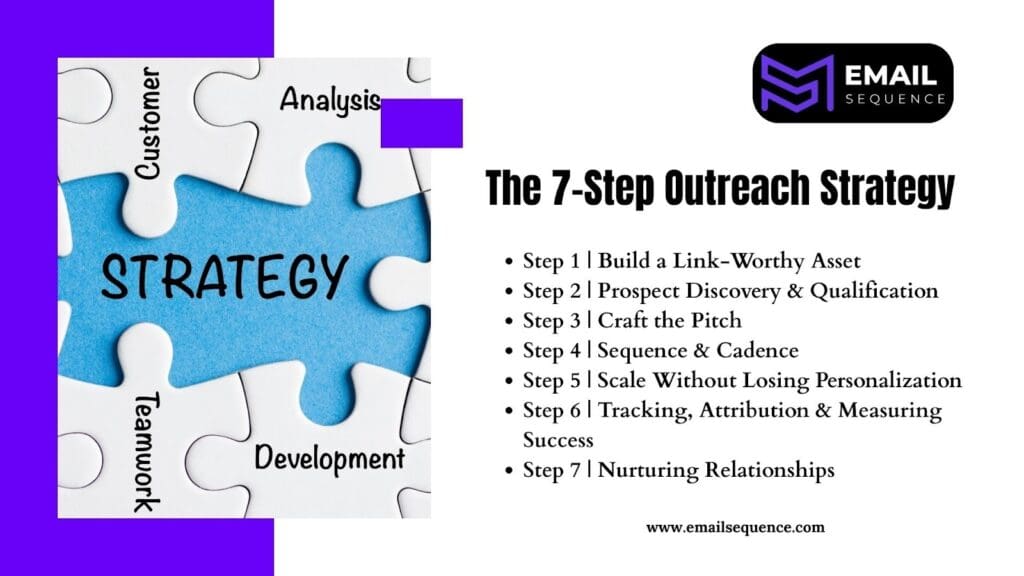
A successful outreach campaign is a methodical process. Following these seven steps will ensure your efforts are organized, scalable, and effective.
Step 1 | Build a Link-Worthy Asset
Before you can even think about outreach, you need a foundational piece of content that journalists and other websites will want to link to. This “link-worthy asset” is the cornerstone of your entire campaign. So, what kind of content naturally attracts high-quality, editorial links?
- Types: Create unique data from original research, definitive guides that cover a topic exhaustively, free online tools, compelling infographics, in-depth case studies, or expert compilations.
- Packaging: Design your asset so it can be broken down into short, pitchable slices. One comprehensive research report can power dozens of unique pitch angles for different audiences.
Step 2 | Prospect Discovery & Qualification
Identifying the right websites to contact is key to achieving your goals, but it’s not just about finding any site—it’s about targeting the ones that truly align with your objectives.
Start by researching websites relevant to your niche or audience, then prioritize them based on their authority, relevance, and potential impact.
- Criteria: Evaluate prospects based on topical relevance, domain authority, organic traffic, audience fit, and linking behavior (e.g., do they have resource pages or do they only link from blog posts?).
- Prioritization: Score prospects to determine which offers the best reward for your effort. Segment your lists into high-touch (manual, personalized outreach) and low-touch (semi-automated) campaigns.
Step 3 | Craft the Pitch
A generic email often gets ignored or deleted—so how do you make your pitch stand out? Start by personalizing your message with the recipient’s name and referencing their specific needs or goals.
Focus on delivering value upfront, keep your message clear and concise, and always end with a strong call-to-action that encourages a response.
Core Elements of a Pitch:
A great pitch email needs a few key things. Start with an opener that explains why you’re reaching out. Then, clearly state your value proposition—what’s in it for them? Build trust with social proof, like a customer testimonial or a data point. Make a simple ask, and finish with a clear call-to-action (CTA) that tells them what to do next.
How to Personalize Your Pitch:
Go beyond just using their name. Reference a recent article they wrote, mention their company’s latest news, or explain how your product or service specifically helps their target audience. This shows you’ve done your homework.
Creating Fallback Options:
For times when you can’t find specific details for deep personalization (like in a low-touch campaign), have some standard, yet relevant, sentences ready. This ensures your email still feels personal and not like a generic template.
Step 4 | Sequence & Cadence
Most of your links will come from follow-up emails. So, how can you follow up effectively without being annoying or harming your professional reputation? The key is a well-planned sequence.
- Multi-step sequences: Plan a series of emails. Start with the initial pitch, follow up with an additional piece of value, send a final polite reminder, and then close the loop gracefully if you do not hear back.
- Timing, cadence & channel mix: Warm up your contacts before emailing them by engaging with them on LinkedIn.
- When to stop outreach: If you have followed up two or three times without a response, it is best to stop. Persisting beyond that point can harm your brand’s reputation.
Step 5 | Scale Without Losing Personalization
Scaling your outreach is essential as your business grows, but how can you do it without losing the personal touch that gets results? The key is to find a balance between automation and customization. Here’s how you can scale your outreach efforts efficiently:
- Templates + modular personalization: Use templates with interchangeable “personalization blocks.” These are 2–3 specific, customized lines that you can swap into each email.
- Micro-segments and dynamic variables: Segment your prospect list into small, highly similar groups to make personalization easier. Reserve fully manual outreach for your top-tier targets.
- Warm-up and domain/IP throttling: Protect your email deliverability by warming up your sending domain and staggering your email sends to avoid being flagged as spam.
Step 6 | Tracking, Attribution & Measuring Success
You can’t improve what you don’t measure, so tracking the right metrics is essential for refining your outreach strategy. But which numbers truly matter when it comes to your outreach emails? Focusing on the right key performance indicators (KPIs) will show you what’s working and where you need to adjust your approach.
- Metrics to track: Monitor reply rates, link acceptance rates, the quality of each link (Domain Rating and traffic), time-to-link, and the overall cost-per-link.
- Tracking setup: Use UTM tags on your asset links, an outreach CRM, and backlink monitoring tools. Keep a detailed spreadsheet for reporting.
- How to present ROI: Show stakeholders the value of a link by estimating the traffic lift and potential conversions it could generate.
Step 7 | Nurturing Relationships
While securing a single backlink is a great win, building a long-term relationship with an editor or publication can lead to consistent link-building opportunities. But how do you transform a one-time link placement into a lasting partnership?
The key is to provide ongoing value even after your link goes live.
- Post-link follow-up: After securing a link, send a thank-you note, share the new article with your own audience, and offer that contact future exclusives.
- Convert one-off links to recurring relationships: Turn a successful guest post into an opportunity for a recurring column or position yourself as a go-to expert for future quotes.
- Keep a CRM of contacts: Maintain a database of your friendly contacts and periodically share new content ideas with them.
High-Converting Outreach Email Template Frameworks
The structure is simple: a compelling subject line, a personalized opener, a clear explanation of why your asset matters to them, a one-line pitch, an easy call to action, and a professional signature. Here are three adaptable frameworks.
1. Broken Link Replacement
- Subject: A broken link on [Their Site Name]
- Body: Hi [Name], I was reading your excellent article on [Topic] and noticed a link to [Broken URL] is no longer working. I recently published a comprehensive guide on [Your Asset Topic] that might make a great replacement.
2. Resource Page Addition
- Subject: Idea for your [Resource Page Title] page
- Body: Hi [Name], Your resource page on [Topic] is a fantastic asset for your readers. I saw you link to resources like [Example Resource]. We just released a free tool that [solves a specific problem] for that same audience. It could be a valuable addition for your readers.
3. Guest Post Pitch
- Subject: Guest post idea for [Their Site Name]
- Body: Hi [Name], I am a long-time reader of your blog and loved your recent post on [Article Title]. I have an idea for a guest post, “[Guest Post Title],” that I believe your audience would find very useful. It would cover [Point 1], [Point 2], and [Point 3]. Are you currently accepting guest contributions?
Deliverability & Reputation: The Silent Campaign Killers
Even the best email won’t make an impact if it ends up in the spam folder. So, how can you ensure that your messages actually reach your intended audience? Start by using a reliable email service provider, avoid spam-triggering words, personalize your email content, and always include a clear unsubscribe option.
- Warm up domains and stagger sends: Avoid blasting thousands of emails from a new domain. You have to start slowly.
- Maintain list hygiene: Regularly clean your email lists to handle bounces and remove inactive or invalid addresses. Always respect unsubscribe requests promptly.
- Monitor spam complaints and sending rates: Keep an eye on your deliverability metrics. If your open rates drop or spam complaints rise, adjust your sending velocity.
- Use authentication (SPF/DKIM/DMARC): Set up proper email authentication records to prove your emails are legitimate. Use warmed IP addresses for large campaigns.
Advanced Tactics & Creative Angles That Win Links
Once you’ve mastered the fundamentals of link building, you can start exploring more advanced tactics. While these strategies often require more effort, they can earn high-authority links that significantly boost your search engine rankings. Here are a few creative ideas to get you started.
- Data/industry roundups: Reach out to journalists with exclusive data or by curating an expert roundup. This crosses over into digital PR and can earn high-authority links.
- Co-created content: Partner with another organization to create a research report or tool, with both parties promoting it and linking to one another.
- Broken link reclamation + better replacement: Instead of just reporting a broken link, create a far superior replacement asset to increase your chances of getting the link.
- Resource page optimization: When pitching for a resource page, explain exactly why your asset is better or different than what is already listed.
- Using internal content: Anchor your outreach around your most important pillar pages to build authority around your core topics.
Checklist: Launch a Link-Building Email Campaign
Ready to start? Use this 10-point checklist.
- Link-worthy asset is finalized and published.
- The prospect list is built, segmented, and scored.
- Personalized email templates are drafted.
- Sending domain is properly warmed up.
- The email sequence is scheduled in your outreach tool.
- UTM tagging and tracking are fully set up.
- Outreach CRM is prepared to manage replies.
- A clear follow-up plan is in place.
- A KPI dashboard is created for reporting.
- A nurture plan for new contacts is established.
Build Links That Last
Email link building is a marathon, not a sprint. To succeed, you must move beyond outdated spammy tactics and focus on building genuine relationships. Start by identifying relevant, high-authority sites with engaged audiences.
Craft personalized outreach emails that offer real value, whether through guest posting, sharing unique data, or creating custom resources. Successful email link building depends on this value exchange. Remember to follow up strategically, waiting 3-5 days before your first nudge.
By putting relationships at the forefront of your strategy, you can build high-quality links that drive long-term SEO success and establish your brand as a trusted authority, one thoughtful email at a time.
Ready to put this strategy into action? Start building your next campaign with our expert tips and resources. Visit emailsequence.com to get started today!
Frequently Asked Questions
How many outreach emails should I send per week?
Focus on quality, not quantity. For a high-touch campaign, 50-100 highly personalized emails per week is a good target. For lower-touch campaigns, you can scale this, but monitor deliverability closely.
What’s a good reply-to-link conversion rate?
This varies widely. A good reply rate for a cold outreach campaign is 5-10%. Of those replies, converting 20-30% into a link is a solid performance.
Is it OK to send pitches on social media instead of email?
Yes, social media can be a great way to warm up a contact or send a brief initial pitch. However, email is generally better for detailed proposals and formal requests.
How long before I should follow up?
Wait at least 3-5 business days before sending your first follow-up. Subsequent follow-ups can be spaced further apart, perhaps a week or more.
How do I know if a link is worth pursuing?
A link is worth pursuing if the website is topically relevant, has a real and engaged audience, and possesses good domain authority and organic traffic.