Boost Conversions with Email Quizzes & Surveys: Insider Tips
Stop guessing. The new rule of email marketing is Zero-Party Data (ZPD)—information your customers voluntarily and proactively share as response data. Email quizzes, surveys, including trivia quiz campaigns and custom surveys, are the most frictionless way to collect this valuable data for in-depth analysis.
Most brands, however, still rely on weak behavioral data, leading to irrelevant emails and stagnant sales. They are leaving money on the table by not using easy-to-use tools and advanced features.
This guide unlocks the secrets to using ZPD, Google Forms, and a variety of quiz maker platforms. We will show you how to leverage email quizzes and surveys to understand your customers on a deeper level.
Learn to create effective forms, engage students, and utilize automatically generated reports to track progress and collect responses. Move beyond basic segmentation and create hyper-personalized experiences that drive revenue and improve customer satisfaction.
The Revenue Rescue Mission
At the heart of a successful ZPD strategy is a powerful engine: conditional logic. This is the number one secret feature found in the best quiz maker solutions and forms with built-in intelligence. Conditional logic allows your quiz or survey to dynamically adjust its questions based on a user’s previous answers, ensuring every individual response shapes their quiz type.
For example, if a customer in a skincare trivia quiz indicates they have “Sensitive Skin,” the system intelligently skips questions related to oily skin treatments. This creates a smarter, more relevant experience and helps tailor polls to user needs.
The golden rule for email quizzes and surveys is that completion rates are directly tied to the promise of personalization. You must always promise a diagnosis or a specific recommendation, not just a generic result.
This promise motivates the user to see the process through, giving you better data that supports more advanced features like custom surveys and automatically generated reports.
The Core Mechanism: Fueling Hyper-Personalization
Email quizzes and surveys create a powerful feedback loop that transforms your marketing efforts. This system is built on a foundation of ZPD, seamless integration, and a clear understanding of the tools at your disposal, including Google Sheets and other Microsoft integrations for cloud storage and data management.
The Zero-Party Data (ZPD) Feedback Loop
ZPD is marketing gold. It is explicit response data that a customer shares, including their preferences, motivations, pain points, and purchase intent. It is the most accurate data you can acquire for advanced analyses and skill level targeting.
The process is a clean, automated flow. A customer completes your own quiz, and the collected ZPD is instantly mapped to their subscriber profile in your Email Service Provider (ESP), like Google Sheets or platforms with unlimited responses.
This new data then triggers a personalized email sequence tailored to their specific answers, providing quick feedback and encouraging participation. This immediate and relevant follow-up is what drives higher engagement and conversions.
For this feedback loop to function, your tools must have seamless integration capabilities, either through webhooks or a native API connection.
The Distinction: Quizzes vs. Surveys
While often used together, quizzes and surveys serve different purposes to engage students and transform online learning. Understanding their unique strengths allows you to deploy them strategically for better student progress and business ideas.
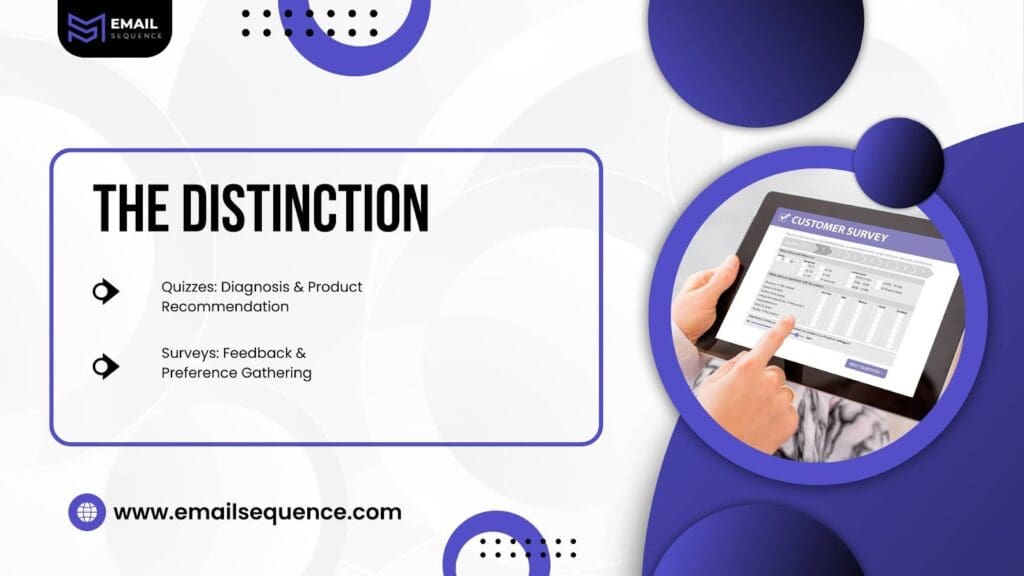
- Quizzes: Diagnosis & Product Recommendation. These are typically 3-7 questions long, are highly visual, and lead to a specific outcome with correct answers or smart recommendations, like a product recommendation. A classic example is a “What’s Your Fitness Goal?” quiz that guides users to the right workout plan or equipment, utilizing great features like adding videos and customizable themes.
- Surveys: Feedback & Preference Gathering. Surveys are shorter, often just 1-3 questions, designed for fast completion. They gather detailed information on user intent or satisfaction, enabling effortless forms that provide the right feedback. An example includes a simple net promoter score, Satmetrix systems-type poll asking, “How often do you want to hear from us?” This helps you respect inbox preferences, improve deliverability, and remain connected.
5 Top Secret Techniques & Advanced Strategies
Standard strategies yield standard results. To achieve extraordinary growth, you need to implement techniques that your competitors do not know.
These five secrets transform email quizzes and surveys from simple tools into a powerful revenue engine, helping you stay engaged, succeed, organize, and track progress.
The “Abandoned Cart” Quiz Alternative
Instead of sending another generic discount, use your own quiz in your second cart abandonment email.
Ask a targeted question: “Help us find the right fit! Did you leave because of [Size], [Color], or [Uncertainty]?” Use their answer to trigger a highly specific follow-up, such as a link to a different product or a guide that addresses their uncertainty, ensuring everyone’s voice is heard.
The Incomplete Reminder Flow
Many users start a quiz but do not finish. With unlimited surveys and the ability to easily export answers, do not let that response data go to waste. Create a segment of these users and automatically send a reminder email 12-24 hours later.
A straightforward way is a subject line like, “Just 2 questions left to get your recommendation!” highly effective at bringing them back to complete the process and allowing actions to visualize data for better tracing.
A/B Test by Completion Time
Stop A/B testing just your subject lines. Instead, test the psychological framing of the time commitment. Run a test comparing “30-Second Quiz” against “5-Question Quiz.”
You may find that one phrasing drives a significantly higher click-to-completion rate for your specific audience, boosting net promoter results.
The Post-Purchase Feedback Loop for LTV
Seven days after a product is delivered, send a one-question custom survey or net promoter score. Customers who rate their experience a 9 or 10 are automatically entered into a review request flow.
Those with a lower score are immediately flagged for a customer service follow-up. This strategy maximizes positive reviews while proactively solving issues, supporting payment management, and ensuring customer satisfaction.
The “Pre-Quiz” Segment
High-effort content like a quiz should not be wasted on unengaged subscribers. Before launching a quiz campaign, create a segment of users who have clicked at least one link in a previous email.
By focusing your efforts and using built-in AI, you ensure your quizzes and forms seamlessly reach your most engaged audience and make everyday tasks easier.
Why Email Quizzes & Surveys Are Crucial
Implementing these strategies is not just about a single campaign; it is about fundamentally improving your business. The benefits are clear, measurable, and long-lasting for both online learning and business bring.
- Drastic Increase in Conversions: Personalized product recommendations based on quiz results, including multiple choice and quiz type responses, can see click-through rates up to 50% higher than generic marketing links.
- Improved Deliverability: High-engagement content like quizzes signals value to ISPs, significantly improving your sender reputation and ensuring emails land in the inbox, helping fulfill everyday tasks.
- A Clearer LTV Path: By understanding customer motivation through ZPD, individual responses, and advanced analyses, you can tailor your nurturing sequence and increase long-term customer value.
- Reduced Return Rates: When you accurately diagnose a customer’s needs upfront using educational assets and market research, you guide them to the right product, minimizing buyer’s remorse and returns.
- Future-Proof Personalization: You own this data, whether collected from the free version or paid plans. ZPD makes your marketing strategy resilient to third-party cookie deprecation and ensures secure cloud storage.
- Reduced Unsubscribe Rates: When emails are personalized and helpful, using actions to visualize data and editable themes, they are perceived as a service, not an intrusion. This leads to happier subscribers and lower unsubscribe rates.
The Tactical Playbook: Email Quiz & Survey Strategies
Here are proven blueprints for integrating quizzes and surveys into your email marketing for better SEO and business growth.
| Strategy | Goal | Key Question Format | Optimal Timing |
| Welcome Flow Grab | Audience Segmentation | Multiple Choice (“Looking for X or Y?”) | Email #2 of Welcome Flow |
| Diagnostic Quiz | Product Recommendation | Image/Text Choice (Visual preference) | Regular Campaign or Nurture Flow |
| Post-Purchase Loop | Customer Service & Review | Single-question NPS/Likert Scale | 3-7 Days Post-Delivery |
| Re-Engagement | List Cleaning/Preference | Multiple Choice (“Yes, fewer emails”) | 90 Days No Open/Click |
Deployment: Tools, Design, and Best Practices
Successful execution depends on the right, easy-to-use tools and a smart approach to design with customizable themes and multilingual support.
Tools and Requirements
Choose an advanced quiz maker with great features and unlimited responses. Your technical setup should include:
- ESP Compatibility: Ensure compatibility with webhooks or APIs to instantly map ZPD to your profiles and allow individuals access to apps.
- Field Mapping: Essential for advanced features, mapping quiz output (e.g., “Result_Type=Budget_Buyer”) directly to your ESP and ensuring trace ID with real-time charts.
- Data Management: Utilize tools like Google Sheets, paid plans, and cloud storage to organize, compile, and easily export data for your educational asset or business.
Designing Effective Quizzes and Surveys

Take advantage of the no-code advantage and effortless forms. Use drag-and-drop builders for customization, adding videos, and branding with editable themes.
To maximize completion rates and encourage participation, quizzes should be under seven questions, surveys under three, and always support mobile use.
Best Practices for a Better Flow
- Provide an Instant Payoff: Effortless forms must deliver value with correct answers or instant recommendations, making everyday tasks easier.
- Mobile-First Design: Ensure all quizzes, surveys, and connected use forms work seamlessly on all devices.
- Test by CTR, not Open Rate: Always rely on Click-Through Rate and in-depth analysis for campaign improvements and skill level targeting.
Conclusion: Optimize Your Email Marketing Today
The era of mass marketing is over. Your highest-performing asset is the response data and insights from email quiz surveys that your subscribers willingly share. Leveraging advanced features, cloud storage, and customizable themes, you can track progress and make everyday tasks more efficient.
Do not let valuable ZPD slip away. Implement a proven email quizzes surveys strategy, like the Incomplete Reminder Flow, using easy-to-use tools such as Google Forms or your favorite apps today.
Start using real-time charts, unlimited surveys, and adjust your quizzes or surveys for better net promoter score and customer satisfaction. Begin now to see your business grow, ensure everyone’s voice is heard, and stay engaged all year long with an email sequence.
Frequently Asked Question
What is an email survey?
An email survey is a questionnaire sent via email to collect feedback, opinions, or data from recipients. It is often used for customer satisfaction, market research, or gathering preferences.
How to create a quiz to collect emails?
Use a quiz maker tool to design an engaging quiz with a clear value proposition (e.g., personalized results). Add an email capture form before showing the results to collect user emails.
What do you mean by mail survey?
A mail survey is a research method where questionnaires are sent to participants via postal mail or email to gather data or opinions.
What are the benefits of email surveys?
- Cost-effective and scalable
- Quick data collection
- Easy to analyze responses
- High reach and convenience for participants
- Enables personalized follow-ups
What are the advantages and disadvantages of mail surveys?
Advantages:
- Wide reach
- Cost-effective
- Respondents can answer at their convenience
Disadvantages:
- Lower response rates
- Delayed feedback (especially for postal mail)
- Limited engagement compared to interactive methods