Email Storytelling: Build Trust & Revenue with Narrative Sequences
Facts tell, but stories sell. Research suggests that people are 22 times more likely to remember a fact when it is wrapped in a story. This simple truth is the secret weapon behind the most profitable email lists.
While most marketers blast features and discount codes, smart brands use email storytelling to build deep, profitable relationships. A narrative sequence does not just open wallets; it captures hearts and minds, turning casual subscribers into lifelong advocates.
In this guide, you will find a compact framework for writing stories, four ready-to-use templates, a complete sequencing guide, and a testing checklist. By the end, you will have the tools to deploy narrative sequences that drive measurable revenue.
Why Stories Beat Features: The Psychology That Makes Emails Stick
Human brains are wired for narrative. When we hear a list of features or statistics, the language processing centers of our brain light up briefly. However, when we read a story, our brains experience “neural coupling.” We feel the emotions of the protagonist and simulate the experience as if it were happening to us.
This biological response is why story-driven email campaigns consistently outperform standard newsletters. Stories bypass the logical, skeptical part of the brain and speak directly to emotions.
The benefits extend beyond a single sale. Consistent storytelling builds familiarity. When subscribers see themselves in your stories, trust deepens. This trust leads to higher reply rates, improved deliverability (because inboxes prioritize conversations), and consistent open rates over time.
Consider this difference:
- Standard Subject Line: 20% Off Productivity Software.
- Result: Ignored by anyone not ready to buy today.
- Story Subject Line: How I reclaimed 10 hours a week (without working harder).
- Result: Curiosity triggered. Emotional connection made. Open rates soar.
The E-S.T.O.R.Y Framework | Simple Formula for Every Story Email
You do not need to be a novelist to write compelling emails. In fact, complex prose often hurts conversion. Effective email storytelling requires a simple, repeatable structure.
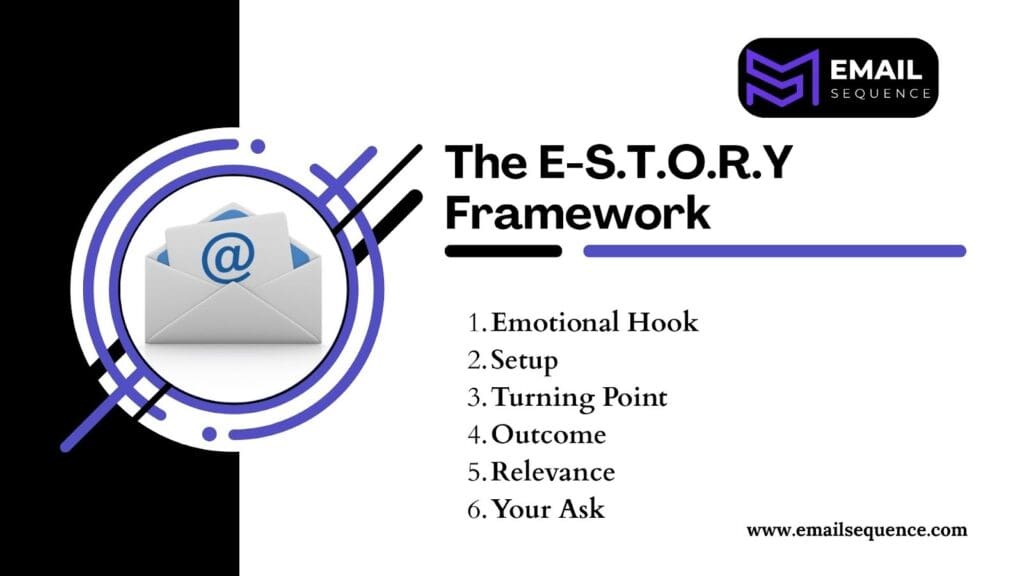
The E-S.T.O.R.Y framework ensures every email you send has a purpose and a punch. Use this formula to draft high-impact emails in minutes:
- Emotional Hook: Start with a feeling, a conflict, or a jarring statement that grabs attention immediately. Your opening line is everything. It must cut through the noise of a crowded inbox and create an immediate emotional connection or spark intense curiosity.
- Setup: Briefly establish the context or the “before” state without dragging on. This is where you paint a picture of the problem or the status quo. Keep it concise, focusing only on the details needed to make the turning point impactful.
- Turning Point: Introduce the moment of change, the realization, or the discovery. It’s the core insight you want to share with your reader.
- Outcome: Show the specific, tangible result or the “after” state. Vague promises don’t sell. Clearly demonstrate the transformation that occurred because of the turning point, using data or a clear visual if possible.
- Relevance: Connect the story back to the reader’s current struggle. This is the critical step where you make the story about them, not just about you. Show them that you understand their pain point and that your experience is relevant to their situation.
- Your Ask: Transition smoothly from the story’s lesson to the Call to Action (CTA). Don’t just tack on a button at the end. Your CTA should feel like the natural next step for the reader, offering them a way to achieve the same outcome you just described.
Pacing matters. A “micro-story” can be as short as three sentences, perfect for daily emails. A “mini-case” might run 300 words, ideal for weekly newsletters. Regardless of length, the E-S.T.O.R.Y structure remains the same.
Sequence Design: Where to Use Stories in the Email Funnel (Welcome → Nurture → Sell → Re-engage)
One story is powerful, but a chain of connected stories is unstoppable. Email storytelling uses narrative sequences to create momentum, drawing readers in. They compel the audience to open the next email to find out what happens next, much like binge-watching a television series.
Different stages of the customer journey require different narrative goals. Here is how to map your stories across the funnel:
1. Welcome Sequence (Goal: Build Origin + Promise)
The welcome series is your first impression, setting the tone for your relationship with your audience. Your goal here is to establish who you are, why you matter, and how you can solve their problems.
Start by introducing your brand’s mission and values, and follow up with useful resources or tips that immediately provide value.
- Cadence: Daily for the first 3 days.
- Primary KPI: Reply rate (to boost sender reputation).
- Story Theme 1: The “Why I Started” story (Vulnerability).
- Story Theme 2: The “Big Mission” story (Shared Values).
2. Nurture Sequence (Goal: Deepening Trust)
Once they know you, you must prove you understand them. Show empathy by addressing their pain points and acknowledging their challenges. Narrative sequences here should focus on validation and education through entertainment.
- Cadence: Weekly or bi-weekly.
- Primary KPI: Click-through rate.
- Story Theme 1: Customer micro-moments (Relatable struggles).
- Story Theme 2: Behind-the-scenes (Transparency).
3. Sales Sequence (Goal: Transformations That Justify Purchase)
Now you pivot to the solution. Clearly identify how your product directly addresses their pain points and makes their life easier. Showcase success stories or examples of real customers who have benefited from your solution.
Highlight unique features or results that set your product apart, ensuring the reader understands the tangible value it brings.
- Cadence: Daily during a launch or promotion.
- Primary KPI: Conversion rate.
- Story Theme 1: The “Hit Rock Bottom” story (Agitation).
- Story Theme 2: The “Glory of Success” story (Social Proof).
4. Re-engage Sequence (Goal: Curiosity / Loss Aversion)
When subscribers go cold, logic alone won’t win them back; you need to spark emotion and curiosity. Re-engage them with personalized content that resonates on a deeper level. Use storytelling to remind them why they subscribed in the first place, and create a sense of urgency with exclusive offers or updates.
- Cadence: 2-3 emails over one week.
- Primary KPI: Reactivation (click or reply).
- Story Theme 1: The “We Miss You” story (Personal connection).
- Story Theme 2: The “Look What Changed” status update.
4 Story Types That Convert (and When to Use Each)
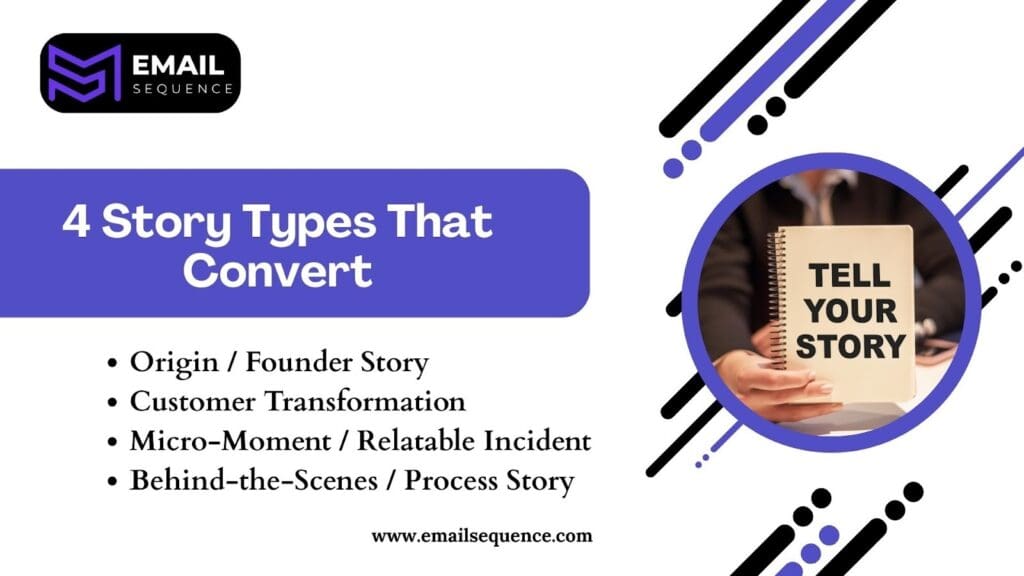
To master email storytelling, it’s important to understand that not all stories serve the same purpose. To maintain an emotional connection without becoming repetitive, rotate through these four core archetypes.
Here is a breakdown of the four essential story types and when to deploy them:
- Origin / Founder Story: Use this to establish brand storytelling and core values early in the relationship. This narrative connects customers to the “why” behind your brand, humanizing your business and fostering loyalty from the outset.
- Template: “I started [Company] because I was tired of [Problem].”
- Customer Transformation: Use this for sales and social proof to show that results are attainable. Highlighting a customer’s success provides tangible evidence of your product’s value and helps prospects visualize their own potential achievements.
- Template: “[Customer Name] went from [Pain Point] to [Goal] in [Timeframe].”
- Micro-Moment / Relatable Incident: Use this for nurturing to spark quick empathy and clicks. These short, everyday anecdotes make your brand feel more personal and approachable, strengthening the emotional connection with your audience.
- Template: “I spilled coffee on my laptop today, and it taught me something about resilience.”
- Behind-the-Scenes / Process Story: Use this to demonstrate transparency and build authority. Showing your audience how things are made, including the challenges and mistakes, builds trust and positions you as an expert in your field.
- Template: “Here is exactly how we built this feature (mistakes included).”
3 Ready-to-Send Story Email Templates
Theory is helpful, but execution is what drives revenue. Below are four complete templates using the frameworks discussed. These story-driven email drafts showcase the power of email storytelling, and you can adapt them to fit your specific niche immediately.
Template 1: Welcome Sequence (Founder Origin)
Subject: I almost quit…
Preview: The real reason I started this journey.
Hi [Name],
Three years ago, I was sitting at my kitchen table, staring at a bank balance that made my stomach turn. I had a great product, but nobody knew about it. I felt like a failure.
I almost went back to my corporate job that day.
But then I made one small shift. I stopped trying to be “professional” and started being real. I shared my struggles openly.
Suddenly, people started listening.
That is why I built [Brand Name]. We are not just about [Product]; we are about helping you navigate the messy middle of [Industry].
I am glad you are here.
Best,
[Your Name]
CTA: Reply and tell me—what is your biggest hurdle right now?
Template 2: Nurture Sequence (Customer Transformation)
Subject: Sarah was skeptical (until Tuesday)
Preview: How one user changed everything in 24 hours.
Hi [Name],
Sarah told us flat out: “I do not think this will work for me.”
She had tried [Competitor Solution] and [Alternative Method]. Nothing stuck. She was frustrated and ready to accept that [Problem] was just part of her life.
We asked her to give us just three days.
On day one, she felt a difference. On day two, she saw results.
By Tuesday—day three—she sent us this email: “I cannot believe I waited this long. The problem is gone.”
You do not have to live with [Problem] forever.
CTA: [Link] Read Sarah’s full story here.
Best,
[Your Name]
Template 3: Sales Sequence (Problem → Turning Point)
Subject: The cost of doing nothing
Preview: Is it worth the risk?
Hi [Name],
We often worry about the cost of buying a solution. But what is the cost of staying exactly where you are?
Imagine it is one year from today.
You have not changed anything. You are still dealing with [Pain Point]. You are still losing time on [Task]. You are still feeling that same frustration you feel right now.
Is that acceptable?
It does not have to be that way. You can choose a different path today.
Join [Product Name] and start your transformation.
CTA: [Link] Yes, I am ready to change.
Best,
[Your Name]
Measure, Test, Iterate: How to Know a Story Works
You cannot improve what you do not measure. While stories feel qualitative, their impact is quantitative. You must track specific metrics to understand if your narrative sequences are performing.
Focus on these key performance indicators (KPIs) to judge success:
- Reply Rate: This is the primary metric for connection. Good stories provoke conversation.
- Click-to-Conversion: Do the people who click actually buy? High clicks with low sales might mean the story was good, but the product alignment was off.
- Time-on-Site: When users click through from a story email, do they stay? This indicates the narrative hooked them effectively.
To optimize, run A/B tests on your narrative elements. Test a “Story Subject Line” (curiosity-based) against a “Direct Subject Line” (benefit-based). Often, the direct line gets fewer opens but higher clicks, while the story line gets massive opens and builds long-term brand equity.
Quick Checklist: Ship Your First Story Sequence in 7 Steps
Ready to launch? Do not overthink it. Follow this checklist to get your first narrative sequence out the door:
- Pick Your Story: Choose one specific incident that illustrates a core belief or customer win.
- Map the Sequence: Decide if this is for welcome, nurture, or sales.
- Write E-S.T.O.R.Y Draft: Use the framework to write the first draft quickly.
- Add Value: Ensure the story transitions to a helpful lesson or offer.
- Insert Personalization: Add [Name] and dynamic relevance lines.
- QA Test: Send a test email to yourself to check formatting on mobile.
- Send Pilot: Send to a small segment first, measure, and then roll out.
Conclusion
Storytelling in email sequences is a powerful way to stand out in crowded inboxes and turn marketing into a two-way relationship. By using the E-S.T.O.R.Y framework, you can create emotionally engaging emails that build trust and strengthen connections with your audience.
By mastering email storytelling, your brand can foster loyalty while driving sustainable revenue growth. The blog introduces a 4-template pack designed to help you craft compelling story-based emails tailored to your brand’s voice.
With these tips, you can start creating impactful email sequences that resonate with your audience and inspire action. Ready to transform your email marketing? Visit emailsequence.com to learn more and start crafting your first story email today!
Frequently Asked Questions
What is email storytelling?
Email storytelling is the practice of using narrative sequences in emails to connect emotionally with subscribers, making your messages memorable, relatable, and persuasive.
Why should I use stories instead of features in emails?
Stories engage the brain emotionally, creating stronger recall and trust. Unlike feature-focused emails, story-driven emails build relationships and increase open, click, and conversion rates over time.
What is the E-S.T.O.R.Y framework?
E-S.T.O.R.Y is a simple email storytelling formula:
- E: Emotional Hook
- S: Setup
- T: Turning Point
- O: Outcome
- R: Relevance
- Y: Your Ask (CTA)
How do I structure story emails across the funnel?
Use different sequences for each stage:
- Welcome: Build origin and mission connection.
- Nurture: Deepen trust through relatable incidents.
- Sales: Highlight transformations and success stories.
- Re-engage: Spark curiosity and regain inactive subscribers.
Are story emails suitable for all industries?
Yes. Any brand can use stories to humanize communication, demonstrate value, and build emotional connection, whether B2B or B2C.