Spam Filter Avoidance: Technical and Content Strategies
Email marketing remains a powerful channel for business growth, yet reaching the inbox is increasingly difficult. Modern filters use complex algorithms that analyze thousands of signals before deciding if an email is worthy of a recipient’s attention. If you ignore current deliverability best practices, your carefully crafted messages will likely disappear into the spam folder.
Successful spam filter avoidance requires more than just luck or writing good copy. It demands a sophisticated understanding of how Internet Service Providers (ISPs) evaluate trust. You must navigate a dual landscape that combines rigorous technical authentication with high-quality content strategies.
This guide explores the essential components of reaching the inbox. We will move beyond simple advice and examine the mechanics of spam triggers, ensuring your infrastructure and your message align to bypass the filters.
What Is Spam Filter Avoidance?
Spam filter avoidance is the strategic practice of configuring email infrastructure and crafting content to ensure messages bypass ISP filtering systems and land in the primary inbox. It is a proactive system, not a reactive fix.
Traditional advice often suggests that you simply avoid using words like “free” or “buy now.” While this helps, it is no longer sufficient. Modern filters look at who you are, how you authenticated your server, and how previous recipients engaged with your mail.
To succeed, you must adopt a holistic approach. You need technical precision to prove your identity and content strategies that engage humans rather than trigger bots. This article will guide you through the necessary steps to master spam filter avoidance.
How Modern Spam Filters Work?
Understanding the enemy is the first step to victory. Many marketers list filters but fail to explain the scoring logic behind them.
Most modern ISPs utilize Bayesian filtering and AI inference. This means the filter learns from past data. If users frequently mark your emails as spam, the AI learns to block future messages that look similar or come from your IP address.
The filters scan your content and your headers simultaneously. They analyze the code structure, link destinations, and text-to-image ratios. However, they also weigh engagement signals heavily.
- Positive Signals: Opens, replies, moving emails to folders, and adding the sender to contacts.
- Negative Signals: Deleting without opening, marking as spam, or ignoring messages entirely.
The filter assigns a sender reputation score based on these inputs. If your score drops below a certain threshold, your email goes to spam, regardless of how clean your content is.
Technical Foundations for Spam Filter Avoidance
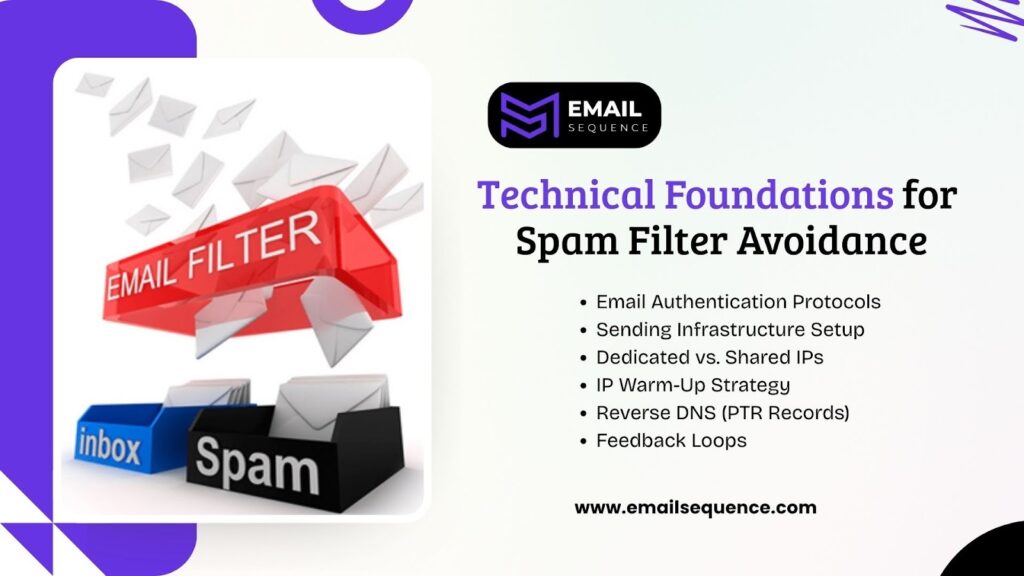
You cannot write your way out of a technical problem. Without a solid technical foundation, even the best content will fail. This section covers the critical infrastructure requirements for authentication protocols and server setup.
Authentication Protocols
Authentication acts as a digital ID card for your emails. It tells the receiving server that you are who you say you are. If these authentication protocols are missing or misconfigured, ISPs will assume you are a spoofer.
Three primary protocols work together to secure your delivery:
- SPF (Sender Policy Framework): This is a DNS record that lists the IP addresses authorized to send email on behalf of your domain. It prevents unauthorized servers from sending mail as you.
- DKIM (DomainKeys Identified Mail): This adds a digital signature to your emails. It verifies that the message was not altered in transit between the sending and receiving servers.
- DMARC: This leverages SPF and DKIM. It gives instructions to the receiving server on what to do if an email fails authentication (e.g., reject it or quarantine it).
A misconfiguration in any of these creates an immediate spam flag. You must ensure your DNS records are accurate and up to date.
Sending Infrastructure
High-volume senders must consider their underlying infrastructure carefully. Your IP address plays a massive role in whether you reach the inbox. Maintaining a dedicated IP with a strong sending reputation is crucial, as ISPs monitor email behavior closely.
- Dedicated vs. Shared IPs: A dedicated IP gives you total control over your reputation, while a shared IP means you share reputation risks with other senders.
- Warm-up Sequences: You cannot send 100,000 emails on day one from a new IP. You must slowly increase volume to establish trust.
- Reverse DNS (PTR Records): This verifies that the IP address matches the domain name, adding another layer of trust.
Feedback loops are also essential. They allow ISPs to report complaints back to you so you can remove dissatisfied users immediately.
Engagement Tracking & Metrics
High engagement is the ultimate antidote to spam filtering. ISPs and mailbox providers want to deliver content their users find valuable, and engagement is their primary measure of value.
Their filters track how users interact with your emails to determine if they are wanted. Think of every positive interaction—an open, a click, a reply, or a forward—as a vote in your favor, telling spam filters that your content belongs in the inbox.
To stay out of the spam folder, you must monitor the same engagement signals that mailbox providers use to filter and prioritize emails:
- Open Rates: Consistently low open rates indicate irrelevance.
- Reply Patterns: Replies are a strong positive signal of genuine conversation.
- Forwarding: This indicates a high value.
- Quick Deletes: Deleting an email immediately after opening (or without opening) signals low value.
If your engagement metrics fall below industry benchmarks, your spam placement will rise.
Content-Level Spam Filter Avoidance Strategies
Once your technical house is in order, you must optimize your content. Content filtering algorithms are sophisticated, but they follow predictable rules.
Craft Spam-Filter-Friendly Subject Lines
Your subject line is the first thing both the user and the filter see. Aggressive sales language triggers filters and annoys users.
You should avoid:
- Trigger Words: Words that imply manipulation or scams.
- All Caps: WRITING LIKE THIS IS A RED FLAG.
- Excessive Punctuation: Avoid multiple exclamation marks!!!.
Instead, focus on value and neutrality.
| Trigger Word | Best Alternative |
| FREE!!! | Exclusive Offer |
| BUY NOW | Learn More |
| RISK-FREE | Satisfaction Guaranteed |
| CLICK HERE | Visit Our Site |
The Role of Email Headers
Email headers contain metadata that users often ignore but filters scrutinize.
Ensure your “From” name is consistent and recognizable. Changing it frequently confuses algorithms. Furthermore, the “Reply-to” address should match the sending email domain. If you send from “brand.com” but ask for replies to “gmail.com,” it looks suspicious.
Email Body & Formatting
The structure of your email body matters as much as the text itself. Well-organized code ensures your email is displayed correctly across devices and email clients, improving readability and user experience.
Messy code, on the other hand, can trigger spam filters or make your email look unprofessional, reducing engagement and trust with your audience.
You should adhere to clean coding standards:
- Minimalist HTML: Avoid heavy CSS or scripts that can trigger security warnings.
- Image-to-Text Ratio: Do not send an email that is just one large image. Spammers use this to hide text. Aim for a healthy balance of 60% text and 40% images.
- Alt Text: Always include alt text for images to help accessibility and context scanning.
Improper use of content filtering elements like “invisible” text (white text on a white background) will guarantee a block.
Link & URL Best Practices
Links are a major vector for malware and phishing attempts, so email filters examine them closely. Suspicious links can damage your sender’s reputation and cause your emails to land in the spam folder. It’s crucial to ensure every URL you include is trustworthy and transparent to both filters and recipients.
- Avoid Shorteners: Public shorteners (like bit.ly) are often abused by spammers and are frequently blocklisted.
- Use Trusted Domains: Link only to reputable sites.
- HTTPS Everywhere: Ensure all links point to secure (HTTPS) pages.
Reputation Management: A Preventive Framework
Your sender reputation is your credit score in the email world. Reputation management involves monitoring and maintaining this score over time.
Sender Reputation Score
ISPs and third-party organizations calculate your reputation score based on volume, complaint rates, and trap hits.
Dashboards like Google Postmaster Tools provide visibility into how Gmail views your domain. If your reputation drops to “Low” or “Bad,” your spam filter avoidance efforts will fail regardless of your content quality.
Complaint & Bounce Handling
Processing feedback loops and bounces instantly is crucial for maintaining the health of your email campaigns. It helps you identify invalid or unengaged email addresses, ensuring your sender reputation remains strong.
Acting quickly on this data allows you to reduce bounce rates, improve deliverability, and increase engagement with your target audience.
- Hard Bounces: The address is invalid. Remove it immediately.
- Soft Bounces: The inbox is full or temporarily unavailable. Retrying is acceptable, but remove chronic soft bounces.
- Complaints: If a user marks you as spam, you must unsubscribe them. Continuing to email them is a violation of best practices.
List Hygiene & Engagement Segmentation
A clean list is a profitable list. Keeping inactive subscribers drags down your engagement metrics.
You should implement policies to remove unengaged users. If a subscriber has not opened an email in 6 months, place them in a re-engagement campaign. If they still do not engage, remove them. This protects your reputation.
Testing, Monitoring & Ongoing Optimization
You cannot set up your email system once and forget it. Deliverability requires constant vigilance. Regularly monitor your bounce rates, maintain a clean email list, and ensure your content complies with spam regulations.
Pre-Send Spam Testing
Before you broadcast to your entire list, test your email against known filters.
Tools like Litmus or Email on Acid can predict how different ISPs will treat your message. They scan for code errors, broken links, and authentication failures. Aim for a passing score across all major providers.
Post-Send Analytics
Analyzing your email performance doesn’t stop at open rates. Digging deeper can reveal critical insights about the health of your email campaigns and pinpoint areas for improvement. Here’s what to watch for:
- Bounce rate: A sudden increase in bounces may signal a data quality issue, such as outdated email addresses or invalid contacts.
- Complaint rate: A spike in complaints typically highlights a content relevance problem, indicating your messaging might not be resonating with your audience.
Troubleshooting Common Spam Filter Issues
When problems arise, use logic to identify the root cause.
| Issue | Likely Cause | Fix | Prevention Strategy |
|---|---|---|---|
| High complaint rate | Misaligned audience expectations | Segment list + Re-confirm opt-in | Set clear expectations at signup + Use double opt-in |
| Excess bounces | Old, inactive, or purchased list | Clean list + Remove hard bounce addresses | Regular list hygiene + Avoid buying lists |
| Spam folder placement | Trigger-heavy content + Low sender reputation | Revise content + Test SPF, DKIM, DMARC authentication | Warm up domain + Maintain engagement consistency |
| Low open rates | Weak subject lines or subscriber fatigue | A/B test subject lines + Reduce frequency | Rotate content types + Suppress inactive users |
| Low click-through rate (CTR) | Irrelevant content or weak CTA | Improve personalization + Stronger call-to-action | Behavioral segmentation + Clear value proposition |
| Sudden drop in deliverability | IP/domain reputation damage | Pause campaigns + Run reputation audit | Gradual volume scaling + Monitor sender score |
| Emails clipped (Gmail) | Message exceeds 102KB size | Reduce email length + Optimize code | Streamline template + Remove excess HTML |
| High unsubscribe rate | Over-emailing or too promotional | Adjust frequency + Add value-first emails | Frequency testing + 80/20 value-to-promo ratio |
| Blocked by corporate filters | Suspicious attachments or formatting | Remove attachments + Simplify design | Use hosted links instead of attachments |
| Low inbox placement on new domain | No sender history | Implement domain warm-up sequence | Start with engaged segment + Increase volume gradually |
Conclusion
Reaching the inbox is a privilege, not a right. To maintain that privilege, you must respect the ecosystem. Effective spam filter avoidance is not a single trick; it is a comprehensive system that marries rigid technical standards with empathetic content creation.
By maintaining your reputation management processes and adhering to strict content filtering standards, you build a sustainable email program. Do not view these steps as obstacles. View them as quality control measures that ensure your audience receives the value they signed up for.
Test your infrastructure, monitor your metrics, and optimize your content continuously. This commitment to quality is the only way to guarantee your message is heard.
Frequently Asked Questions
What is spam filter avoidance?
Spam filter avoidance is the set of technical and creative strategies used to ensure emails bypass ISP filters and land in the recipient’s primary inbox.
Are there universal trigger words to avoid?
While no single word guarantees a block, aggressive sales terms like “Cash,” “Free!!!,” and “Urgent” increase your spam score. Context matters more than individual words.
Do images cause spam flags?
Images alone do not cause flags, but sending image-only emails does. Filters cannot read text inside images easily, so they assume you are hiding content.
How often should I review delivery metrics?
You should review high-level metrics after every campaign. Conduct a deep dive into reputation and infrastructure health monthly.
Does personalization impact spam scoring?
Yes, positively. Personalized emails generally receive higher engagement, which signals to filters that the content is relevant and trusted.