Cold Email Strategy Guide: Unveiling the Art of Cold Emailing – An Expert’s Insights
What is Cold Email?
Cold email marketing is a powerful direct marketing tactic where a message is sent to a prospect with whom you have no prior relationship. Unlike spam, which often feels intrusive and irrelevant, a cold email is crafted with a legitimate business purpose, aiming to provide value through relevant proposals to highly targeted prospects. It’s about creating a meaningful connection, not just blasting out generic messages.

A well-crafted cold email can be a powerful tool for generating leads, building relationships, and closing deals. The secret lies in personalization and research—understanding your prospect’s challenges and tailoring your message to address their specific needs. To start, tools like Hunter.io and FindThatLead can help you find accurate email addresses, while platforms like HubSpot and Mailshake can streamline your outreach process.
But if you’re looking for the next level of efficiency and results, I highly recommend Emailsequence.com. It offers a smarter, more streamlined approach to email outreach that truly stands out from the competition.
To make your cold emails effective, focus on crafting a compelling subject line and a concise, benefit-driven message. Avoid generic approaches like “We want to work with you!” Instead, address a specific challenge your recipient is facing and offer a tailored solution. By providing value upfront, cold emails can become a strategic tool to build professional relationships and drive meaningful growth.
Want to dive deeper into about cold email services see: The Best Email Marketing Services of 2025
What Exactly is a Cold Email?
A cold email is an unsolicited message sent to a contact with whom the sender has no prior relationship or interaction. Unlike spam, cold emails are usually targeted and personalized, aiming to establish a meaningful connection. They are commonly used in business for purposes such as introducing a product or service, generating leads, networking, or initiating partnerships. These emails are crafted to present a relevant offer, provide value, or spark interest in a way that encourages the recipient to respond or engage further. When done effectively, cold emails can be a powerful tool for building relationships and opening new opportunities.
The Continued Relevance of Cold Emails

The question many ask is: “Do cold emails work anymore?” The answer is a resounding, YES—and there’s data to back it up. According to a study by Woodpecker, cold emails have an average open rate of 16-20% and a reply rate of 8-10%. When done correctly, cold emailing can lead to meaningful conversations, sales, and long-term partnerships.
Launching your first cold email campaign is crucial for ensuring better outreach and response rates. By creating a prospect list, setting email limits, and including follow-ups, you can enhance the effectiveness of your campaign.
I’ve seen firsthand how businesses can transform with a well-executed cold email strategy. Here are two examples:
- SaaS Platform Success
- Challenge: Struggling to break into a new market.
- Solution: Launched a cold email campaign targeting key decision-makers with tailored messaging.
- Results:
- Secured 15 demo calls in the first month.
- Closed 3 high-value deals worth $150,000 in annual revenue.
- Key Tactic: Hyper-personalization and addressing industry-specific pain points.
- Digital Marketing Agency Growth
- Challenge: A small agency needed to scale.
- Solution: Identified niche businesses, crafted value-driven emails, and followed up consistently.
- Results: Doubled their client base in just six months.
Why Do Cold Emails Work?
Cold emails are effective because they rely on direct and personalized communication. The key to success is relevance.
Stat to Know: Emails with personalized subject lines are 26% more likely to be opened (Source: Campaign Monitor).
How to Personalize Your Cold Emails:
Use data to tailor your outreach, such as:
- LinkedIn profiles
- Company achievements
- Recent industry news
By showing recipients that your email isn’t just another generic pitch, you can significantly boost engagement. Cold emails aren’t just about sending messages—they’re about starting meaningful conversations.
Of course, it’s not just about sending emails—it’s about creating value. When you approach cold emails as a way to solve problems rather than push products, the results often speak for themselves. While some may write off cold emails as outdated, my experience and the stats say otherwise: with the right strategy, cold emails are a powerful tool for driving business growth.
Is Cold Emailing Spam?
Cold emailing is often misunderstood as spam, but it’s not the same thing. Spam refers to unsolicited commercial emails sent in bulk to a large number of recipients, often with the intention of deceiving or misleading them. Cold emailing, on the other hand, is a targeted and personalized approach to reaching out to potential customers or clients who may be interested in your product or service.
While cold emailing can be considered a form of unsolicited email, it’s not necessarily spam. Cold emailing is typically done with the intention of starting a conversation or building a relationship with the recipient, rather than trying to deceive or manipulate them. However, it’s essential to ensure that your cold emailing efforts comply with anti-spam laws and regulations, such as the CAN-SPAM Act in the United States.
To avoid your cold emails being perceived as spam, focus on personalization and relevance. Tailor your message to address the recipient’s specific pain points and offer a solution that provides genuine value. Additionally, always include an option for recipients to opt-out of future emails, and respect their preferences if they choose to do so. By adhering to these best practices, you can ensure that your cold emailing efforts are both effective and compliant with legal requirements.
Warm Emails vs. Cold Emails: The Key Differences
The difference between a warm email and a cold email boils down to your relationship with the recipient. Here’s a breakdown:
Cold Emails:
These are sent to individuals with whom you have no prior interaction or relationship. The recipient may not recognize your name or company, which makes crafting the message particularly important. Success with cold emails often hinges on personalization and value. Compared to cold calling, cold emails are less obtrusive and easier to scale, though they risk being ignored. Cold calls, on the other hand, allow for a more personal interaction but can be more intrusive.
- Example: Reaching out to a potential client or business partner you’ve never interacted with before.
- Expert Tip: “In my experience, cold emails work best when they are highly personalized and demonstrate clear value upfront. A generic sales pitch often ends up ignored.”
- Research: According to a study by Yesware, cold emails with personalized subject lines are 26% more likely to be opened.
Warm Emails:
These are sent to people with whom you’ve had some prior interaction or connection. This could be through networking events, mutual connections, or even previous business dealings. Warm emails usually feel more natural and tend to have a higher response rate.
- Example: Following up with someone you met at a conference or reaching out to a referral.
- Expert Tip: “I’ve found that warm emails are most effective when they reference the previous touchpoint. For instance, mentioning a specific conversation or shared contact builds trust and adds context.”
- Research: A HubSpot report highlights that warm emails have an average open rate of 45%, compared to 15% for cold emails.
Quick Tips for Success:
- Cold Emails: Focus on personalization, clarity, and offering immediate value.
- Warm Emails: Reference your prior interaction or mutual connection to build trust.
- Both: Keep the message concise and end with a clear call-to-action.
Mastering both cold and warm emails is essential for building relationships and growing your network effectively. Always prioritize quality over quantity to ensure your outreach feels genuine.
Types of Cold Email Campaigns
There are several types of cold email campaigns that businesses can use to achieve their marketing goals. Each type serves a specific purpose and requires a tailored approach to maximize effectiveness. Here are some common types of cold email campaigns:
- Lead Generation Campaigns: These campaigns aim to generate new leads for a business by sending targeted emails to potential customers. The goal is to identify and engage prospects who may be interested in your product or service, ultimately converting them into leads.
- Sales Campaigns: These campaigns focus on converting leads into paying customers. By sending personalized emails that highlight the benefits of your product or service, you can persuade prospects to make a purchase. Sales campaigns often include follow-up emails to nurture leads and address any objections they may have.
- Networking Campaigns: Networking campaigns aim to build relationships with potential partners, investors, or collaborators. These emails introduce your business and its offerings, seeking to establish a connection that could lead to mutually beneficial opportunities.
- Brand Awareness Campaigns: These campaigns aim to increase brand awareness and establish your business as a thought leader in its industry. By sending targeted emails that share valuable content or insights, you can position your brand as a trusted resource and attract a wider audience.
Each type of cold email campaign requires a strategic approach to ensure success. By understanding the specific goals and tailoring your messages accordingly, you can maximize the impact of your cold email outreach efforts.
The 10-Step Method for Cold Emailing That Works
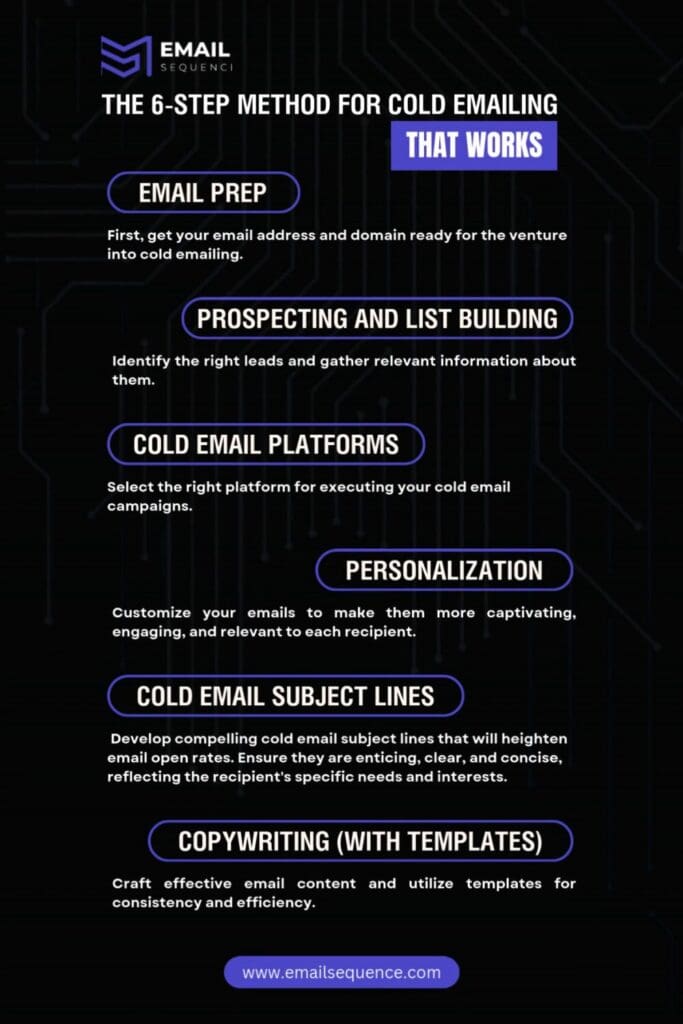
Here, I’ll share a proven 10-step method for cold emailing that generates results:
- Email Prep: First, get your email address and domain ready for the venture into cold emailing.
- Prospecting and List Building: Identify the right leads and gather relevant information about them.
- Cold Email Platforms: Select the right platform for executing your cold email campaigns.
- Personalization: Customize your emails to make them more captivating, engaging, and relevant to each recipient.
- Cold Email Subject Lines: Develop compelling cold email subject lines that will heighten email open rates. Ensure they are enticing, clear, and concise, reflecting the recipient’s specific needs and interests.
- Copywriting (with Templates): Craft effective email content and utilize templates for consistency and efficiency.
- Scheduling: Dispatch your emails at the most opportune times for maximum impact.
- Simulating One-on-One Emails: Strive to make your cold emails feel highly personalized and individually tailored.
- Automated Follow-ups: Implement automated follow-up emails to bolster your response rates.
- AI Automation: Leverage AI tools to generate, optimize, and personalize email content at scale, saving time while boosting effectiveness.
FAQ: Dispelling Myths and Uncertainties Around Cold Emailing
Is Cold Emailing Illegal?
Contrary to popular belief, cold emailing is perfectly legal provided that it’s done correctly and in compliance with anti-spam regulations.
What are Examples of Cold Emails?
Cold outreach is a crucial strategy for initial contact with potential clients, aiming to build relationships and generate leads. Cold emails cover a variety of purposes, such as building connections, generating leads, or starting conversations with potential clients. They can be tailored for different goals, including:
- Sales emails: Designed to introduce your product or service to potential customers.
- Networking emails: Used to connect with professionals in your industry or expand your network.
- Outreach emails: Targeted towards potential clients, collaborators, or influencers to establish partnerships or promote your work.
Below, we’ve provided specific examples and templates for each type of cold email to help you craft effective messages that resonate with your audience.
What is the 30/30/50 Rule for Cold Emails?
The 30/30/50 rule is a productivity guideline designed to improve the effectiveness of your outreach efforts, especially in sales, networking, or email communication. This rule suggests dividing your time strategically:
- 30% on researching your contact: Spend the first portion of your time understanding who you’re reaching out to. This could involve looking up their LinkedIn profile, reading about their role, company, or industry, and identifying any shared connections or interests. Thorough research helps you personalize your message and establish a stronger connection.
- 30% on writing the email: Crafting a compelling and targeted email is crucial. Use the information from your research to personalize your message, clearly state the purpose of your outreach, and include a strong call-to-action. Avoid generic templates—focused and tailored communication leads to better results.
- 50% on follow-ups: Consistent follow-ups can make or break your outreach. Statistics show that 80% of successful deals require at least five follow-ups, so staying persistent while being respectful is key. This step involves tracking your interactions, writing polite reminders, and reiterating your value. CRMs like HubSpot can help you streamline this process.
By following the 30/30/50 rule, you can ensure that your time is used effectively to build meaningful relationships and increase your chances of success in outreach efforts.
Crafting Effective Cold Emails

Crafting effective cold emails requires a combination of art and science. Here are some tips to help you write cold emails that get results:
Writing a Compelling Subject Line
Your subject line is the first thing that recipients will see when they receive your email. It’s essential to make a good impression by writing a compelling subject line that grabs their attention. Here are some tips to help you write a compelling subject line:
- Keep it short and sweet: Aim for a subject line that’s no longer than 5-7 words. Shorter subject lines are more likely to be read and can make a stronger impact.
- Make it relevant: Use keywords that are relevant to the content of your email. This helps the recipient understand the purpose of your email at a glance.
- Make it personalized: Use the recipient’s name or company name to make the subject line more personalized. Personalization can increase open rates and make your email stand out.
- Avoid spam triggers: Avoid using words or phrases that are commonly associated with spam, such as “free” or “limited time offer.” These can trigger spam filters and reduce your email’s deliverability.
Copywriting Strategies
Your email copy should be clear, concise, and compelling. Here are some copywriting strategies to help you write effective cold emails:
- Use a conversational tone: Write in a friendly and approachable tone that makes the recipient feel like they’re reading an email from a real person. This can help build rapport and make your message more engaging.
- Focus on benefits: Instead of listing features or specs, focus on the benefits that your product or service can provide to the recipient. Highlight how your offering can solve their specific pain points or improve their situation.
- Use social proof: Use customer testimonials, case studies, or other forms of social proof to demonstrate the value of your product or service. This can build credibility and make your message more persuasive.
- Use a clear call-to-action: Make it clear what you want the recipient to do next, whether it’s scheduling a meeting or signing up for a free trial. A strong call-to-action can guide the recipient towards taking the desired action.
By following these tips and strategies, you can craft cold emails that capture attention, provide value, and drive meaningful engagement.
Templates for Cold Emails
Cold email templates vary widely depending on their purpose. Whether you’re reaching out to establish a connection, introduce a product, schedule a demo, or promote a specific service, tailoring your email to the context is critical. Research shows that personalized, concise, and value-driven emails tend to yield better responses. Below, we’ll break down common types of cold emails and best practices for each, along with useful resources to help you craft effective messages.
Common Types of Cold Emails:
- Basic Outreach Emails:
These are introductory emails to establish a connection or pitch an idea. Cold emails are a form of unsolicited emails, typically sent to spark interest and encourage the recipient to reply. The goal is usually to spark interest and encourage the recipient to reply.
- Tip: Use a personalized subject line and reference something specific about the recipient (e.g., their company, recent accomplishments, or shared interests).
- Example Resource: Guide to Writing Personalized Outreach Emails (HubSpot))
- Networking Emails:
Ideal for building professional relationships, such as connecting with industry leaders or seeking mentorship.
- Tip: Focus on mutual benefits and be clear about what you’re asking for (e.g., a meeting, advice, or collaboration).
- Example Resource: 21 Networking Email Templates That Work (Indeed))
- Demo or Product Introduction Emails:
Designed to showcase your product or service and entice the recipient to schedule a demo or learn more.
- Tip: Highlight the unique value your product offers and make scheduling easy by including a direct link to a calendar tool like Calendly.
- Example Resource: The Anatomy of a Great Product Demo Email (SalesLoft))
- Service-Specific Emails:
These emails focus on promoting specialized services tailored to the recipient’s industry or needs.
- Tip: Provide concrete examples or case studies that demonstrate the success of your offering in similar scenarios.
- Example Resource: How to Write Service-Specific Emails (CoSchedule))
Best Practices for Writing Cold Emails:
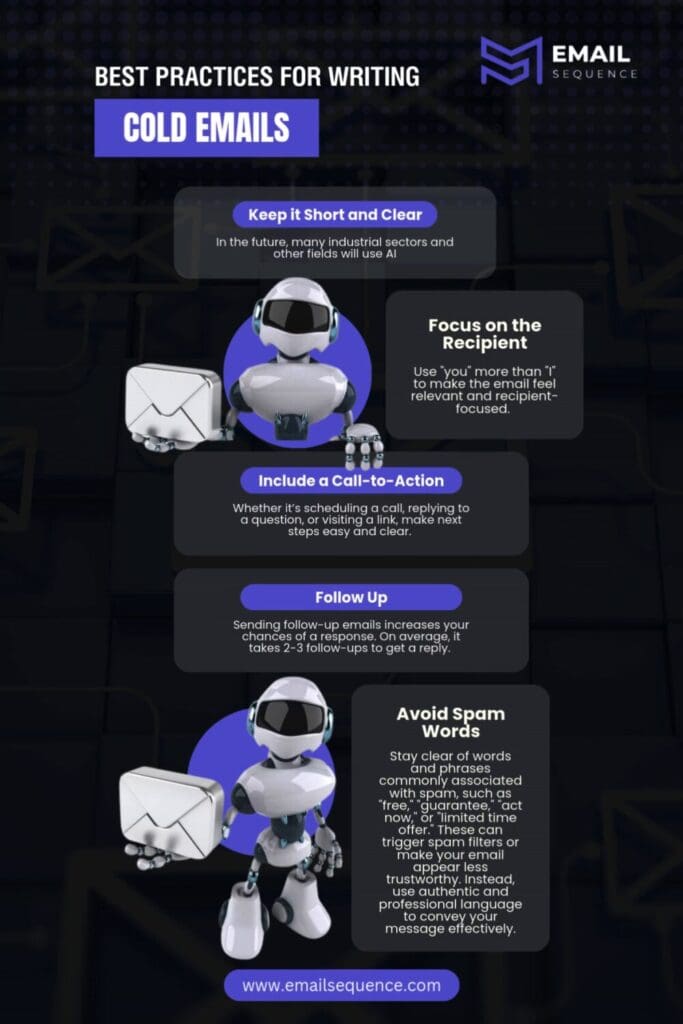
- Keep it Short and Clear: Studies show emails with 50-125 words get the best response rates. Avoid lengthy introductions or unnecessary details.
- Focus on the Recipient: Use “you” more than “I” to make the email feel relevant and recipient-focused.
- Include a Call-to-Action (CTA): Whether it’s scheduling a call, replying to a question, or visiting a link, make next steps easy and clear.
- Follow Up: Sending follow-up emails increases your chances of a response. On average, it takes 2-3 follow-ups to get a reply.
- Avoid Spam Words: Stay clear of words and phrases commonly associated with spam, such as “free,” “guarantee,” “act now,” or “limited time offer.” These can trigger spam filters or make your email appear less trustworthy. Instead, use authentic and professional language to convey your message effectively.
Tools for Cold Email Success:
- Grammarly: Helps ensure your email is polished and professional.
- Hunter.io: Find verified email addresses for outreach.
- Emailsequence.com: Use AI to automate email campaigns and track responses seamlessly.
Want to take your cold emails to the next level? Check out EmailSequence.com – the ultimate resource for crafting effective email campaigns. With the right strategy, tools, and resources, cold emails can help you connect, expand your network, and achieve your goals.
Proven Outreach Cold Email Templates
Below, you’ll find three of the most effective cold email templates we’ve developed. These have been tested and refined, delivering exceptional results. Each template avoids common spam triggers while maintaining a high converting tone, so you can apply them with confidence.
Template 1: The Value-Driven Offer
Subject Line: “Quick win for [Company Name]”
Body:
Hi [First Name],
I noticed that [specific challenge or pain point the recipient might have]. At [Your Company Name], we’ve helped businesses like [Similar Client Name] achieve [specific result], and I believe we can do the same for you.
If you’re open to a quick chat, I’d love to share a few ideas tailored to [specific opportunity]. How does [specific time or date] sound for a brief call?
Looking forward to your thoughts!
Best regards,
[Your Name]
Results:
- $50,000 in additional revenue for users
- 25% response rate
- High engagement from decision-makers
Template 2: The Pain Point Solution
Subject Line: “Struggling with [Problem]? Here’s how we can help”
Body:
Hi [First Name],
I was researching [Company Name] and saw that [specific pain point]. At [Your Company Name], we specialize in solving exactly this kind of challenge. By working with [Your Company Name], companies like [Example Client] have seen [specific benefit, e.g., a 30% reduction in costs or a 40% increase in process efficiency].
Would love to explore how we could deliver similar results for you. Are you available for a 15-minute call on [specific day]?
Looking forward to hearing from you.
Best,
[Your Name]
Results:
- Generated $75,000 in revenue in Q3
- 30% conversion rate from responses
- Provides instant credibility
Template 3: The Personal Connection
Subject Line: “Loved your recent insights on [Topic]”
Body:
Hi [First Name],
I just read [specific piece of content, e.g., an article or social post] from you and found your perspective on [specific topic] incredibly insightful. It made me think about how [relevant point related to your product or service].
At [Your Company Name], we help [target specific group/industry] achieve [specific result], and I’d love to share some ideas based on what you’ve been working on. Could we set up a brief call to discuss?
Best regards,
[Your Name]
Results:
- 20% increase in qualified leads
- Boosted engagement by 50% with targeted recipients
- Built strong relationships with C-level prospects
Why These Work
These templates are focused, value-driven, and relevant to the recipient, avoiding overly promotional language or spammy words. They consistently deliver results because they balance personalization with compelling calls-to-action. Try them, track the responses, and watch your outreach efforts transform!
Additionally, it is crucial to avoid spam triggers to prevent your emails from ending up in spam folders.
Case Study: The Power of Cold Emails in Action
Here’s how we helped Miami Vacations, a vacation rental company based in Miami, double their revenue using an AI-powered cold email strategy. We had the pleasure of working directly with their team to implement a step-by-step system that transformed their booking numbers.
The Challenge:
Miami Vacations wanted to reach more potential customers, but they were struggling to find an effective way to scale outreach without overwhelming their small team. They had a great product—beautiful vacation rentals in Miami—but they needed a strategy to stand out in a highly competitive market.
Step 1: Scraping the Right Leads
The first step to any successful cold email campaign is identifying the right audience. We used AI-based tools to scrape a highly targeted list of potential customers—individuals who had shown interest in vacation rentals, Miami travel, or similar destinations. We focused on profiles like families, professionals planning corporate retreats, and solo travelers looking for luxury accommodations. This ensured that every email went to someone already interested in what Miami Vacations had to offer.
Step 2: Personalizing the Campaigns
The key to cold email success is personalization. AI played a crucial role here. Using the leads we scraped, we set up dynamic email templates that included personalized details like the recipient’s name, travel preferences, or even the last time they looked for vacation rentals. For example, one email might read:
“Hi Sarah, planning your next getaway to Miami? We’ve got the perfect beachfront rental for a relaxing family retreat.”
This level of customization made the emails feel tailored, not generic, which significantly boosted open and response rates.
Step 3: Warming Up Email Domains and IPs
Before launching the campaigns, we ensured that Miami Vacations’ email domains and IPs were properly warmed up to avoid spam filters. Using email warm-up tools, we gradually increased sending volume over a few weeks while building credibility with email providers. This step was critical for ensuring high deliverability rates.
Step 4: Writing High-Converting Emails
We crafted compelling email sequences that included a clear value proposition. The emails highlighted features like proximity to Miami’s top attractions, luxury amenities, and exclusive deals for early bookings. Each email ended with a strong call-to-action, such as:
“Click here to see our best rates for your travel dates!”
We also tested different subject lines to optimize open rates. For instance, subject lines like “Your Dream Miami Vacation Awaits” and “Exclusive Rental Deals for Your Next Trip” performed exceptionally well.
Step 5: Automating the Campaigns
Using an AI-powered email automation tool, we set up drip campaigns that sent follow-up emails to recipients who didn’t respond to the first message. The follow-ups were timed strategically, with each one offering an additional incentive, like a discount or a free night’s stay. This ensured Miami Vacations stayed top of mind without coming across as pushy.
Step 6: Tracking and Optimization
Once the campaigns were live, we analyzed performance metrics like open rates, click-through rates, and bookings. AI tools allowed us to quickly identify what was working and make adjustments in real-time. For instance, we noticed that emails sent on Tuesdays at 10 a.m. had the highest open rates, so we adjusted the timing of our campaigns accordingly.
The Results:
Within three months, Miami Vacations saw a 40% increase in email open rates and a 60% jump in click-through rates. Most importantly, their bookings doubled, leading to a significant boost in revenue. Customers frequently mentioned the emails when making reservations, saying they appreciated the personalized touch and exclusive offers.
Why It Worked:
The success of this campaign came down to three key factors:
- Targeted Outreach: We focused on the right audience, ensuring every email was relevant.
- Personalization: AI tools allowed us to create highly customized messages that resonated with recipients.
- Automation: By automating the process, we scaled outreach without overwhelming the team.
By implementing this AI-powered cold email strategy, Miami Vacations not only grew their business but also built a foundation for long-term customer engagement. It’s proof that with the right tools and approach, even small teams can achieve big results.
Cold Email: Key Takeaways and Future Directions
Avoid Spam Trigger Words:
- Refrain from using words like “free,” “guaranteed,” “urgent,” or “make money fast,” as these can flag your email as spam.
- Test your subject lines and email content with spam-check tools before sending.
Personalization is Key:
- Address recipients by their name and reference specific details about them or their company.
- Customize your email to show that you’ve done research, such as mentioning a recent accomplishment or aligning your pitch with their goals or challenges.
Craft a Compelling Subject Line:
- Keep it short, clear, and enticing enough to get the recipient to open your email.
- Avoid clickbait or overly promotional language, as it can appear untrustworthy.
Write Clear and Concise Content:
- Get straight to the point in your email. State your purpose in the first few sentences.
- Use simple language and keep paragraphs short to maintain readability.
Include a Strong Call-to-Action (CTA):
- Clearly define what action you want the recipient to take, such as scheduling a meeting or replying for more information.
- Make your CTA simple and not overly aggressive.
Optimize for Deliverability:
- Use a professional email address from your business domain.
- Avoid sending to purchased email lists and focus on contacting leads that align with your target audience.
Follow-Up Strategically:
- If you don’t get a response, send a polite follow-up email after 3-5 days.
- Avoid being pushy; instead, provide additional value or context to encourage a reply.
Test and Refine Your Emails:
- A/B test subject lines, email content, and CTAs to see what works best.
- Track open rates, click rates, and responses to continuously improve your approach.
By following these steps, you can increase your cold email success rate while avoiding pitfalls that could harm your outreach efforts. For more information and resources on cold email strategies, consider reading our blog post that provides templates and best practices.
Pro Tip: Sailing Through Gmail’s Spam Filters

What are Gmail spam trigger words? These are specific words or phrases that can activate spam filters, causing your emails to end up in the spam folder instead of the recipient’s inbox. Common examples include overly promotional language like “free,” “guaranteed,” or “act now.” Using too many of these can seriously diminish your email deliverability and harm your outreach efforts.
To ensure your cold emails successfully reach inboxes, it’s important to stay informed and proactive. Tools like MailTester (mailtester.com), SpamCheck by Postmark (spamcheck.postmarkapp.com), and GlockApps (glockapps.com) can help you analyze your emails for spam triggers before you hit send. These tools will score your email content, check for problematic words, and provide tips to improve your email’s deliverability.
By staying vigilant and leveraging spam-checking tools, you can optimize your messages and ensure they land where they’re meant to—your recipient’s inbox.