Cold Email Subject Line: Get More Opens
A cold email subject line is the single most critical factor in whether your email gets opened or ignored. To maximize opens, it must be short, personalized, curiosity-driven, and value-focused, clearly showing the recipient why your email is relevant.
Subject lines under 50 characters, highlighting a benefit, solution, or urgent opportunity, consistently outperform generic lines. Combining psychology, personalization, and actionable language ensures your cold email stands out in crowded inboxes and drives engagement, replies, and conversions from the very first impression.
What Is a Cold Email Subject Line?
A cold email subject line is the first message a recipient sees in their inbox when they have had no prior contact with you. It signals relevance, value, and credibility, determining whether the email is opened or ignored.
Unlike general email subject lines, cold email subject lines must quickly capture attention, convey a benefit, and spark curiosity, all within seconds.
An email subject line must accomplish a difficult task in very few words. It needs to capture attention, communicate relevance, and encourage action—all before the recipient has any established trust or familiarity with the sender.
Why Subject Lines Matter in Cold Email Campaigns
Subject lines are not just a formality. They are a strategic element of every successful cold email campaign. Three factors make them especially important:
- Email open rates: A compelling subject line directly determines how many recipients actually open the email. Without a strong subject line, even the best-written email body will go unread.
- First impressions: The subject line shapes the recipient’s first perception of the sender. A relevant, professional subject line signals credibility. A generic or spammy one signals the opposite.
- Engagement in outreach campaigns: Higher open rates lead to more replies, more meetings booked, and better overall campaign performance. Subject lines are the entry point to all of that.
Why Cold Email Subject Lines Determine Email Open Rates
Inbox Competition and Limited Attention
Most of those emails get skimmed in a matter of seconds. Recipients make fast decisions about which emails deserve their time and which ones do not. In that environment, your subject line has roughly two to three seconds to make an impression.
The Psychology Behind Email Opens
Human behavior plays a significant role in why some subject lines get opened, and others do not. Three psychological triggers consistently drive email opens:
What makes someone click on an email they have never asked for? The answer often lies in one of these three forces:
- Curiosity: Subject lines that hint at valuable information without fully revealing it create a gap that readers feel compelled to close. The desire to find out more is a powerful motivator.
- Relevance: When a subject line mirrors a problem the recipient is currently facing or a goal they are trying to achieve, it feels less like a cold email and more like a timely, helpful message.
- Personalization: Seeing your name, company, or a specific detail about your work in a subject line triggers immediate attention. It signals that the email was written specifically for you, not mass-blasted to thousands.
- Urgency: Subject lines that include a time-sensitive element, like an expiring offer or a deadline, create a sense of scarcity that encourages immediate action. People are more likely to open an email if they fear missing out.
Key Elements of a High-Performing Subject Line
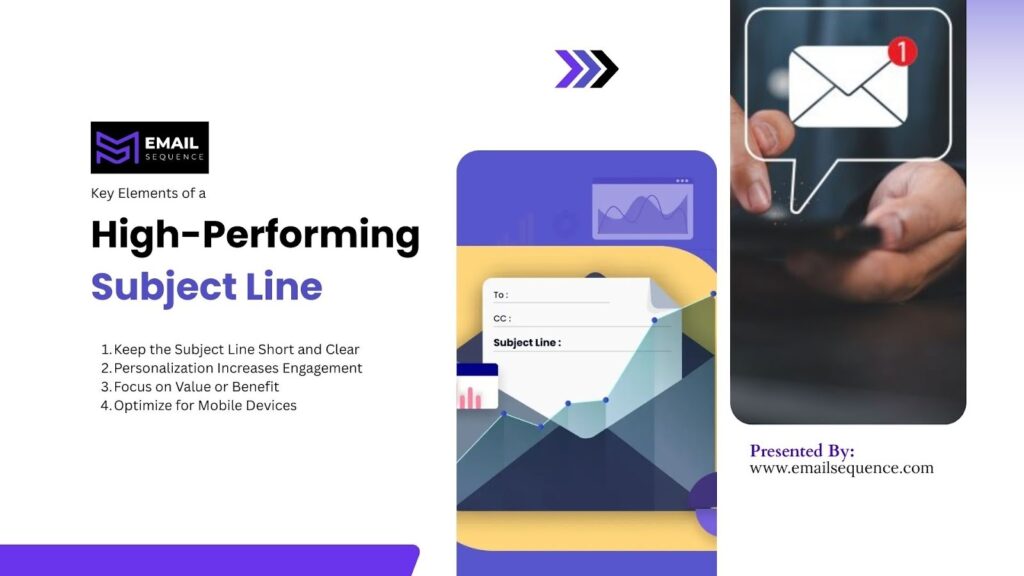
1. Keep the Subject Line Short and Clear
Length matters more than most senders realize. Subject lines between 40 and 60 characters tend to perform best because they are long enough to communicate a clear message but short enough to display fully across most email clients and devices.
2. Personalization Increases Engagement
Generic subject lines feel like mass communication. Personalized email subject lines feel like individual outreach. Adding the recipient’s first name, company name, or a reference to their specific industry signals that the email was crafted with them in mind.
Practical personalization options include:
- Recipient’s first name (e.g., “Sarah, quick idea for your team”)
- Company name (e.g., “Idea for improving [Company Name] leads”)
- Industry or role reference (e.g., “A faster approach for SaaS sales teams”)
3. Focus on Value or Benefit
People open emails when they believe there is something useful inside. A subject line that clearly communicates a benefit—more leads, less time, a specific solution—gives recipients a concrete reason to click. Vague subject lines that fail to communicate any value are easy to ignore.
4. Optimize for Mobile Devices
With over 50% of emails being opened on mobile, your subject line’s first impression is often a truncated one.
Here’s how to optimize your subject lines for mobile:
- Keep it under 50 characters: This is a safe length to avoid your message getting cut off on most mobile devices.
- Front-load important words: Place the most critical information at the beginning of the subject line to grab attention immediately.
- Use pre-header text: Leverage the snippet of text that appears after the subject line in most email clients. Use it to add compelling context that complements the subject line.
How to Write a Cold Email Subject Line That Gets Opened
Step 1: Identify the Prospect’s Pain Point
Before writing a single word, research the recipient. What challenges does their company face? What role do they hold, and what pressures come with it? A subject line built around a real pain point feels immediately relevant.
- Check the company’s website: Look for recent news, blog posts, or case studies that highlight their priorities or challenges.
- Review their LinkedIn profile: Note their job title, recent posts, and any shared content to understand their professional focus.
Step 2: Highlight a Clear Benefit
Once you understand the prospect’s challenge, frame your subject line around the solution or result. Do not focus on what you offer—focus on what the recipient will gain. “Increase your demo bookings” is more compelling than “Our sales outreach tool.” The benefit should be specific, believable, and directly tied to something the recipient cares about.
Step 3: Personalize the Message
Adding a personal touch to your subject line can significantly boost open rates and prevent your email from landing in the spam folder. Instead of generic phrases, use specific details that show you’ve done your homework.
Here’s how to do it effectively:
- Reference their company or role: “Idea for [Company Name]’s next product launch.”
- Mention a recent achievement: “Congrats on the [Award/Milestone].”
- Connect to their content: “Loved your post on [Topic].”
- Point out a competitor: “Strategy to outperform [Competitor Name].”
Step 4: Keep the Subject Line Concise
After drafting your subject line, cut any unnecessary words. Every word should serve a purpose. If the subject line reads clearly without a word, remove it. Aim for under 50 characters.
Short subject lines are easier to read, harder to ignore, and more likely to display fully on mobile devices.
Cold Email Subject Line Writing Formula
[Pain Point] + [Benefit] + [Personalization] + [Urgency] = High Open Rate
This formula combines key psychological triggers to make your subject line irresistible. Here’s how it works:
- Pain Point: Address a problem your prospect is likely facing.
- Benefit: Offer a clear, desirable outcome.
- Personalization: Use their name or reference their company to show it’s not a mass email.
- Urgency: Add a time-sensitive element to encourage immediate action.
Examples:
- “John, struggling with content? Let’s double your blog traffic by next month.”
- “Quick idea for [Company Name] to cut marketing spend this quarter?”
- “Tired of manual data entry, Sarah? We can automate your workflow in one week.”
Cold Email Subject Line Writing Process
| Step | Action | Example |
| Research | Identify the prospect’s challenge | Low website leads |
| Value | Show benefit or solution | Increase your leads by 30% |
| Personalize | Mention the name or the company | Idea for your marketing team |
| Optimize | Keep the subject line concise | Under 50 characters |
| Test | Compare multiple subject lines | Run A/B testing |
5 Proven Strategies for Writing Cold Email Subject Lines That Get Opened
Use Curiosity to Encourage Opens
Sparking curiosity is a powerful psychological trigger that can dramatically increase your email open rates. By creating an “information gap,” you make recipients feel compelled to click and discover what’s inside.
To effectively use curiosity, you can:
- Hint at exclusive or hidden information: Use phrases like “An idea for [Company Name]” or “Did you know about this?” to suggest you have valuable insights they don’t.
- Pose an unexpected question: A question like “Is your team prepared for this?” prompts the recipient to reflect and seek the answer within your email.
- Use a single, intriguing word: Sometimes, a one-word subject line like “Question” or “Idea” can stand out in a crowded inbox and pique enough interest for a click.
Include Numbers or Specific Data
Numbers stand out in text-heavy inboxes. A subject line that includes a specific figure—”3 ways to increase your demo bookings” or “Save 5 hours a week on outreach”—is more concrete and credible than one that makes vague promises.
Ask Questions That Trigger Interest
Questions engage the reader’s mind immediately. A well-crafted question subject line makes the recipient think about their own situation and wonder whether the email holds the answer.
“Are you still managing outreach manually?” works because it speaks directly to a recognizable challenge. The best question subject lines are ones that the prospect has likely asked themselves already.
Create Urgency or Scarcity
Using urgency and scarcity in your subject lines can significantly boost open rates by tapping into the reader’s fear of missing out (FOMO). When an opportunity feels limited, it compels immediate action.
Here’s how to effectively create urgency and scarcity:
- Time-Sensitive Offers: Use phrases like “Ends tonight,” “24-hour flash sale,” or “Last chance” to set a clear deadline. This prompts immediate opens from recipients who don’t want to miss a deal.
- Limited Availability: Highlight scarcity by mentioning specific numbers, such as “Only 3 seats left” or “Exclusive access for the first 50 sign-ups.” This makes the offer feel more exclusive and valuable.
Use Humor or Creativity Carefully
A creative subject line can make your email pop in a crowded inbox. Using humor can make you seem more approachable, but it’s risky—what’s funny to one person might be unprofessional to another. Always prioritize clarity over being clever, and save the creativity for when you know your audience well.
- For a marketing agency: “Your marketing needs a taco.” (Playful and memorable)
- For a software company: “Don’t open this email.” (Uses reverse psychology to create curiosity)
Warning: Are You Making These Email Subject Line Mistakes?
- Using spam words: Avoid terms like “free,” “guaranteed,” and “urgent,” which can get your email flagged as spam.
- Being too long: Keep subject lines under 60 characters and to the point, as long ones get cut off on mobile.
- Sending generic messages: Personalize your subject line with a name or company to increase open rates.
- Writing clickbait: Don’t use misleading subject lines that don’t match your email’s content. This erodes trust.
- Using all lowercase: This can look unprofessional and lazy, causing your email to be ignored.
- Asking vague questions: A subject like “Quick question?” from an unknown sender is often deleted.
- Ignoring preview text: Use the preview text to add context and give another reason to open your email.
Write Subject Lines That Actually Get Opened
A cold email subject line is the make-or-break element that determines whether your email is opened or ignored. Craft high-performing lines using personalization, clear value propositions, curiosity hooks, and concise wording. Focus on the recipient’s pain points, goals, and industry context, front-load critical information, and avoid spammy language.
Keep lines under 50 characters for mobile optimization, and use A/B testing with tools to continuously improve results. By applying these strategies consistently, you can increase open rates, drive engagement, and convert prospects into opportunities with every cold outreach
Ready to turn more opens into opportunities? Contact us for expert email sequence services that persuade recipients to open, engage, and convert.
Frequently Asked Questions
What makes a cold email subject line effective?
An effective cold email subject line is short, relevant, and clearly communicates value or curiosity. It speaks directly to the recipient’s situation, uses personalization where possible, and avoids spam trigger words. The best subject lines feel less like a sales pitch and more like a message worth opening.
How long should a cold email subject line be?
Most high-performing email subject lines fall between 40 and 60 characters. Shorter subject lines—under 50 characters—tend to perform especially well on mobile devices, where screen space is limited.
Should email subject lines be personalized?
Yes. Personalized email subject lines consistently outperform generic ones. Including the recipient’s name, company, or a reference to their specific role or industry signals that the email was crafted with them in mind. Even a small degree of personalization makes the email feel more relevant and less like a mass broadcast, which increases the likelihood of an open.
What words should be avoided in email subject lines?
Avoid spam trigger words such as “free,” “guaranteed,” “urgent,” “act now,” “no obligation,” and “limited time offer.” These words flag emails as spam in many email clients and reduce overall deliverability. They also signal low credibility to recipients who do see them. Focus on words that communicate genuine value and relevance instead.
How can businesses increase cold email open rates?
Businesses can increase email open rates by writing short, personalized subject lines that communicate clear value or curiosity. Testing multiple subject line variations through A/B testing helps identify what resonates with specific audiences.