How to Write a Cold Email for B2B that Actually Works
If you’re looking to unlock the secret sauce to crafting cold emails that not only get opened but also drive B2B conversions, you’re in the right place. I’ve spent years tinkering with the art of cold emailing, and I’ve cracked some essential strategies to help entrepreneurs, sales professionals, and business owners land big clients through their inboxes. Identifying and contacting the appropriate person is crucial in cold email outreach to ensure your efforts are targeted and effective.
Personalizing your emails to the prospect’s company by highlighting specific achievements or topics related to their business demonstrates genuine interest and thorough research.
Here’s the thing about cold emailing—it’s not just about hitting “send” and hoping for the best. There’s a science and an art to getting it right. And trust me, once you master it, you can unlock serious revenue opportunities. Using a B2B cold email template can significantly enhance your outreach efforts by providing a customizable framework that maximizes engagement and response rates.
What is a Cold Email?
Cold emailing is the process of reaching out to potential clients or business prospects you don’t have an existing relationship with. It’s like cold calling but for the digital era, and many B2B professionals prefer it over a cold call due to its less intrusive nature. When done well, it’s a powerful tool for B2B sales and networking.
But here’s the kicker—it’s not just about sending random pitches to random email addresses. A good cold email feels like it was tailor-made for the recipient, even if it’s part of a broader campaign. Effective cold email outreach strategies, such as personalization, follow-ups, and using templates, are crucial for ensuring these emails are opened and responded to.
Understanding Your Audience
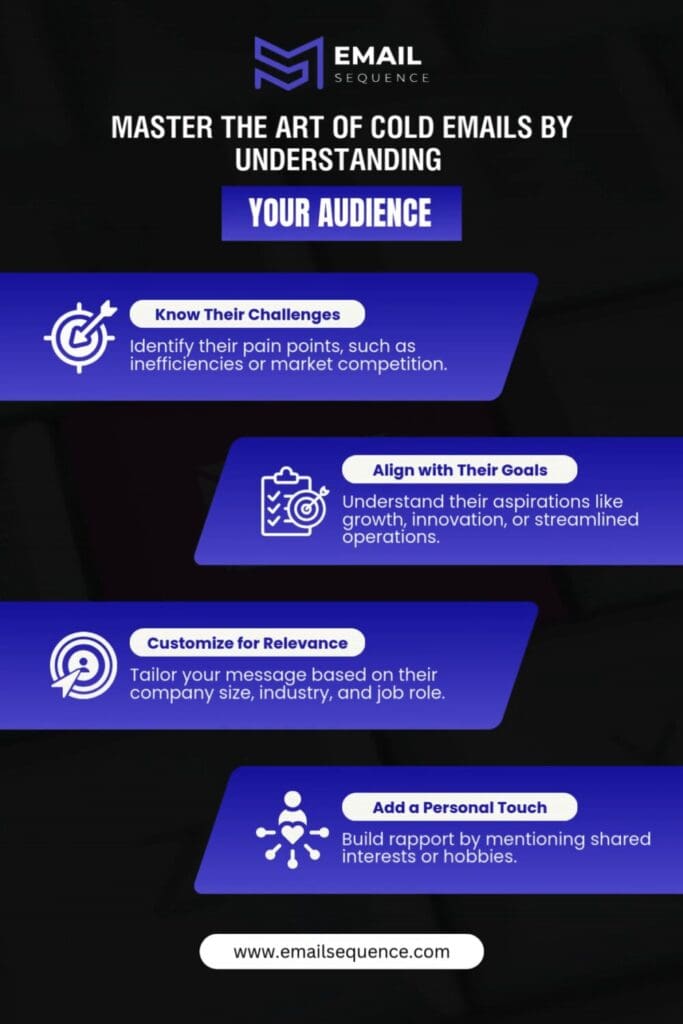
Understanding your audience is crucial to writing effective cold emails. Before you start crafting your email, take the time to research your audience and understand their needs, pain points, and interests.
Research Your Audience
Researching your audience involves gathering information about their company, role, and industry. You can use online tools such as LinkedIn, Crunchbase, or Datanyze to gather this information. Social media platforms are also goldmines for insights into their interests and pain points.
Some key things to research about your audience include:
- Company Size, Industry, and Job Function: Knowing these details helps you tailor your message to their specific context.
- Pain Points and Challenges: Identify what keeps them up at night. Are they struggling with efficiency, growth, or market competition?
- Goals and Aspirations: Understand what they aim to achieve. Are they looking to expand, innovate, or streamline operations?
- Interests and Hobbies: Personal touches can make your email stand out. Mentioning a shared interest can build rapport.
- Preferred Communication Channels: Knowing whether they prefer email, LinkedIn messages, or another platform can increase your chances of a response.
By understanding your audience, you can tailor your email to their specific needs and interests, increasing the chances of a response. This research phase is the foundation of effective cold emailing, ensuring your message resonates and feels relevant.
Does Cold Emailing Work for B2B in 2025?
Absolutely, and here’s why. According to a study by McKinsey, email marketing is 40 times more effective at acquiring new customers compared to social media. But here’s the catch—the success lies in how the email is structured and targeted.
Take this from Sales Guru Laura Simmons, who notes, “Cold emails are still one of the most underrated tools in B2B marketing—when done strategically.”
Is B2B Cold Emailing Legal?
Here’s where things get serious. Yes, it’s legal to send marketing emails, but you absolutely need to follow the rules. The CAN-SPAM Act in the U.S. requires your email to have a clear opt-out option, accurate headers, and the sender’s information. Similar regulations, like GDPR in Europe, have strict rules as well. Personally, I think these laws are a good thing. They protect people from being bombarded by unwanted emails and force businesses to be more transparent and respectful of their audience.
Ignoring these rules? That’s a terrible idea. Not only could your emails get flagged as spam—ruining your reputation and deliverability—but you could also end up in serious legal trouble. Trust me, it’s not worth the risk. Following the rules is a small price to pay for doing email marketing the right way.
What Makes a Good B2B Cold Email?
Crafting a winning cold email for B2B comes down to a few essential elements:
An effective cold email campaign is crucial for reaching out to potential clients and driving engagement. It is important to use well-researched sales cold email templates to generate leads effectively.
To enhance the effectiveness of your cold email campaigns, consider using cold email templates that are personalized and well-researched.
1. A Value-Packed Opening Line
A Subject Line that Demands Attention
Your subject line is everything—it can make or break your email campaign. Think of it as your first impression, your one shot to grab attention and stand out in a crowded inbox.
What to avoid:
- Spammy words like “free,” “urgent,” or “guaranteed.”
- All-caps or vague, generic phrases.
These are red flags for spam filters and can send your email straight to the junk folder.
What to do instead:
Focus on personalization and sparking curiosity. A subject line like:
- “Hey [First Name], how’s your [specific challenge] going?”
feels conversational and tailored, making it more likely to catch the recipient’s eye.
Real-life example:
BrightWave Fitness struggled with low open rates using generic subject lines like “Save Big on Your Next Workout Plan!” After switching to personalized, curiosity-driven lines, such as:
- “Struggling to stay on track? We’ve got you.”
- “Hey Sarah, ready to crush your fitness goals?”
their open rates shot up from 12% to 28% in just one month.
Quick tips for subject lines that work:
- Make them short and intriguing (6-7 words perform best).
- Use a conversational tone.
- Personalize whenever possible.
Forget formalities like “I hope this email finds you well.” These lines feel generic and can make the recipient lose interest before even understanding your message. Instead, start by showing how you can solve their problem or add value right away.
Using cold sales email templates can also help craft effective subject lines by providing customizable and pre-crafted messages that save time and improve the effectiveness of your cold email campaigns.
2. Personalization
No one wants to read a cookie-cutter email—it’s the quickest way to get ignored. Taking even 5–10 minutes to research your prospect can completely change the outcome of your outreach.
Why it matters:
Personalization shows you care enough to understand who they are and what they’re dealing with. Tailor your message by referencing:
- Specific details about their company, role, or industry.
- A recent achievement or challenge they might be facing.
For example:
If their company just launched a new product, mention it and connect how you can help. Recognizing achievements or tying your message to industry news can spark an instant connection.
Real-life example from Airbnb:
Airbnb’s early outreach to property hosts wasn’t generic—they referenced the local market and highlighted specific benefits for the host. This made their value proposition clear and relevant, driving a high response rate.
Pro tip:
Building rapport through personalization—whether it’s a shared connection or thoughtful observation—can make all the difference in getting a reply. It’s a small time investment with big payoffs.
For example:
By nailing these two elements, you’ll create cold emails that actually get opened, read, and responded to.
- “I noticed your team is gearing up for the launch of [specific product], and I’d love to share some ideas on how to build buzz around it quickly.”
This immediately catches attention because it addresses a challenge they’re facing and offers a potential solution.
Another example:
- “I noticed your team is expanding into [specific area], and I think a refreshed branding strategy could help you stand out in such a crowded space. Here’s how I can help streamline that process.”
The key is to show you’ve done your homework. Reference something specific about their business, goals, or challenges, and explain exactly how you can address it. This makes your outreach personal, thoughtful, and relevant.
In a sea of generic emails, this is how you truly stand out. Using cold outreach email templates can also help personalize your messages effectively, ensuring they resonate with your target audience.
3. Present a Compelling Value Proposition
A compelling value proposition is essential to writing effective cold emails. Your value proposition should clearly state the benefits of your product or service and how it can solve the prospect’s pain points.
Some key things to include in your value proposition include:
- Clear and Concise Benefits: State the benefits of your product or service in a straightforward manner. Avoid jargon and focus on tangible outcomes.
- Solving Pain Points: Describe how your product or service addresses the specific pain points you identified during your research. This shows you understand their challenges and have a solution.
- Unique Selling Proposition: Highlight what sets your product or service apart from the competition. Why should they choose you over others?
- Call to Action: End with a clear call to action, such as scheduling a meeting or demo. Make it easy for them to take the next step.
By presenting a compelling value proposition, you can grab the prospect’s attention and increase the chances of a response. Remember, the goal is to make it clear why your solution is the best fit for their needs.
3. Clear and Actionable CTAs
I always make it crystal clear what I want the recipient to do next. Whether it’s scheduling a call, reviewing a document, or replying to an email, my Call to Action (CTA) leaves no room for confusion.
Here’s how I keep it simple and effective:
Scheduling a Call
Be direct and specific:
“Are you available for a 10-minute call on Wednesday at 2 PM or Thursday at 10 AM?”
Offering clear time slots makes it easy for them to say “yes” or suggest an alternative.
Requesting Feedback
Provide clear instructions:
“I’ve attached our latest report on [topic]. Could you review sections 3 and 5 and share your thoughts by Friday?”
Specific asks make tasks feel manageable and actionable.
Email Replies
Guide them toward a quick response:
- “Do you agree with [specific point]?”
- “Can you confirm whether we should move ahead with this by Tuesday?”
Sharing a Resource
Highlight the benefit and make it enticing:
“Click here to download our free checklist for streamlining your hiring process—it’s just two pages and could save you hours!”
Pro Tips I Follow:
- Focus on their convenience: I keep CTAs short, clear, and jargon-free.
- Make the next step effortless: The goal is to reduce friction and make it easy for them to take action.
I’ve also found it helpful to experiment with tone to see what resonates best:
- Casual: “How does your calendar look this week for a quick chat?”
- Direct: “Let me know if Thursday works for a call.”
Finally, I often use personalized sales email templates. They save me time and boost response rates when tailored properly. By refining my CTAs over time, I’ve learned how to consistently drive action and engagement.
Why Cold Emailing is Key for Business Growth
Case in point—PriceLabs, a tech startup, grew their revenue by 70% within 6 months, Simply by refining their cold email strategy, this B2B SaaS company unlocked massive growth. They implemented targeted campaigns aimed at decision-makers in key industries, using data-driven insights to craft compelling email copy. Each email was tailored to address specific pain points, paired with personalized follow-ups that felt authentic and engaging. Utilizing the best cold email templates recommended by sales experts can further enhance outreach efforts.
The results? Truly game-changing. Their open rates skyrocketed from 20% to 45%, while reply rates doubled within three months. By the end of the quarter, they had landed over 30 new clients, many of whom signed long-term contracts.
Here’s what their CEO said: “Cold emails brought in nearly half of our new clients last quarter. Without them, we’d be leaving millions on the table. It’s been a critical part of our strategy to scale quickly and connect with the right people at the right time.”
Additionally, their team monitored performance metrics closely, tweaking subject lines, call-to-action phrases, and timing to optimize results. They even A/B tested email templates to identify what resonated most with prospects. Not only did this improve their conversion rates, but it also helped them build a predictable pipeline of high-quality leads.
This success story highlights the power of a well-thought-out cold email strategy. When done right, it can be one of the most efficient, cost-effective ways to grow your business. Incorporating social proof, such as testimonials or endorsements, in your cold emails can significantly enhance trust and engagement with prospects.
Writing the Perfect B2B Cold Email
Here’s a quick breakdown of how to nail it.
- Start Strong with a Personal Touch
Begin your message with something that grabs the recipient’s attention while showing them you’ve done your homework. This could be a compliment, an observation, or an interesting data point about their business. Using a cold sales email template can help ensure your message is structured effectively and personalized. Writing cold emails that are targeted and relevant to the recipient’s pain points is crucial for success.
- Example: “I’ve been following your company for a while, and I’m impressed with how you’ve grown your social media presence over the past year—your engagement rates are outstanding!”
- Example: “I came across your recent blog post on sustainable marketing strategies. It’s clear your team is doing innovative work in this space!”
- Establish the Problem Clearly
Identify a pain point or challenge the recipient might be facing. Be specific, and show that you understand their business or industry. Avoid being overly critical—frame the problem as an opportunity for improvement. Mentioning the prospect’s company and its unique challenges can make your email more relevant and engaging.
- Example: “I noticed your website’s bounce rate is quite high—over 50%—which could mean visitors aren’t finding the information they need or getting hooked on your content.”
- Example: “Your team has invested a lot in paid ads, but I see your organic search visibility is low. This could mean you’re missing out on valuable long-term traffic.”
- Pitch Your Solution Effectively
Explain how you can help solve the problem you’ve identified. Keep it straightforward and concise, focusing on the value you bring. Avoid jargon and focus on outcomes.
- Example: “My team specializes in optimizing websites to lower bounce rates. With a few design tweaks and better content structuring, we’ve helped clients reduce bounce rates by up to 30% in just three months.”
- Example: “We’ve developed an SEO strategy that boosts organic search rankings for companies like yours. Our recent client in your industry saw a 50% increase in organic traffic in just six months.”
- End with a Clear Call-to-Action (CTA)
Finish your message with a CTA that’s easy to respond to and low-pressure. Make it clear what the next step is and how they can take it.
- Example: “Would you be open to a quick 15-minute call next week to discuss how we can help improve your website’s performance?”
- Example: “I’d love to share a few free recommendations for improving your organic search strategy. Let me know if that’s something you’d be interested in!”
Key thing to remember:
By combining a strong opening, a clear problem, a concise solution, and an actionable CTA, you can craft messages that are not only engaging but also highly effective at sparking meaningful conversations.
Best Practices for Sending Cold Emails
- Use a Business Domain 🔒 A professional email domain (e.g., [email protected]) builds trust and avoids the spam folder. For example, seeing an email from [email protected] versus [email protected] makes a huge difference in credibility. In my experience, clients are far more responsive when emails come from a polished, branded domain. Incorporating a structured sales process in your cold email outreach can further enhance your credibility and response rates.
- Keep it Short and Sweet—Stay under 150 words. Busy professionals don’t have time for essays. For instance, instead of writing, “We are reaching out to introduce our company, which specializes in innovative marketing solutions tailored to businesses like yours,” try, “We help businesses like yours grow with custom marketing solutions. Let’s chat!” I’ve found concise messages with clear value propositions get the most replies. A well-coordinated sales team can effectively utilize these templates to streamline their outreach and personalize messages, improving engagement with potential clients.
- Follow Up Like a Pro Don’t stop after one attempt. Research shows most deals close after 3-4 follow-ups, and I’ve personally seen this work wonders. For example, after sending an initial email, follow up with a quick message like, “Just circling back to see if you’re available for a quick chat this week.” Keep it polite and persistent without being pushy.
Including Contact Information
Including contact information is essential to writing effective cold emails. Your contact information should include your name, email address, phone number, and company website.
Some key things to consider when including contact information include:
- Easy to Find and Read: Make sure your contact information is easy to find and read. Place it at the end of your email in a clear, organized format.
- Links to Company Website or Social Media: Include a link to your company website or social media profiles. This provides additional context and allows the recipient to learn more about you.
- Professional Email Signature: Use a professional email signature that includes your contact information. This adds a touch of professionalism and makes it easy for the recipient to get in touch with you.
By including contact information, you can make it easy for the prospect to get in touch with you and increase the chances of a response. Clear and accessible contact details show that you are open and ready to engage, which can encourage the recipient to take the next step.
Common Mistakes to Avoid
Knowing what NOT to do is just as important when it comes to email marketing. Here are some common pitfalls I’ve seen (and sometimes made myself) that you should avoid:
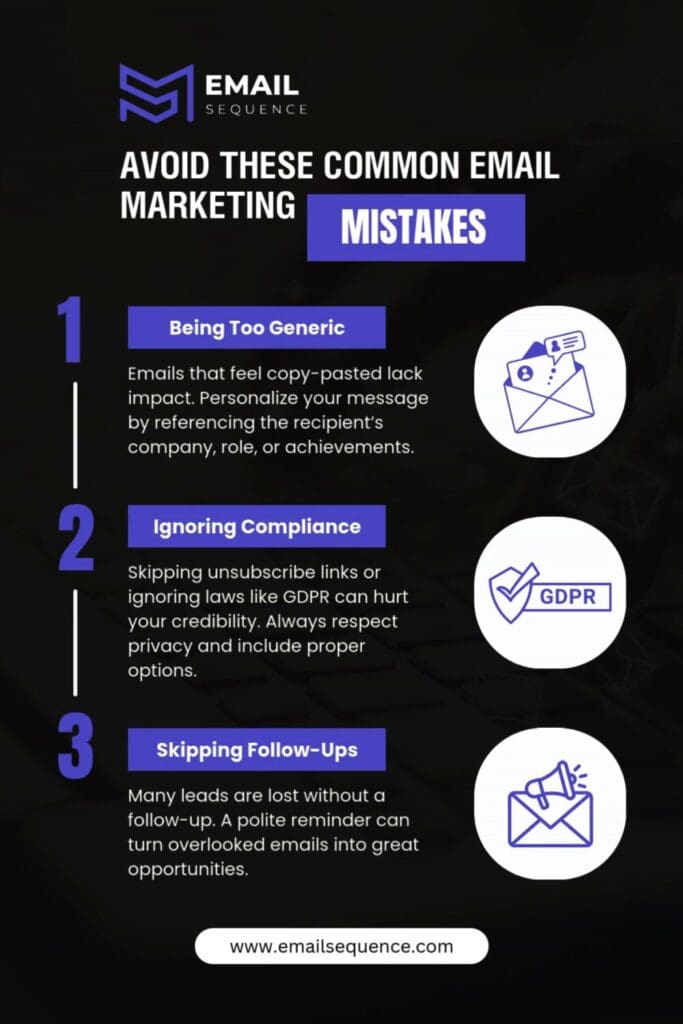
- Being Too Generic—Avoid using templates that scream “copy-paste.” For example, I once received an email that started with “Dear [Insert Name Here].” It was obvious they didn’t double-check the merge fields, and it completely turned me off from engaging with them. Instead, personalize your emails with details that show you’ve done your homework, like referencing something specific about the recipient’s company or recent work. Generic emails feel lazy and won’t get you the responses you’re hoping for.
- Ignoring Compliance—This might sound boring, but it’s critical. Make sure your emails comply with local email marketing laws, like GDPR in the EU or CAN-SPAM in the U.S. For instance, I’ve seen businesses fail to include an unsubscribe link in their emails, which is not only illegal but also incredibly frustrating for recipients. Personally, I always associate this kind of oversight with a lack of professionalism. A clear unsubscribe option shows respect for the recipient’s time and privacy.
- Skipping Follow-Ups—You’re leaving money on the table if you don’t follow up. I used to worry about seeming pushy, so I avoided follow-ups entirely. Big mistake! I’ve since learned that many people are simply busy and appreciate a friendly nudge. For instance, I once sent a follow-up email a week after my first contact, and it turned into a great business opportunity because the recipient had just overlooked my initial message. Always follow up—it doesn’t have to be aggressive; just polite and timely.
Can AI Help with Cold Emails?
Absolutely. AI has transformed the way businesses approach cold emailing, making the process faster, more efficient, and results-driven. Here’s how AI is changing the game:
Personalized Emails in Seconds
Tools like ChatGPT can generate highly personalized email drafts almost instantly. By analyzing input data—such as recipient details, industry, or past interactions—AI can craft messages that feel tailored and relevant, which significantly improves open and response rates.
Optimizing for Maximum Results
Platforms like EmailSequence.com take personalization a step further by optimizing key elements of your email campaigns. These include:
- Subject Lines: AI tests and suggests subject lines likely to grab attention.
- Timing: Based on user behavior, AI identifies the best time to send emails for higher engagement.
- Content: It analyzes tone, length, and structure to ensure the message resonates with your audience.
Expert Insights on AI in Cold Emails
Marketing expert Janet Lee highlights the impact of AI on cold emailing:
“AI is revolutionizing cold emailing by taking the guesswork out of personalization and timing. It allows marketers to focus on building relationships while the technology handles the technicalities.”
Why It Matters
AI-powered tools not only save time but also enhance the effectiveness of your outreach efforts. By leveraging these technologies, you can minimize manual work, refine your approach, and achieve better results in less time.
Bonus B2B Cold Email Tips
When it comes to B2B cold emails, a few extra steps can make all the difference. Here are some additional strategies I personally recommend to help you get better results:
1. Use Tools to Find Accurate Email Addresses
One of the biggest challenges in cold emailing is ensuring your message actually reaches the right person. I recommend using tools like Hunter.io or FindThatEmail to locate correctly formatted and verified email addresses. These tools can save you hours of guesswork and reduce your bounce rate significantly. Always double-check the contact information before hitting send—accuracy is key.
2. Leverage Trigger Events to Make Emails More Relevant
Timing is everything, and leveraging trigger events can make your cold emails stand out. For example, if a company just announced a funding round or if your prospect was recently promoted, use these details to tailor your message. Begin your email with something like:
“I saw your company just raised $5M in Series A funding—congratulations! I’d love to talk about how we can help you scale your operations during this exciting time.”
This shows you’ve done your homework and sets a positive tone right away.
3. A/B Test Everything for Better Performance
Testing is a game-changer for email campaigns. I always A/B test subject lines, CTAs (calls-to-action), and even the timing of follow-ups. For instance, try one subject line that’s direct and another that’s more curiosity-driven. Measure which one gets better open rates. Similarly, test different CTAs like “Book a demo” versus “Let’s connect for 15 minutes.” Over time, you’ll learn what resonates best with your target audience.
B2B Email Templates and Examples
Here are a few B2B cold email templates and tips to help you get started with professional communication. Whether you’re reaching out for the first time, proposing a partnership, or pitching your service, crafting the right email can make all the difference. I’ve also included some advice and additional examples to help you stand out.
Sales reps can utilize these templates to save time and enhance personalization in their outreach, ultimately driving engagement and increasing sales opportunities.
Template 1: Introduction Email
This template is ideal for making a positive first impression. Use it to introduce yourself, your company, and how you can add value to the recipient’s business.
Subject Line: Quick question about [Recipient’s Business]
Hi [First Name],
I recently came across [specific observation, e.g., “your blog on sustainable marketing” or “your recent webinar on scaling startups”], and I was really impressed by [mention something you genuinely admired, e.g., “how you explained X concept” or “your innovative approach to Y”].
At [Your Company], we specialize in [your solution, e.g., “helping small businesses streamline their operations using AI-powered tools”]. I believe we could help you achieve [specific goal, e.g., “reduce inefficiencies” or “scale your operations”].
Would you be open to a quick 15-minute call next week to discuss how we might collaborate?
Looking forward to hearing from you!
Best regards,
[Your Name]
[Your Position]
[Your Contact Info]
Cold emails are one of the most effective B2B tools for growth—if done right. The key is crafting emails that feel personal, provide value, and drive action.
Extra Tips for Introduction Emails:
- Personalize, personalize, personalize. Mention specifics about the recipient’s business or achievements to show that you’ve done your homework.
- Keep it short and to the point; respect the recipient’s time.
- Avoid generic phrases like “we are the best at X.” Instead, focus on how you can solve a problem they care about.
- Need a call-to-action? Make it simple, e.g., “Would you be open to a short call?”
Want to take your email marketing to the next level? EmailSequence.com can help you craft AI-powered cold emails that 10x your revenue. Don’t leave sales on the table—get started today!
Template 2: Partnership Proposal
Use this template to propose a partnership that could benefit both parties. Highlight mutual goals and be clear about what you’re offering.
Subject Line: Ideas for growing [Recipient’s Business]
Hi [First Name],
I’ve been following the work you’re doing at [Company Name] and have a lot of respect for [specific accomplishment, e.g., “your recent expansion into new markets” or “your innovative approach to product development”].
I believe there’s a great opportunity for us to partner and achieve [specific goal, e.g., “increased market reach” or “jointly solve a key challenge in the industry”]. At [Your Company], we’ve successfully [specific achievement, e.g., “helped similar businesses grow by X%” or “developed solutions tailored to your industry”].
Could we set up a quick 20-minute call to explore this idea further? I’d love to hear your thoughts.
Looking forward to connecting,
[Your Name]
[Your Position]
[Your Contact Info]
Additional Templates
Template 3: Follow-Up Email
Follow-ups are key to keeping the conversation alive. Use this template to check back after no response.
Subject Line: Just following up on my last email
Hi [First Name],
I hope this email finds you well. I wanted to follow up on the email I sent on [date] regarding [specific topic, e.g., “a potential collaboration” or “how we can help with X”].
I’d love the opportunity to discuss this further and see how we might be able to work together. Are you available for a quick call next week?
Let me know what works best for you. I look forward to hearing from you!
Best regards,
[Your Name]
Template 4: Product or Service Pitch
If you’re directly pitching a product or service, focus on the benefits and keep the tone conversational.
Subject Line: A solution to [specific challenge, e.g., “streamline your hiring process”]
Hi [First Name],
I noticed that [specific challenge, e.g., “hiring the right talent can be time-consuming”]. At [Your Company], we’ve developed [specific solution, e.g., “an AI-powered hiring platform”] that helps businesses like yours [benefit, e.g., “find top talent in half the time”].
Our platform has helped companies like [Example Client] boost [specific metric, e.g., “hiring efficiency by 30%”]. I’d love to chat about how we can do the same for [Recipient’s Company].
How does your availability look next week for a quick demo?
Looking forward to connecting!
[Your Name]
Template 5: Event Invitation
Inviting someone to an event? This template can help.
Subject Line: Join us for [Event Name]
Hi [First Name],
I wanted to personally invite you to [Event Name], happening on [date]. It’s a [brief description, e.g., “virtual summit featuring top industry leaders” or “networking dinner for professionals in X field”].
I think you’d find it valuable, especially as we’ll be discussing [specific topic of interest, e.g., “emerging trends in your industry”].
Let me know if you’d like me to reserve a spot for you. I’d love to see you there!
Best regards,
[Your Name]
Testing Emails Before Sending
Testing your emails before sending them is essential to ensure that they are delivered correctly and that they look professional. Here are some tips for testing your emails:
- Test Your Email Address: Make sure that your email address is correct and that you can receive emails at that address. This might seem basic, but it’s crucial to ensure that your communication channel is open and functional.
- Test Your Email Template: Test your email template to ensure that it looks professional and that all the links and images are working correctly. Send a test email to yourself or a colleague to check the formatting and functionality.
- Test Your Email Content: Test your email content to ensure that it is free of spelling and grammar errors and that it is engaging and relevant to your recipients. Tools like Grammarly can help you catch any mistakes before you hit send.
- Test Your Email Subject Line: Test your email subject line to ensure that it is attention-grabbing and relevant to your recipients. A/B testing different subject lines can help you determine which one performs better in terms of open rates.
By thoroughly testing your emails, you can ensure that they make a positive impression and increase the chances of a successful cold email campaign.
Ignoring Follow-up Sequences
Ignoring follow-up sequences is a common mistake that can hurt your cold email campaigns. Follow-up sequences are essential to keep your recipients engaged and to increase the chances of getting a response. Here are some tips for creating effective follow-up sequences:
- Create a Follow-up Sequence: Create a follow-up sequence that includes multiple emails sent at regular intervals. This keeps your outreach consistent and shows persistence without being overly aggressive.
- Personalize Your Follow-up Emails: Personalize your follow-up emails to make them more relevant and engaging to your recipients. Reference previous emails or interactions to show that you are genuinely interested in connecting.
- Use Different Subject Lines: Use different subject lines for each follow-up email to keep your recipients engaged and interested. This can help you avoid the appearance of spam and increase the likelihood of your emails being opened.
- Use Different Email Content: Use different email content for each follow-up email to provide more value and insights to your recipients. This can include new information, case studies, or additional benefits of your product or service.
By implementing a well-thought-out follow-up sequence, you can significantly improve the effectiveness of your cold email campaigns and increase your chances of getting a response.
Scaling Your Cold Email Campaigns
Scaling your cold email campaigns requires careful planning and execution. Here are some tips for scaling your cold email campaigns:
- Use Automation Tools: Use automation tools to streamline your cold email campaigns and increase your productivity. Tools like Mailshake or Woodpecker can help you manage large volumes of emails and automate follow-ups. EmailSequence.com is one the best tools there is to automate email.
- Use Email Templates: Use email templates to create consistent and professional emails that can be sent to multiple recipients. This saves time and ensures that your messaging remains on point. Customize these templates to add a personal touch.
- Use Personalization: Use personalization to make your emails more relevant and engaging to your recipients. Personalization tokens and dynamic content can help tailor your emails to each recipient’s specific needs and interests.
- Use Follow-up Sequences: Use follow-up sequences to keep your recipients engaged and increase the chances of getting a response. Automated follow-up sequences can ensure that no lead falls through the cracks.
By following these tips, you can effectively scale your cold email campaigns and reach a larger audience without sacrificing personalization and engagement.
Creating Personalized & Unique Cold Email Copies
Creating personalized and unique cold email copies is essential to increase the chances of getting a response. Here are some tips for creating personalized and unique cold email copies:
- Use Personalization Tokens: Use personalization tokens to insert the recipient’s name, company, and other relevant information into the email. This makes your email feel more tailored and less like a mass message.
- Use Dynamic Content: Use dynamic content to create emails that are tailored to the recipient’s interests and needs. This can include personalized recommendations, relevant case studies, or industry-specific insights.
- Use Segmentation: Use segmentation to create emails that are tailored to specific groups of recipients. Segment your audience based on factors like industry, job role, or company size to ensure your messaging is relevant.
- Use A/B Testing: Use A/B testing to test different email copies and determine which one performs better. Experiment with different subject lines, email content, and CTAs to find the most effective combination.
By creating personalized and unique cold email copies, you can increase the relevance and engagement of your emails, leading to higher response rates and more successful cold email campaigns.
Recap: Key Points for Writing a B2B Cold Email
- Start with Clarity: Clearly state your purpose within the first two sentences so the recipient knows why you’re reaching out.
- Make It Personal: Address them by name, reference their company, and include specific details to show the email is tailored for them.
- Be Concise: Keep your email brief—3-5 short paragraphs max. No one has time for long messages.
- Craft a Strong Subject Line: Use a subject that grabs attention and is relevant. Examples:
- “Quick question about [specific process]”
- “Idea for growing [Company Name]”
- “Invitation to [Event Name]”
- End with a Clear Call-to-Action: Suggest the next step, like scheduling a call, replying, or signing up for something.
These tips will help you craft a cold email that’s actionable, engaging, and effective.