Email Sequence Copywriting: The 4-Stage Blueprint
Imagine turning a curious subscriber into a paying customer with just a few carefully crafted emails. That’s the power of great copywriting.
Yet, most email sequences fail. They bombard your inbox with repetitive sales pitches, each a carbon copy of the last. This lazy approach leads to reader fatigue, high unsubscribe rates, and zero conversions.
The problem? A fundamental misunderstanding of what an email sequence should accomplish. It’s not just about selling a product; it’s about guiding a potential customer on a carefully structured journey.
Effective email sequence copywriting is a measured, step-by-step process designed to dismantle a reader’s natural skepticism. It builds trust, delivers value, and establishes belief before ever asking for the sale.
This guide presents a proven blueprint for conversion. We will explore the 4-Stage Copy Framework, a psychological model that dictates the precise content, tone, and formula for every email in your sequence. By following this structure, you will learn how to create campaigns that do not just sell but also build lasting customer relationships.
The Strategic Foundation: Mastering Email Persuasion
To write truly persuasive emails, you must first understand the psychological obstacles you are trying to overcome. Each stage of your sequence has a distinct goal, and your copy must be engineered to meet it.
The Pacing Principle: Building Belief with Email Storytelling
What is the primary goal of your email sequence? It is not to sell, but to advance the reader’s stage of awareness. You can accomplish this by using a narrative structure to lower resistance and make the process relatable. How can you frame this journey?
- Challenge: Start by identifying a problem your reader faces. Be specific and show that you understand their pain points. For example, is their team struggling with productivity, or are they wasting hours on manual tasks?
- Struggle: Dive deeper into the difficulties and frustrations tied to the problem. Use relatable examples or scenarios to show you truly get what they’re going through. Highlight how this issue might be holding them back or creating unnecessary stress.
- Solution: Present your product or service as the ultimate resolution to their struggle. Explain how it directly addresses their pain points, saves them time, or improves their situation. Use clear benefits and, if possible, include proof like testimonials, stats, or success stories.
The Trust Accelerators
How can you build credibility and motivate your audience to act? You need to leverage proven psychological triggers that accelerate trust and create a compelling reason to move forward.
Authority & Social Proof:
Leverage case studies, testimonials, and industry recognition to build strong credibility and trust with your audience. Case studies showcase real-world success stories, providing tangible proof of how your product or service has delivered results for others.
To maximize effectiveness, showcase these assets across your website, marketing materials, and social media channels. For example, create a dedicated “Success Stories” section on your site, include testimonials on your homepage, or share case studies through email campaigns.
Scarcity and Urgency:
Want your final emails to spark action? Adding authentic scarcity or urgency can make all the difference. When people know there’s a real reason to act now, they’re more likely to leap.
Here’s how to create a sense of urgency:
- Highlight time-sensitive offers with clear deadlines.
- Emphasize limited availability (e.g., “Only 5 spots left!”).
- Set firm, non-negotiable cutoffs to encourage quick decisions.
The Value Equation
Your offer needs to be a no-brainer. The secret? Magnifying its benefits while minimizing its costs. It’s not about listing features; it’s about showcasing the transformation your product or service delivers.
Here’s how to frame your value effectively:
- Focus on the Outcome: Don’t just sell a “social media course.” Sell “a proven system to land your first three clients in 30 days.” Connect every feature back to a tangible, desirable result.
- Quantify the Benefits: Use numbers to make the value concrete. Will they save time? How much? Will they make more money? Give them an estimate. For example, “Save 10 hours a week on admin tasks” is far more powerful than “more efficient.”
- Minimize the Perceived Cost: Frame the price in a relatable context. Instead of “$300,” try “for less than the cost of your daily coffee for two months.” You can also emphasize guarantees, free trials, or payment plans to reduce the financial risk.
The 4-Stage Copywriting Blueprint: Mapping Formulas to Intent
This section provides the actionable strategy for your email sequence copywriting. It maps proven, classic conversion copy formulas to the correct stage of the sequence, ensuring every email serves its intended purpose.
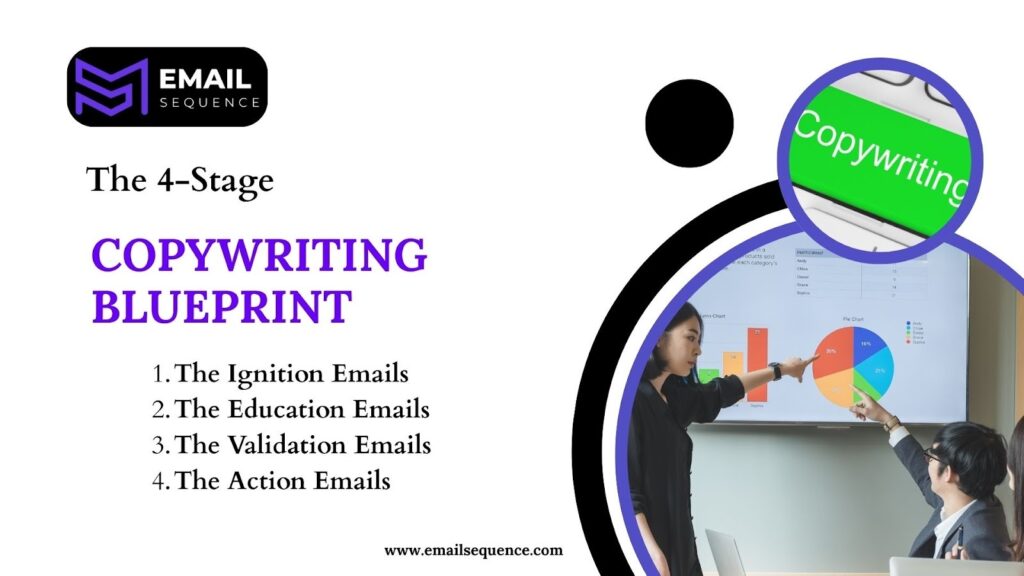
Stage 1: The Ignition Emails (1-2)
What is the goal of the first emails? You must capture immediate attention and acknowledge the reader’s specific pain point. Your primary metric here is a high open rate, so your subject line is critical.
Primary Formula:
PAS (Pain, Agitate, Solve): This is a highly effective formula because it taps directly into the reader’s emotions.
- P – Pain: Start by identifying a specific problem your reader is experiencing. Make it relatable and immediate.
- A – Agitate: Dig deeper into that pain. Describe the frustrations, consequences, and negative feelings that come from leaving the problem unsolved. This creates a sense of urgency.
- S – Solve: Present your product or service as the clear, direct solution that brings relief from the agitated pain.
Secondary Formula:
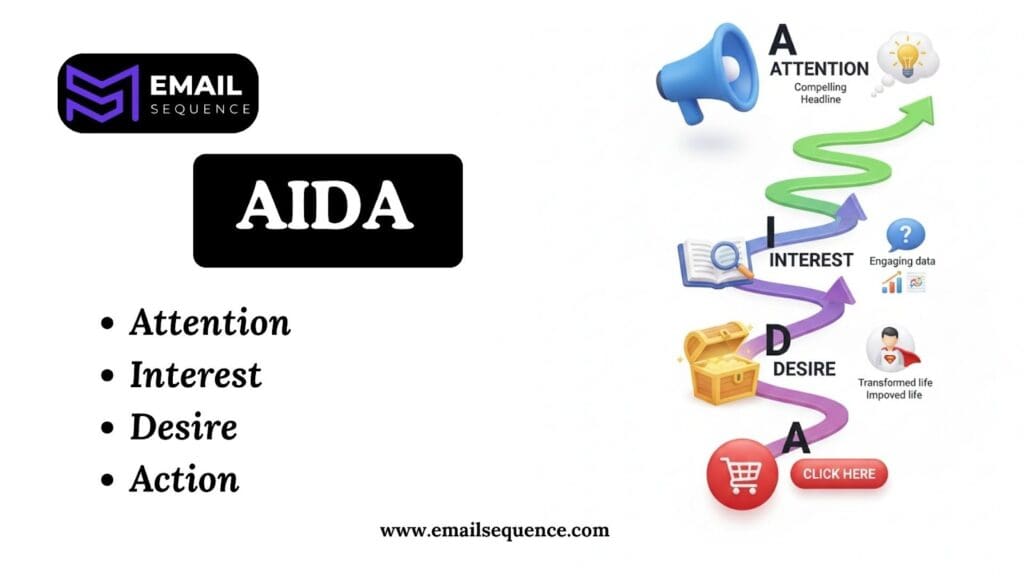
AIDA (Attention, Interest, Desire, Action): This is a foundational marketing formula that guides the reader on a journey from awareness to purchase.
- A – Attention: Grab their attention with a compelling headline, subject line, or opening sentence.
- I – Interest: Hold their interest by sharing relevant, engaging information that speaks to their needs.
- D – Desire: Build desire by showing them how your solution will benefit them and improve their life.
- A – Action: Tell them exactly what to do next (e.g., “click here,” “buy now”).
For the first emails in your sequence, you’ll mainly focus on the Attention and Interest parts of AIDA to hook the reader and make them want to hear more from you.
Stage 2: The Education Emails (2-3)
What is your objective in the education phase? Your goal is to demonstrate expertise, build rapport, and deliver genuine value without asking for a sale. This builds trust and positions you as an authority.
Primary Formula:
The “How-To” Shift. Offer a tactical piece of advice or a valuable insight that the reader can implement immediately. After providing this free value, you can introduce your product as the way to scale, automate, or perfect that advice.
Metric Focus:
Pay attention to reading time, replies (a great engagement signal for B2B), and clicks on non-sales content like blog posts or guides. These metrics show how well your audience connects with your content and whether you’re addressing their pain points.
Stage 3: The Validation Emails (3-4)
How do you crush your reader’s skepticism? In the validation stage, you must provide external, undeniable proof that your solution works. This is where strategic sales copy makes its first appearance.
Primary Formulas:
BAB (Before-After-Bridge) and the Four Ps (Promise, Paint, Proof, Push) are two powerful copywriting formulas designed to persuade readers by highlighting transformation and building trust.
BAB (Before-After-Bridge)
This formula works by creating a relatable problem and presenting your solution as the bridge to a better future.
- Before: Describe the reader’s current problem or pain point.
- After: Paint a picture of what their world would look like after solving that problem.
- Bridge: Introduce your product or service as the solution that gets them from the “Before” to the “After.”
Four Ps (Promise, Paint, Proof, Push)
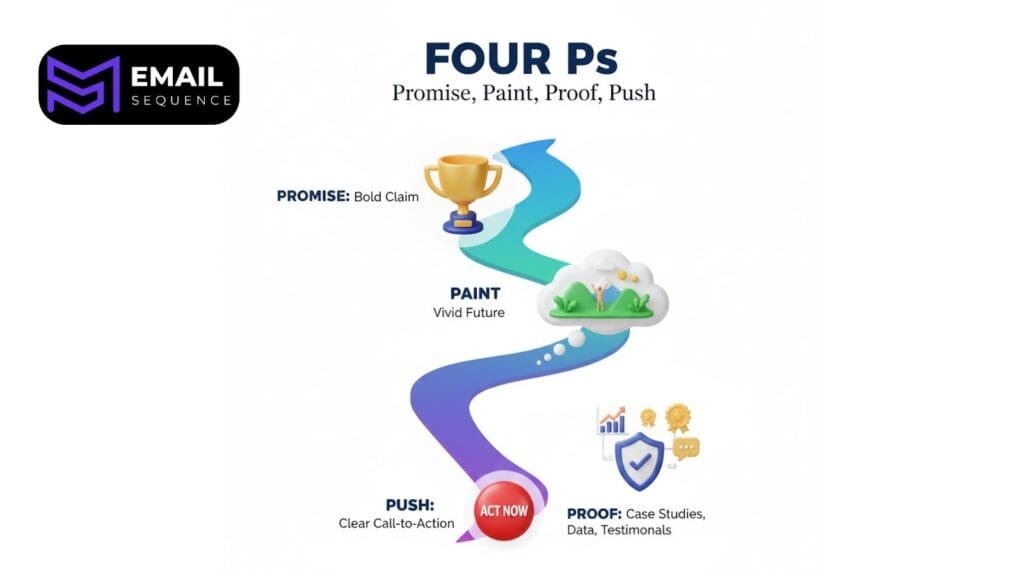
This formula builds a compelling argument by combining an appealing outcome with concrete evidence.
- Promise: Start with a bold claim about what your solution can do for the reader.
- Paint: Describe the promised future in vivid detail so the reader can imagine themselves experiencing it.
- Proof: Back up your promise with evidence like case studies, testimonials, data, or endorsements.
- Push: Tell the reader exactly what to do next to achieve the promised result.
Stage 4: The Action Emails (4-5)
What is the final goal? The action emails are designed to drive the final conversion, whether it is a purchase, a demo booking, or a consultation call. The copy must be direct, clear, and compelling.
Primary Formula: The FAB Framework:
The FAB formula is a powerful marketing tool that helps businesses effectively communicate the value of their products or services. By breaking down a product’s characteristics into Features, Advantages, and Benefits, this approach ensures the message resonates with the audience and highlights how the offering solves their problems or fulfills their needs.
What FAB Stands For:
- Features: These are the product’s or service’s characteristics—what it is or what it does. Features describe the tangible aspects or functionalities of the offering.
Example: A smartphone with a 48MP camera.
- Advantages: These explain why the feature is valuable. They highlight how the feature improves the user’s experience or solves a challenge.
Example: A 48MP camera allows for high-quality, professional-grade photos.
- Benefits: This is the most critical part. Benefits show how the product or service directly impacts the user, answering the question, “What’s in it for me?”
Example: With a 48MP camera, users can capture stunning memories without needing expensive equipment.
Copy Strategy:
Immediately state the core promise. Eliminate all ambiguity and focus purely on the benefits of taking action now. Use scarcity and urgency triggers to reinforce the need to act immediately.
Tactical Copy Mechanics: Writing High-Converting Sales Copy
Beyond the strategic framework, the mechanics of your writing play a huge role in an email’s success. These practical tips will help you optimize the structure and language of every email you send.
Subject Line Optimization (The Hook)
How do you get someone to open your email in a crowded inbox? You must master the art of the subject line.
- The Curiosity Gap vs. The Direct Benefit: Use a curiosity-based subject line when your goal is to intrigue the reader (e.g., “The one mistake everyone makes…”). Use a direct benefit line when the value is clear and compelling (e.g., “Save 10 hours a week with this trick”).
- Personalization: Go beyond just using the reader’s first name. Reference their industry, a resource they downloaded, or a recent action they took to make the email feel highly relevant.
Body Copy Scannability
Your reader’s attention is a precious commodity. To make sure your message actually lands, it needs to be effortlessly scannable, especially since most people will read it on their phone. Think less “wall of text” and more “inviting, bite-sized ideas.” The goal is to make your email easy to digest, not a chore to get through.
- Use short paragraphs: Aim for paragraphs that are no more than one to three lines long.
- Use formatting strategically: Employ bolding, bullet points, and short sentences to guide the reader’s eye and maintain a smooth flow. Aim for a 6th to 8th-grade reading level for maximum clarity.
Crafting the Conversion CTA
To write a call to action that gets clicks, avoid generic language and highlight the specific value the reader will gain. Make it clear, compelling, and tailored to their needs. Focus on solving a problem or offering a benefit they can’t ignore.
- Be specific: Instead of “Click Here,” use action-oriented phrases like “See How Much Time You’ll Save” or “Get Your Free Marketing Plan.”
- Reinforce urgency: Use the final sentence before your CTA to reinforce scarcity or the benefit of acting now. For example, “This offer expires at midnight.”
Your Email Sequence Copywriting Action Plan
Success in email marketing does not come from a single brilliant email. It is the result of a deliberate, psychologically-driven strategy that paces the message across the entire customer journey. By viewing email sequence copywriting as a process of building belief, you can move readers from skepticism to conversion with confidence.
Here is your checklist for putting this framework into action:
- Design your sequence: Use the 4-Stage Framework (Ignition, Education, Validation, Action) as the blueprint for your next campaign.
- Map your formulas: Assign a proven conversion copy formula (PAS, BAB, FAB) to each email based on its specific goal.
- Crush skepticism: Ensure your Validation Stage is packed with undeniable proof. This stage is often the bottleneck that, when addressed, drives significantly higher conversion rates in the final Action email.
Conclusion
Email marketing is a powerful tool for businesses to connect with their audience and drive conversions. By understanding the stages of an effective email sequence – Attention, Interest, Desire, Action – and applying proven strategies such as segmentation and personalization, businesses can maximize the effectiveness of their email campaigns.
Additionally, utilizing metrics and testing different elements in each stage of your email sequence copywriting can further optimize performance and boost conversion rates. It’s also crucial to ensure that each email in the sequence has a clear goal and resonates emotionally with the recipient.
By following this 4-stage framework, you can create email sequences that not only capture your audience’s attention but also guide them seamlessly toward conversion.
Ready to put these strategies into action? Visit EmailSequence.com to learn how our customizable, formula-driven sequences can boost your email conversions.
Frequently Asked Questions
What is an email sequence in marketing?
An email sequence is a series of pre-planned, automated emails sent to subscribers over a specific period. Its goal is to nurture leads, build trust, and guide recipients toward a desired action, such as making a purchase or booking a consultation.
How do I write an effective email sequence?
An effective email sequence follows a structured framework: grab attention, provide value, validate your solution with proof, and drive action. Use proven copy formulas like PAS (Pain, Agitate, Solve), BAB (Before-After-Bridge), and FAB (Features, Advantages, Benefits) for each stage.
How many emails should be in a marketing sequence?
Most high-converting sequences contain 4–5 emails covering the stages: Ignition, Education, Validation, and Action. However, the exact number depends on your product, audience, and campaign goals.
What are the key elements of a high-converting email?
A high-converting email includes:
- A compelling subject line
- Clear, scannable content
- Emotional storytelling or value-driven content
- Credible proof (testimonials, case studies)
- A strong, specific call-to-action (CTA)
5. How do I build trust in email sequences?
Trust is built through:
- Delivering value consistently
- Providing social proof (testimonials, case studies)
- Sharing expertise and actionable tips
- Using a professional and consistent brand tone