Email Sunset Policy: The 2026 Guide to Better Deliverability
Managing a massive email list may look impressive, but it can harm your results if most recipients never engage. In 2026, “Intelligent Inboxes” from Google and Yahoo reward relevant, wanted emails but penalize brands for so-called Graymail, messages delivered yet ignored.
The cost of maintaining inactive subscribers is high: your emails are more likely to end up in the spam folder, hurting your sender reputation and overall deliverability. The answer lies in adopting a strategic email sunset policy.
This approach uses automation to identify disengaged contacts, attempts re-engagement, and then suppresses those who remain unresponsive. By enforcing an effective email sunset policy, you protect your sender reputation, improve deliverability, and ensure your messages reach engaged, valuable subscribers.
Why “Less is More” in 2026: Strategic Benefits
Pruning your list might feel painful. You worked hard to generate leads. However, keeping inactive subscribers creates a negative impact on your marketing efforts. Here is why a clean list is essential.
Protecting Your Sender Reputation
Sender Reputation is the credit score of your email program. Internet Service Providers (ISPs) track how users interact with your emails. If you have low engagement, ISPs assume your content is unwanted.
By removing unengaged subscribers, you signal to ISPs that you are a high-quality sender. This ensures your emails reach the inbox rather than the junk folder.
Avoiding Spam Traps
Old, dormant accounts often turn into Recycled Spam Traps. These are email addresses that providers reclaim to catch spammers. If you hit one of these traps, it indicates you possess poor list hygiene. A robust sunset policy prevents you from hitting these dangerous addresses.
Compliance Efficiency
Modern regulations like GDPR and CCPA require strict consent management. Continuing to email people who no longer want to hear from you is risky. A sunset policy ensures you meet the “Consent” requirements of modern Email Compliance Laws by stopping communication with those who have checked out.
The Engagement Scoring Matrix (2026 Standards)
Many competitors suggest a generic 6-month rule for everyone. We recommend a tiered approach based on subscriber behavior. This method allows you to manage contacts with precision.
- VIP / Active (< 45 Days): These users display high activity (clicks and replies). Keep them in your daily or primary flows.
- Dormant (46 – 90 Days): These users open emails but do not click. Move them to a “Reduced Cadence” segment.
- At-Risk (91 – 180 Days): These users show zero activity. This is your win-back threshold. Trigger a re-engagement campaign.
- Sunset Zone (> 180 Days): Engagement is non-existent. Trigger auto-suppression immediately.
Identifying “Disengaged” Contacts: Signals vs. Noise
In 2026, you cannot rely solely on open rates. Apple’s Mail Privacy Protection (MPP) often marks emails as “opened” even if the user never saw them. You need better signals to determine who your disengaged users are.
Click Behavior Over Open Rates
Focus on click-through rates, replies, and website activity. These are the true indicators of an interested subscriber. If a user has “opened” every email but never clicked in six months, they are likely a false positive.
Hard vs. Soft Bounces
Differentiate between a dead address and a full inbox. Remove hard bounces immediately. Monitor soft bounces for patterns. If an address soft bounces multiple times over a certain period, it is time to sunset it.
AI Sentiment Analysis
This is a unique value add for modern marketers. Use AI tools to detect “Unsubscribe Sentiment” in replies. Sometimes a user replies with frustration before they find the unsubscribe link. Catching this early protects your domain reputation.
The “Wake the Dead” Sequence: Your Re-Engagement Blueprint
Before you move a contact to your suppression list, give them one last chance. This is your win back campaign.
- The Pattern Interrupt: Change your subject line style completely. If you usually use emojis and HTML templates, send a plain-text email. Ask a simple question. This breaks the user’s mental pattern.
- The High-Value Offer: Provide a deep discount or an exclusive lead magnet. This must be something you have not shared before. It needs to be irresistible to re engage them.
- The Permission Pass: Send a “Is this goodbye?” email. Give them a simple, 1-click button to stay on the list. If they click, they are safe.
- The Hard Sunset: If there is no action after these three emails, move them to the suppression list. Do not hesitate.
Implementation: How to Set It and Forget It
You should not manage this manually. An effective sunset policy runs on autopilot.
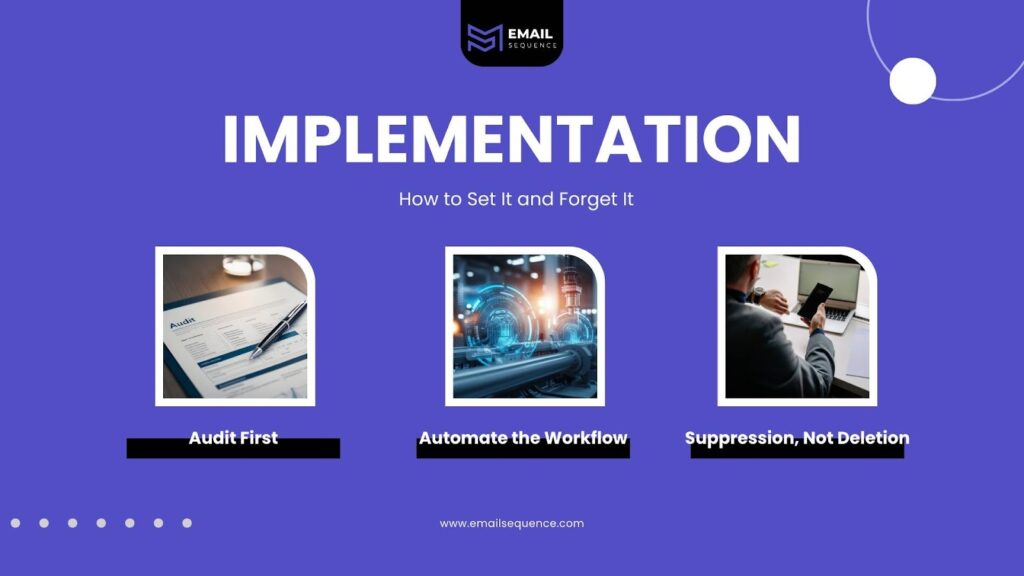
- Audit First: Run a “re-engagement threshold” test on your current list. Identify the number of subscribers classified under the “At-Risk” segment.
- Automate the Workflow: Set up dynamic segments in your ESP. Automatically trigger the win-back sequence once a subscriber hits 90 days of inactivity.
- Suppression, Not Deletion: Archive inactive leads rather than deleting them. This prevents you from accidentally re-importing them later or retargeting them in paid ad campaigns.
Handling the “Borderline” Exceptions
Not every business fits the standard model. You must adapt your sunset strategy based on your sales cycle.
- High-Ticket Sales Cycles: B2B brands often have longer decision periods. You may extend the sunset threshold to 12 months for these leads, provided you lower the email frequency.
- Seasonal Buyers: Identify “Black Friday Only” shoppers. Tag them specifically so they are not accidentally sunsetted in July. They are not unengaged subscribers; they are just seasonal.
Conclusion and Next Steps
An email sunset policy is not a funeral for your list; it is a rebirth for your deliverability. By removing the dead weight, you ensure your messages reach the people who actually want to buy from you. Your deliverability rates will climb, and your revenue per subscriber will increase.
Do not let inactive contacts drag down your ROI.
Not sure where your list stands? Use our AI Deliverability Calculator to audit your list health today, or let EmailSequence build your automated sunset flows for you.
Frequently Asked Questions (FAQs)
What is an email sunset policy?
An email sunset policy is a strategic process to identify, re-engage, and suppress inactive subscribers. It helps improve email deliverability and protects your sender reputation by focusing on engaged subscribers.
Why is removing inactive subscribers important?
Inactive subscribers harm your email engagement metrics and can lead to spam complaints or lower deliverability rates. Removing them ensures your emails reach an engaged audience.
How does a sunset policy improve email deliverability?
By stopping emails to uninterested subscribers, you reduce spam traps and improve engagement rates, signaling inbox providers to prioritize your messages.
What are disengaged contacts in email marketing?
Disengaged contacts are subscribers who show little to no interaction, such as not opening or clicking emails over a certain period.
How can I re-engage inactive subscribers?
Use a re-engagement campaign with compelling offers, personalized messages, and a clear call-to-action to win back their interest before suppression.