Email Urgency Copywriting: 9 Tactics to Drive Sales
A subscriber opens your email. They read the first few lines. They might even click a link. But then, they close the tab, telling themselves they will “come back to it later.” In most cases, “later” means never. This scenario is the nightmare of every email marketer.
To combat procrastination, successful campaigns rely on email urgency copywriting. By strategically implementing urgency and scarcity, you transform passive interest into immediate action. These psychological triggers compel readers to act now rather than risk missing out on a valuable opportunity.
In this guide, you will learn exactly how to harness the power of urgent messaging and scarcity tactics to increase open rates, boost clicks, and maximize conversions.
What Is Email Urgency Copywriting?
Email urgency copywriting is the art of using language and psychological triggers to encourage recipients to take immediate action. It shifts the reader’s mindset from “I might want this” to “I need to get this right now.”
While often used interchangeably, there is a distinct difference between urgency and scarcity:
- Urgency relates to time. It implies that an offer or opportunity will expire soon (e.g., “Sale ends at midnight”).
- Scarcity relates to quantity. It implies that the supply of a product or service is limited (e.g., “Only 5 seats remaining”).
Combining these two concepts creates a powerful dynamic. When a subscriber realizes that time is running out and supplies are dwindling, the pressure to act intensifies. This dual approach drives immediate response more effectively than either tactic used in isolation.
The Psychology Behind Urgency and Scarcity
Human beings are wired to react strongly to the possibility of loss. This behavioral trait, known as loss aversion, suggests that the pain of losing something is psychologically twice as powerful as the pleasure of gaining something.
When you apply urgency and scarcity tactics, you tap directly into this instinct. You are not just offering a benefit; you are highlighting the threat of losing that benefit.
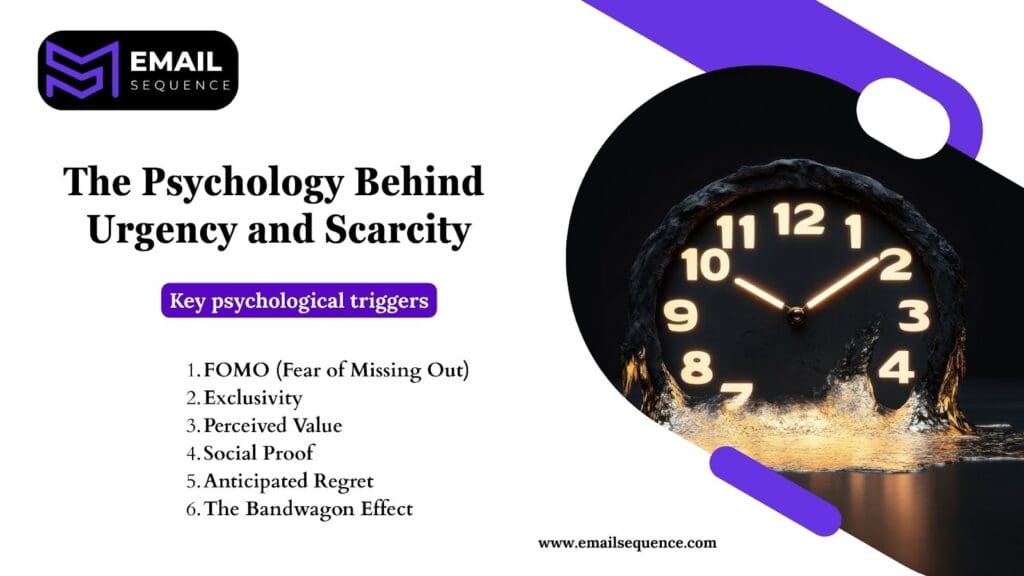
Key psychological triggers include:
- FOMO (Fear of Missing Out): The anxiety that others are getting a great deal or exclusive experience that you’re missing out on. In marketing, it creates a powerful urge to act before the opportunity vanishes.
- Exclusivity: Scarcity often implies a “members-only” feel. When something is limited, it feels more prestigious, desirable, and valuable to the few who can obtain it.
- Perceived Value: The “Scarcity Heuristic” leads us to believe that hard items to get are of higher quality or higher value than those that are abundant.
- Social Proof: When an item is selling out fast, it signals to others that the product is popular and high-quality, validating their desire to buy it.
- Anticipated Regret: This trigger makes customers think about how bad they will feel later if they don’t take action now, pushing them to convert to avoid future disappointment.
- The Bandwagon Effect: Similar to social proof, this psychological phenomenon occurs when people do something primarily because others are doing it, intensified by the clock ticking down.
By leveraging these triggers, email urgency copywriting bypasses the logical, procrastinating brain and appeals directly to the emotional, reactive brain.
Urgency & Scarcity Tactics That Work
Implementing these strategies requires more than just adding exclamation points. You need specific, actionable tactics that signal to the reader that delaying is not an option. Here are four proven methods to incorporate urgent messaging and scarcity into your campaigns.
Limited Time Offers
Time constraints are the most common form of urgency. However, vague deadlines like “ending soon” often fail to motivate action. Specificity is key.
Effective limited-time offers use:
- Deadlines with exact times: “Offer expires at 11:59 PM EST on Thursday.” This leaves no room for ambiguity.
- Countdown timers: A visual ticking clock embedded in the email creates a visceral sense of passing time.
- Reminder emails: Sending a “last chance” email a few hours before the deadline reinforces the urgency and captures procrastinators.
Low-Quantity Scarcity
Scarcity tactics work best when the limitation is tangible. If you are selling digital products, this can be trickier, but for physical goods or event-based offers, it is highly effective.
Examples of low-quantity scarcity include:
- Stock warnings: “Only 12 units left in stock.”
- Capacity limits: “Webinar room limited to 100 attendees.”
- Tiered pricing: “First 50 buyers get 50% off.”
By highlighting low availability, you create competition among your subscribers. They know that if they do not act, someone else will take their spot.
Exclusive Access Offers
Making subscribers feel special can drive immediate action. When an offer is framed as a privilege, the desire to claim it increases.
Exclusive access strategies involve:
- VIP offers: “Exclusive access for our gold members.”
- Early-bird access: allowing specific segments to purchase before the general public.
- Waitlists: Building anticipation for a product launch by limiting initial access to a select group.
This approach combines action triggers with the psychological need for status and belonging.
Deadline-Driven Bonuses
Sometimes, the main offer is not enough to spur immediate action. Adding a deadline-driven bonus can tip the scales.
This tactic involves:
- Free gifts: “Buy within the next 24 hours and get a free consultation.”
- Extra discounts: “Complete your purchase by Friday for an extra 10% off.”
- Fast-action bonuses: Rewards specifically for the first few people to respond.
These bonuses add layers of value that disappear if the user hesitates, reinforcing the email urgency copywriting strategy.
Action-Oriented CTAs
Your Call to Action (CTA) is the tipping point. Passive language here can undo all the hard work of your urgency copy.
To create action triggers in your buttons:
- Use strong verbs: “Claim Your Spot,” “Reserve Now,” “Get Instant Access.”
- Add temporal words: “Today,” “Now,” “Instantly.”
- Focus on the benefit: “Start Saving Today” is better than “Submit.”
A strong CTA commands the reader to act immediately rather than suggesting they consider it.
Step-by-Step Guide: Writing Emails That Drive Immediate Action
Creating effective urgency emails is a process, not a guess. Follow these steps to build campaigns that consistently generate an immediate response.
Step 1: Crafting the subject line to trigger opens:
The subject line is your first hurdle. Use active verbs, specific deadlines, and numbers to grab attention. Phrases like “24 Hours Left” or “Final Notice” clearly signal that time is a factor.
Step 2: Writing body copy that creates urgency without overwhelming the reader:
The body copy should explain why the deadline exists. Be clear and concise. Do not use all caps or excessive exclamation marks, as this can look like spam. Instead, use persuasive arguments about the value they will lose if they miss the deadline.
Step 3: Using clear call-to-action (CTA) buttons for immediate response:
Place your CTA prominently. Make sure it stands out visually. The text on the button should reinforce the urgent messaging used in the body copy.
Step 4: Strategically placing deadlines and scarcity elements in the email:
Put important information “above the fold,” so readers see it without scrolling. Repeat the deadline or scarcity warning near the CTA to reinforce the message right at the point of decision.
Step 5: Segmenting audiences to increase the relevance of urgency messaging:
Urgency is most effective when it is relevant. Send “low stock” alerts to people who viewed a specific product. Personalized urgency feels more like a service than a sales tactic.
Real Email Copy Examples
Seeing these tactics in action helps clarify how to apply them. Here are three examples of how to structure your subject lines and copy for maximum impact.
Limited-Time Offer Example:
- Subject: Only 48 Hours Left – Save 30% Today!
- Body: “The clock is ticking. You have less than 48 hours to claim your 30% discount. Once the timer hits zero, this price disappears forever.”
Low Stock Scarcity Example:
- Subject: Only 3 Seats Left – Register Now!
- Body: “We are almost at capacity. Only 3 seats remain for tomorrow’s workshop. If you want to secure your spot, you must act now.”
Exclusive VIP Access Example:
- Subject: Early Access for VIPs – Ends Today!
- Body: “As a VIP, you get first dibs. Shop the collection 24 hours before the public. But hurry, this exclusive access closes tonight.”
Do’s and Don’ts (Ethical Urgency & Scarcity)
While effective, urgency and scarcity must be used responsibly. False urgency destroys trust and damages your brand reputation.
| Do | Don’t |
| Be specific and truthful with deadlines and stock levels | Create fake scarcity repeatedly — erodes credibility |
| Use urgency sparingly to maintain trust | Overuse urgency in every email — leads to subscriber fatigue |
| Combine urgency with real value (discounts, bonuses, exclusive access) | Make vague or ambiguous promises that frustrate readers |
| Test different urgency tactics to see what drives action | Ignore performance metrics; don’t track open/click rates |
| Maintain brand voice while creating urgency | Pressure users in a manipulative or aggressive tone |
When NOT to Use Urgency
Urgency is a powerful tool, but it is not a hammer for every nail. There are times when a calm, supportive approach is better.
Avoid urgency in educational content or newsletters meant to build relationships. In these cases, adding stress to the reader’s experience feels forced and out of place. Similarly, if you are guiding a customer through a complex support issue, urgent messaging can cause anxiety rather than action.
Furthermore, consider your brand voice. If you are a luxury brand focused on relaxation and ease, screaming “BUY NOW” might clash with your identity. Always ensure your tactics align with your overall brand strategy.
Turn Passive Readers into Active Buyers
Email urgency copywriting is essential for cutting through the noise of a crowded inbox. By combining clear deadlines, limited availability, and psychological triggers like loss aversion, you drive immediate response from your subscribers.
However, the key to long-term success lies in authenticity. Use these urgent messaging and scarcity tactics honestly and ethically. When your audience trusts that your deadlines are real and your stock warnings are accurate, they will be trained to act quickly every time you send an offer.
Start testing these strategies today. Refine your copy, measure your results, and watch your conversions climb. Ready to turn your emails into a revenue-generating machine? Visit our website and discover how the right email sequence can transform your business. Take action now and supercharge your email marketing.
Frequently Asked Questions
What is email urgency copywriting?
Email urgency copywriting is the practice of using persuasive language, time‑sensitive deadlines, and scarcity triggers to motivate subscribers to take immediate action rather than delay or ignore an offer.
How does urgency improve email conversion rates?
Urgency taps into psychological triggers like FOMO (fear of missing out), loss aversion, and social proof, all of which make readers more likely to act quickly rather than procrastinate.
What is email urgency copywriting and why does it increase conversions?
Email urgency copywriting is the strategic use of time-sensitive language, scarcity cues, and psychological triggers in email marketing to prompt immediate action. By highlighting limited availability, deadlines, or exclusive opportunities, urgency-focused email copy reduces hesitation and increases click-through and conversion rates. When done ethically, it taps into loss aversion and prioritization without sounding pushy or spammy—making it a powerful tool for sales emails, product launches, and promotional campaigns.
How can you use email urgency copywriting without sounding manipulative or spammy?
To use email urgency copywriting effectively, focus on real deadlines, genuine scarcity, and clear value rather than exaggerated pressure. Use concise subject lines, action-oriented CTAs, and conversational urgency phrases like “ending tonight” or “last chance to join.” Avoid overusing countdown language or false claims, as trust is critical for long-term email engagement. Authentic urgency paired with customer-centric messaging drives results while protecting deliverability and brand credibility.
What’s the difference between urgency and scarcity in email marketing?
Urgency relates to time limits (e.g., offer ends tonight), while scarcity refers to limited quantity (e.g., only 10 items left). Combined, they amplify the incentive to act immediately.
How do I write an email subject line that creates urgency?
Use specific timeframes (“Ends Today,” “24 Hours Left”), action verbs (“Reserve Now”), and numbers (“Only 3 Seats Left”) to communicate that the opportunity won’t last.