Emotional Email Copywriting: Triggers That Drive Action
Ever find yourself clicking “Buy Now” on an email offer that just gets you? Or deleting another without a second thought? The difference isn’t always the deal, it’s the emotion behind it. Logic might make the case for a purchase, but it is the power of copywriting combined with raw human emotion that compels the click.
Great copy taps into the right feelings to transform passive readers into active buyers, sometimes in just seconds. It is not just about selling a product; it is about creating a connection that resonates deeply.
By mastering emotional email copywriting, you unlock the ultimate tool for driving results. As a copywriting expert, let me guide you through the process of integrating powerful psychological tactics into your strategy.
Copywriting isn’t just words on a page; it’s the bridge between your message and your audience’s desires. Let’s harness its power together.
What Is Emotional Email Copywriting?
Emotional email copywriting is the practice of using language that elicits a specific feeling to prompt an immediate behavior. Unlike standard persuasive copy, which relies heavily on features, logic, and rational arguments, emotional copy targets the subconscious drivers of human behavior.
Emotional appeals cut through the noise of a crowded inbox. While informational copy focuses on features and logic, emotional copy targets the subconscious drivers of human behavior.
The Psychology Behind Response Triggers
Understanding how emotions influence decision-making transforms how you write. When you tap into persuasion psychology, you move from guessing what works to engineering specific outcomes.
Why do certain subject lines command attention while others fade into the background? The answer lies in how our brains prioritize information that signals danger, opportunity, or connection.
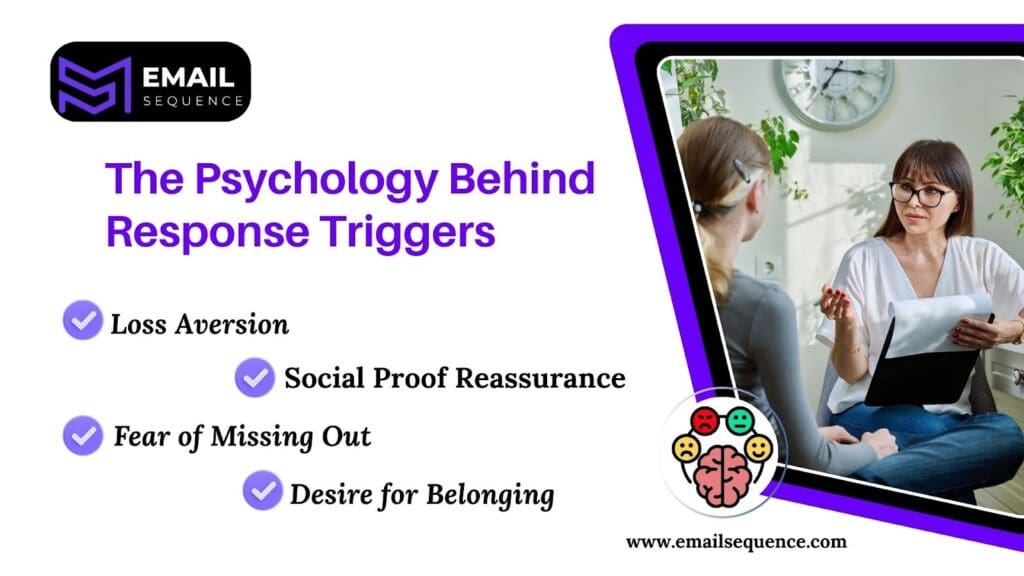
Here are the key psychological principles that drive engagement:
- Loss Aversion: The psychological pain of losing something is twice as powerful as the pleasure of gaining it.
- Social Proof Reassurance: People look to the actions of others to determine correct behavior, especially in uncertain situations.
- Fear of Missing Out (FOMO): The anxiety that an exciting or interesting event may currently be happening elsewhere, often aroused by posts seen on social media.
- Desire for Belonging: Humans have an innate need to be part of a group, making exclusive communities highly attractive.
- Reward Anticipation: The brain releases dopamine not when we receive a reward, but when we anticipate it.
These principles directly correlate with email engagement metrics. Psychological triggers like curiosity increase open rates, while trust and social proof drive click-through rates.
The 7 Core Emotional Triggers That Make Emails Convert
You do not need to reinvent the wheel to write high-converting emails. Focusing on these seven core triggers will provide a solid foundation for your emotional marketing strategy.
1. Curiosity
Curiosity works by creating an “information gap”—a space between what your reader knows and what they want to know. The brain instinctively wants to close this gap, making it a powerful tool for boosting open rates.
- Example Subject Line 1: “Don’t open this email (unless you want to triple your traffic).”
- Example Subject Line 2: “The one myth about email marketing we need to debunk.”
2. Urgency & FOMO
Urgency and the Fear of Missing Out (FOMO) push subscribers to act now rather than later. This trigger is based on the principle of loss aversion; people are more motivated to avoid a loss than to acquire a gain.
- Example CTA 1: “Last chance: 50% off ends at midnight.”
3. Fear & Pain Avoidance
This trigger addresses a problem your audience is already facing. By carefully agitating a known pain point, you can position your solution as the ideal form of relief. This must be used ethically; the goal isn’t to scare your audience, but to show you understand their challenges and have a clear path to resolving them.
- Example Copy: “Is your current software slowing your team down? Here’s how to fix it.”
4. Desire & Aspiration
Instead of focusing on pain, this trigger taps into pleasure and ambition. It paints a picture of who the reader wants to become or what they want to achieve. Connect your product not just to a feature but to a feeling or a future state, such as more successful, healthier, or more fulfilled.
- Example Copy: “Imagine closing deals with confidence every single time.”
5. Belonging & Identity
Humans are social creaturesOnce you’ve validated their emotions, it’s time to introduce your solution as the logical next step with a deep need to belong. Frame your offer as an entry ticket into an exclusive group or a way to reinforce a subscriber’s identity.
When your message aligns with their sense of self, it feels less like a sales pitch and more like an invitation.
- Example Copy: “Join 20,000+ top marketers who are already using our framework
6. Trust & Safety
Every purchase decision involves some level of risk. This trigger works to remove that friction by providing reassurance. Use social proof (testimonials, reviews), data, guarantees, and clear, authoritative language to make the decision feel safe and smart.
- Example Copy: “Loved by over 5,000 teams and rated 4.9/5 stars.”
7. Surprise & Delight
Unexpected positive rewards trigger dopamine, creating a memorable and positive brand association. This isn’t about predictable discounts; it’s about genuine, unexpected value. Use this for building loyalty with existing customers, turning them from one-time buyers into enthusiastic brand advocates.
- Example Copy: “We noticed you’re a loyal customer, so here’s exclusive early access.”
Emotional Appeals: Which One to Use for Which Audience?
Emotional marketing works differently depending on the relationship you have with the subscriber. A cold prospect requires a different approach than a loyal customer. You must map your response triggers to the customer’s stage in the journey to maximize impact.
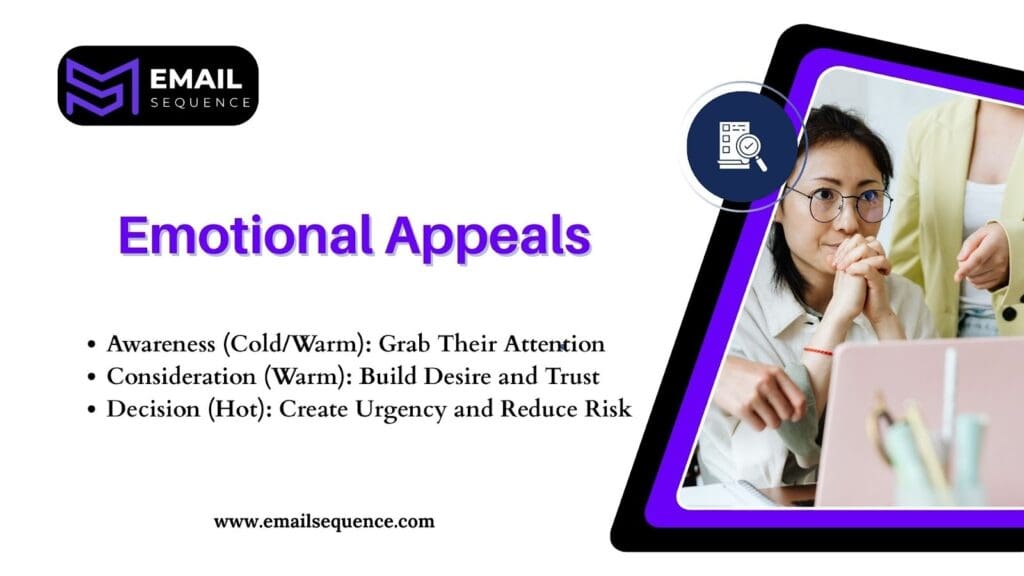
Awareness (Cold/Warm): Grab Their Attention
At this stage, your audience is either unaware or just starting to notice your brand. Use elements of curiosity and surprise to make them stop scrolling and pay attention. Think catchy headlines, intriguing visuals, or unexpected statements that spark interest.
Consideration (Warm): Build Desire and Trust
Now that they’re paying attention, it’s time to show them why they need your solution. Focus on creating desire by emphasizing benefits, fostering a sense of belonging, and showcasing social proof. Share testimonials, case studies, or examples of others who have successfully used your product or service.
Decision (Hot): Create Urgency and Reduce Risk
When your audience is ready to decide, raise the stakes and make it easy for them to say yes. Use tactics like fear of missing out (FOMO), urgency (limited-time offers), and trust-building (money-back guarantees). The goal here is to nudge them over the finish line with confidence.
Step-by-Step Process: How to Write High-Converting Emotional Email Copy
Writing copy that connects requires a systematic approach. Follow this detailed process to ensure every email you send leverages the right emotional email copywriting tactics.
Step 1: Define the Emotion You Want to Trigger
Choose one primary emotion such as curiosity, fear, desire, or trust. Connect this emotion directly to your reader’s biggest challenge or deepest desire to create a genuine connection.
Understand what drives them, what they truly need or want, and use that emotion to speak directly to their heart.
Step 2: Understand the Reader’s Psychological State
To craft targeted emotional appeals, you must analyze the reader’s current mindset. Are they feeling overwhelmed, excited, or anxious? Understanding their state of mind allows you to tailor your message for maximum impact.
Think about their daily challenges, their aspirations, and what keeps them up at night. Ask yourself the following questions to gain clarity:
- What do they fear most right now?
- What is the specific outcome they desire?
- What objections prevent them from acting?
- What motivates them to seek a solution?
Step 3: Craft an Emotion-Based Subject Line
Your subject line has a big job to do. It’s the first thing your subscribers see, and it’s often the deciding factor in whether they open your email. Use curiosity, urgency, or intrigue to grab attention and ensure it resonates with your audience’s needs or interests.
Keeping the subject line under 40 characters ensures clarity and impact, but don’t sacrifice value for brevity. Here are some unique and engaging ideas for killer subject lines:
- “You’re just one step away from [desired benefit]”
- “This limited-time offer is too good to miss!”
- “Say goodbye to [specific pain point] for good.”
- “Your quick guide to mastering [relevant topic]”
- “Can we help you solve [specific problem]?”
- “Here’s what you’ve been waiting for…”
Step 4: Begin With an Emotionally Resonant Opening Line
You have roughly two seconds to hook the reader. Start with a relatable emotion, a specific fear, a strong desire, or a story that places them immediately in the narrative.
Here’s how to craft an opening that resonates:
- Ask a question that targets a core emotion: “Are you tired of feeling overlooked in meetings?”
- Make a bold statement they can relate to: “That Sunday evening dread is a sign it’s time for a change.”
- Paint a picture of a desired future: “Imagine finishing your workday with energy to spare.”
Step 5: Highlight the Pain Point or Desire Using Empathy
Show the reader you understand their emotional state to build a genuine connection. Use emotional marketing to mirror their feelings and validate their experience before you pitch.
Step 6: Introduce the Solution Using Persuasion Psychology
Once you’ve validated their emotions, it’s time to introduce your solution as the logical next step. This is where you bridge the gap between their pain and your remedy, making your offer feel like a natural resolution rather than a sales pitch.
- Frame Your Solution as Relief: Position your offer as the answer to their frustration. For example, “That’s why we created [Your Product], to ensure every ounce of your effort translates into measurable success.”
- Connect Features to Feelings: Don’t just list features; explain how they solve the emotional problem.
- Make It the Hero: Present your solution as the tool that empowers them to overcome their challenges. You’re not just selling a product; you’re offering them a way to become the hero of their own story.
Step 7: Add Proof or Social Validation
Trust triggers reduce the friction of the ask. Incorporate testimonials, specific results, or case studies to prove your claims are credible.
Step 8: Use a Clear, Emotion-Driven CTA
Your call to action should tie back to the primary emotion of the email.
- Desire CTA: “Claim your transformation.”
- Fear CTA: “Stop losing revenue today.”
- Curiosity CTA: “See what is inside.”
Examples of Emotional Email Copy (Mini Frameworks)
Seeing these concepts in action helps clarify how to structure your drafts. Here are five mini-frameworks you can adapt.
Fear-Based
- Subject: The mistake costing you sales
- Body: Most CEOs ignore this metric until it is too late. Do not let your quarterly goals slip away because of a blind spot.
- CTA: Fix the leak now.
Curiosity-Based
- Subject: You should see this…
- Body: We found something interesting in the data this week. It challenges everything we thought we knew about retention.
- CTA: Reveal the data.
Desire-Based
- Subject: Imagine your inbox looking like this
- Body: Picture waking up to zero unread messages and a perfectly organized schedule. It is not a dream; it is your new Monday morning.
- CTA: Get organized instantly.
Trust-Based
- Subject: We have got your back
- Body: Trying a new tool feels risky. That is why we cover you with a 60-day guarantee. If you do not love it, we will refund you. No questions asked.
- CTA: Start your risk-free trial.
Identity-Based
- Subject: For the rebels
- Body: This course is not for everyone. It is for the creators who refuse to settle for the status quo.
- CTA: Join the movement.
Mistakes to Avoid in Emotional Email Copywriting
While powerful, emotion can backfire if used incorrectly. A poorly executed emotional appeal can feel manipulative, damage your brand’s credibility, and lead to unsubscribes. To maintain a healthy and trusting relationship with your email list, it’s crucial to avoid these common pitfalls.
- Overusing Fear: Constant alarmism numbs the audience and creates fatigue.
- Manipulative Language: Never trick the reader into opening an email with false promises.
- Too Much Hype: Persuasion psychology works best when it feels authentic, not exaggerated.
- Emotional Inconsistency: Ensure the emotion in the subject line matches the body copy.
- Not Aligning with Brand Voice: If your brand is serious, avoid overly playful curiosity triggers that feel out of character.
Advanced Techniques for Emotional Email Copy (Pro-Level)
Once you’ve mastered the foundational techniques of emotional email copywriting, it’s time to explore more sophisticated strategies for an even greater impact.
By layering different methods, such as combining multiple response triggers, you can create a message that is significantly more compelling and persuasive.
Consider these advanced strategies to elevate your copy:
- Layering Triggers: Combine curiosity with FOMO (e.g., “See the secret deal before it expires”).
- Pattern Interruption: Use unexpected formatting or tone to jolt the reader out of autopilot.
- Open Loop Storytelling: Start a story in one email and finish it in the next to keep them reading.
- Sensory Words: Use visceral language that evokes sight, sound, and touch to intensify emotions.
- Testing Frameworks: Rigorously A/B test different emotional angles to see what resonates best.
Conclusion & Quick Action Plan
Emotional email copywriting transforms bland messages into compelling narratives that drive revenue. By understanding what motivates your audience and applying the right triggers, you move beyond simple communication and achieve a genuine connection.
Do not overwhelm yourself by trying everything at once. Start with this simple 7-day experiment:
- Pick a Trigger: Choose “Curiosity” for your next campaign.
- Choose a Metric: Focus on Open Rate as your key performance indicator.
- Run 2 Variants: Send one generic subject line and one curiosity-driven subject line. Measure the difference.
Document your results and iterate. Your audience will tell you exactly what they feel; you just have to listen. Ready to dive deeper? Visit emailsequence.com for more advanced strategies and templates.
Frequently Asked Questions
Is emotional email copywriting manipulative?
No, not when used ethically. It simply aligns your message with how human beings naturally process information and make decisions.
Which trigger works best for cold B2B outreach?
Curiosity and Pain-Avoidance often work best. You must pique their interest or show you can solve a burning problem immediately.
How soon will I see results?
You can see changes in Open Rates immediately. Changes in conversion typically happen as you refine your emotional messaging over a few campaigns.
How many emotional triggers can I combine?
Focus on one primary emotion per email to keep the message clear. You can layer a secondary trigger (like urgency) near the CTA.
What KPIs should sales teams care about most?
Sales teams should focus on Reply Rate and Conversion Rate. High open rates mean the subject line worked, but replies mean the emotional hook landed.