A Guide to Flawless Subscriber Onboarding | Email Sequence
Did you know that 70% of subscriber churn happens within the first 21 days? This early period is a critical window where new users decide if your service is valuable. Many businesses make the mistake of viewing onboarding as just a single welcome email. This approach fails to address the user’s initial needs and questions. True success lies in treating subscriber onboarding as a core retention strategy.
Effective onboarding isn’t just a welcome; it’s an active process designed to quickly showcase your product’s core value. Many strategies fail by sending the same messages to all users, rather than adapting to individual behavior.
This guide will provide a different path. We will show you how to build a powerful subscriber onboarding system that drives engagement and reduces churn. The key is to define a specific User Activation Action (UAA) and then deploy automated email sequences that respond to user behavior.
This method translates directly into higher activation rates and greater long-term retention. By following this blueprint, you can stop churn before it starts and turn new sign-ups into loyal customers.
The Foundation (The Static Welcome Process)
The first step in building a strong onboarding sequence is to perfect the initial welcome process. Your goal here is to achieve 100% email deliverability, eliminate any friction for the new user, and clearly set expectations for what comes next. This is the bedrock upon which your entire subscriber journey is built.
Email 1: The Instant “Thank You” & Access Email (Trigger: Sign-up)
When a user signs up, your first email must be immediate, clear, and valuable. This initial interaction sets the tone for your entire relationship. How can you ensure it makes the right impression?
- Action 1: Immediate Value Delivery: Do not make users wait. Your first email must provide immediate access to whatever you promised, whether it is a download link for a freebie or a login page for your service.
- Action 2: The “From” Field Trust: Build trust from the very first email. Send your message from a real person’s name, like “Jane at [Company],” or a dedicated team, such as “The [Company] Onboarding Team.” Avoid impersonal and untrustworthy addresses like “Do Not Reply.”
- Action 3: Set Expectations: Briefly explain what the user can expect from you in the coming days. Introduce the subscriber journey and let them know what valuable information is on the way.
The Dynamic Flow Blueprint (Driving User Activation)
Now, it’s time to make your subscriber onboarding truly impactful. Your primary objective is to guide each new user to the moment they experience the core value of your product for the first time. Aim to achieve this within 48 hours of sign-up for an effective onboarding experience.
The strategy involves a branching email sequence based on a single, critical trigger: whether the user has performed the User Activation Action (UAA).
A. Flow A: The Engaged Path (User HAS Performed the UAA)
This path is for users who have taken the desired first step. They are engaged and ready for what is next. Your goal is to reinforce their positive action and guide them toward deeper engagement.
The User Action Assessment (UAA) is a process designed to evaluate and confirm a user’s understanding or completion of a specific task. It ensures users meet certain criteria before moving forward.
Once a user completes the UAA, it’s important to send a confirmation email. This immediate feedback not only validates their effort but also encourages continued engagement. The email should include the following:
- A congratulatory message acknowledging their achievement.
- A clear confirmation of their successful completion,
- Contact information for support in case they have further questions
Email 2A: The “Success Confirmed” Email (Trigger: UAA Completion)
Once a user completes the UAA, send an email that confirms their success. This immediate feedback validates their action and builds momentum. What should this email include?.
- Action 4: Acknowledge & Reward: Acknowledge their specific achievement. For example, send a message like, “Your first campaign is running!” or “You have successfully created your first project.”
- Action 5: Next-Level Value: Do not stop there. Immediately offer the next logical step to enhance their experience. Provide links to optimization tips, advanced feature tutorials, or other resources that encourage deeper exploration of your product.
B. Flow B: The Hesitation Path (User HAS NOT Performed the UAA)
This path is designed for users who have not yet taken the key activation step. Your mission is to identify and remove the friction that is holding them back.
Email 2B: The “Quick Win” Nudge (Trigger: 24 Hours No UAA/No Login)
If a user has not performed the UAA within 24 hours, it is time for a gentle nudge. This email should make it incredibly easy for them to get started and help them overcome any initial hesitation.
- Action 6: Focus on Micro-Friction: Offer a simple, low-effort solution. Provide a link to a 5-minute setup video or a 1-click template that gets them started instantly. The goal is to offer a quick win.
- Action 7: Overcome the Biggest Barrier: Directly address the most common obstacle that new users face. For instance, you could say, “Do not get stuck on Step 1—here is an easy fix to get you moving.”
Long-Term Habit Building (Retention & Segmentation)
Once a user is activated, the focus shifts to building long-term habits and retaining them as a customer. This phase of the new user onboarding process uses customer onboarding emails to segment users and deliver highly relevant content that keeps them engaged beyond the first week.
A. Email 3: The Social Proof Email (Day 5/7)
Show new users what success looks like by highlighting real-life examples and relatable stories. Share testimonials, case studies, or user-generated content that illustrates how others have benefited from your service.
Use social proof to inspire confidence, showing them the tangible long-term value they can expect. Authentic experiences resonate, so focus on genuine results that align with their goals.
Action 8: Show the Future
Share a brief case study or testimonial from a user who achieved the UAA and has seen great results. This helps new subscribers visualize their own potential success.
Action 9: Aspirational Content
Answer the question, “What does life look like after 30 days of using this product?” Paint a picture of the benefits and outcomes they can expect if they continue to engage.
B. Email 4: The Survey/Feedback Email (Day 10/14)
Don’t wait for users to leave before you find out what went wrong. Being proactive during Subscriber Onboarding and asking for feedback is one of the simplest yet most powerful ways to prevent churn.
A well-timed survey during this stage not only provides invaluable insights into your user experience but also shows your subscribers that you care about their journey and are committed to helping them succeed.
Action 10: Proactive Churn Prevention
Ask one straightforward question: “What is confusing you right now?” This direct approach encourages honest feedback and helps you understand user pain points.
Action 11: Segmentation Trigger
Use this opportunity to segment users based on their needs. Offer options for help, such as “Do you need help with X?” When a user clicks a link, you can automatically place them into a specialized help sequence that addresses their specific problem.
V. Technical Implementation & Measurement
To execute this strategy effectively, it’s crucial to have the right technical foundation in place. Understanding the essential technical details is key to ensuring success.
- Technical Tip 1: The “Clean Start”: Use a dedicated IP address or a new subdomain specifically for your user onboarding emails. This protects the deliverability of your main domain and ensures your critical onboarding messages land in the inbox.
- Technical Tip 2: Measuring Activation: The primary Key Performance Indicator (KPI) for your onboarding sequence should be the user activation rate. While open and click rates are useful, your main goal is to get users to perform the UAA. Define and track this conversion rate closely.
The quality of your customer onboarding emails directly influences the lifetime value of your subscribers. A well-executed strategy turns new users into advocates.
Your Dynamic Onboarding Checklist
Successful subscriber onboarding is not about sending a static welcome email. It is about creating dynamic content that guides users to value and builds lasting habits.
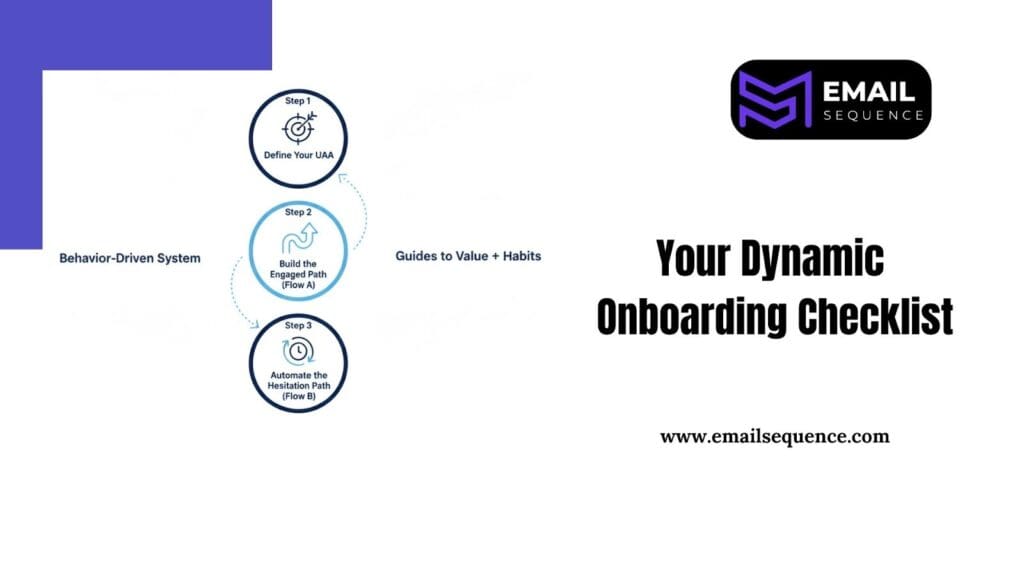
Here are the three essential steps to take today:
- Define your UAA today.
- Build the Engaged Path (Flow A) first.
- Automate the Hesitation Path (Flow B) to stop churn before it starts.
By designing high-converting, dynamic email sequences, you can transform your onboarding process from a simple greeting into a powerful engine for growth and retention.
Conclusion
Building an effective user onboarding process is crucial for the growth and retention of any business. By defining your Unique Actionable Advantage (UAA) and implementing the Engaged Path and Hesitation Path strategies, you can create a seamless onboarding experience that not only converts users but also prevents early churn.
With the power of email sequences, you can engage with your users in a dynamic and personalized way, turning subscriber onboarding into a seamless experience that guides them toward success with your product or service. So why wait? Take action today and transform your onboarding process into a powerful engine for growth and retention.
Visit our website, emailsequence.com, to learn more about how we can help you design high-converting email sequences for your onboarding process.
Frequently Asked Question
What is subscriber onboarding?
Subscriber onboarding is the process of guiding new users through your product or service, helping them reach their first success quickly, and ensuring they understand the value you offer.
Why is subscriber onboarding important?
Effective onboarding reduces early churn, increases engagement, and turns new sign-ups into loyal customers by showing value in the first 21 days.
What is a User Activation Action (UAA)?
A UAA is a specific action that shows a user has experienced your product’s core value, such as completing a setup, sending their first email, or creating a project.
What should the first onboarding email include?
It should provide immediate value, build trust with a real sender, and set clear expectations for the next steps in the onboarding journey.
How can social proof improve subscriber onboarding?
Social proof, like testimonials or case studies, shows new users the results others have achieved, inspiring confidence and motivating them to complete key actions.