Email Copywriting Tips: 6 Formulas That Convert Better
On average, a person is hit with over 120 emails each day. Most marketers get lost in this digital flood because they see email as just a way to announce a new feature or share a blog post.
By using proven psychological triggers and persuasive language, strong copy can increase open rates by over 20% and click-through rates by as much as 300%, turning a simple message into a powerful revenue-generating tool..
To succeed, you need to leverage persuasive writing rather than descriptive writing. This shift requires a framework built on three core pillars: Clarity, Credibility, and Emotional Resonance. These pillars transform static text into a dynamic sales tool that cuts through the noise.
In this guide, we will move beyond basic advice and focus on high-impact formulas. We will explore how specific email copywriting tips can help you overcome distraction and increase your revenue. You will learn how to structure your message so that every word earns its place and every sentence leads closer to a conversion.
Pillar 1: Clarity (The Foundational Email Writing Techniques)
Your reader should never have to guess what you offer or what to do next. Confusion kills conversions, yet many writers hide their message behind vague promises or clever wordplay.
With billions of emails sent daily and projected to hit 376 billion by 2026, you only have seconds to grab attention. Prioritize clarity and directness to make your point quickly and effectively.
To achieve this, you must master foundational email writing techniques that strip away ambiguity.
Tip 1: Master the AIDA Funnel (Attention, Interest, Desire, Action)
Looking for email copywriting tips to help organize your thoughts in a short email? The AIDA framework provides a logical flow that guides the reader from the subject line to the click without wasting a single syllable.
- Attention (Subject Line):
Your subject line has one job. It must stop the scroll and force the user to open the email. Use curiosity or a bold promise to grab their attention immediately. - Interest (Opening Lines):
Hook the reader by addressing a relevant problem or a desire they already hold. You must demonstrate that you understand their current reality before you can change it. - Desire (Body Copy):
Show them how their life improves with your solution. This section builds the bridge between their problem and your product, creating a craving for the result you offer. - Action (CTA):
Tell them exactly what to do next. Do not be subtle; use clear, command-oriented language that leaves no room for hesitation.
Tip 2: The 1-Minute Rule & 1-Goal Rule
Why do so many emails fail to generate a click? It often boils down to cognitive overload. When a reader is presented with too much information or too many choices, their brain defaults to the easiest option: doing nothing.
This is why simplicity and focus are your greatest allies in email marketing. By overwhelming your audience, you inadvertently encourage them to disengage rather than convert.
- The 60-Second Scan:
Your email must be readable in under one minute. If the reader sees a wall of text, they will likely delete it before reading a single word. - Single Focus:
Assign one specific goal to every email you send. Whether it is downloading a white paper or purchasing a product, focusing on a single objective increases the likelihood of success. - Singular Call-to-Action:
Include only one primary Call-to-Action (CTA). offering multiple choices leads to decision paralysis, which often results in the user taking no action at all.
Tip 3: The Preview Text Power Play
One of the most overlooked email copywriting tips involves the preview text. Are you ignoring this valuable real estate right next to your subject line? The preview text is often the deciding factor for whether an email gets opened or archived.
Use this space to tease the value inside, ask a compelling question, or highlight an irresistible offer. Don’t waste it with generic filler like “Can’t see this email? Click here.” Make every word count and watch your open rates soar!
- Complete the Thought:
Use the preview text to finish the sentence started in your subject line. This creates a cohesive message before the email is even opened. - The Curiosity Loop:
Tease the content inside without giving it all away. Persuasive writing relies on creating an information gap that the reader feels compelled to close by clicking open. - Avoid Repetition:
Do not repeat the subject line in the preview text. Use this space to add new context or urgency that supports your main hook.
Pillar 2: Credibility (Conversion Copy Formulas for Trust)
Once you have captured attention, you must sustain it by proving that you are trustworthy. Skepticism is the default state of the modern consumer, and your copy must work hard to dismantle it. This section focuses on conversion copy structures that establish authority and proof.
These formulas help you present your solution as the only logical choice.
Formula 4: The PAS (Problem-Agitate-Solve) Framework
Is your audience aware they have a problem, but unaware of the severity? The PAS framework is essential for B2B and SaaS markets because it forces the reader to confront the cost of inaction.
- Problem (Identify the Pain):
Call out the specific issue your reader faces. Be precise in your description so they feel seen and understood instantly. - Agitate (Twist the Knife):
Deepen the wound by explaining the consequences of leaving the problem unsolved. Discuss the lost revenue, the wasted time, or the stress it causes. - Solve (Present the Solution):
Introduce your product as the relief they have been waiting for. After high agitation, your solution will feel like a breath of fresh air.
Formula 5: Simplify the “How” with the BAB (Before-After-Bridge) Framework
Do you sell a transformation or a result? The BAB framework is one of the most effective email writing techniques for showing the value of a product by contrasting the present with a better future.
- Before (Current State):
Describe the reader’s world as it is now, complete with its frustrations and limitations. This validates their current struggle. - After (Aspirational State):
Paint a vivid picture of what life looks like after the problem is solved. Focus on the emotions and benefits of this new reality. - Bridge (The Vehicle):
Position your product as the vehicle that takes them from “Before” to “After.” This makes the purchase feel like a necessary step toward their goals.
Formula 6: The FAB (Features-Advantages-Benefits) Translator
Do you find yourself listing technical specifications that bore your readers? You must learn to translate cold features into warm benefits that resonate with human needs.
Features (What it is):
These are the specific, factual, and often technical aspects of what you’re selling. Think of them as the ‘what’ of your product. For example, “Our software has an automated reporting tool.”
This statement is objective and verifiable. It’s the building block, but on its own, it doesn’t sell. Your customer is probably thinking, “So what?” That’s where the next steps come in.
Advantages (What it does):
- Simplifies your workflow by gathering data from all your channels.
- Combines everything into one easy-to-use dashboard.
- Saves time by eliminating the need to switch between platforms.
- Gives you a clear, big-picture view of your performance.
Benefits (Why it matters):
Describe the ultimate payoff for the user. “You save ten hours a week on manual data entry, allowing you to leave the office on time every Friday.”
Pillar 3: Emotional Resonance (Advanced Sales Copy Tips)
Logic may justify a purchase, but emotion drives the decision to buy. To trigger immediate action, effective email copywriting tips often suggest tapping into psychological drivers like fear, belonging, and reciprocity.
These sales copy tips are designed to push the hesitant reader over the line.
Tip 7: Proactive Objection Handling
What’s the one thing stopping your ideal customer from hitting “buy”? Is it the price? The timing? Or maybe they just don’t trust you yet? Whatever it is, you can’t just cross your fingers and hope they’ll ignore that nagging doubt.
You need to address it head-on. By tackling their biggest hesitation directly in your copy, you show that you understand their concerns and have a solid answer, building trust and clearing the path to purchase.
- Identify the Top Objection: Ask your sales team: What’s the number one reason prospects hesitate? Is it the price? The complexity of implementation? A perceived lack of features? Pinpoint the biggest deal-breaker.
- Address It Directly: Dedicate a section of your copy to dismantling that objection. If it’s price, create a “Is [Your Product] Worth It?” section that breaks down the ROI. If it’s complexity, include a testimonial from a customer who found the onboarding process surprisingly simple.
- Use Social Proof as Your Weapon: Feature a quote from a customer who had the same objection. For example: “I was worried about the cost, but after just one month, we saved over $2,000 in wasted ad spend. It paid for itself instantly.” This shows you understand their hesitation and proves it’s unfounded.
Tip 8: The Reciprocity Principle
Why should the reader do something for you if you have done nothing for them? The principle of reciprocity states that humans feel a natural obligation to return favors, making this a powerful tool in conversion copy.
- Give First:
Offer something of genuine value before you ask for the sale. This could be a free template, a unique insight, or a helpful checklist. - Create Goodwill:
Ensure the value you provide is high quality. Sending a low-value freebie can actually damage your credibility rather than build it. - The Ask:
When you finally make your request, it will land more softly. The reader will be more inclined to say yes because you have already deposited value into the relationship.
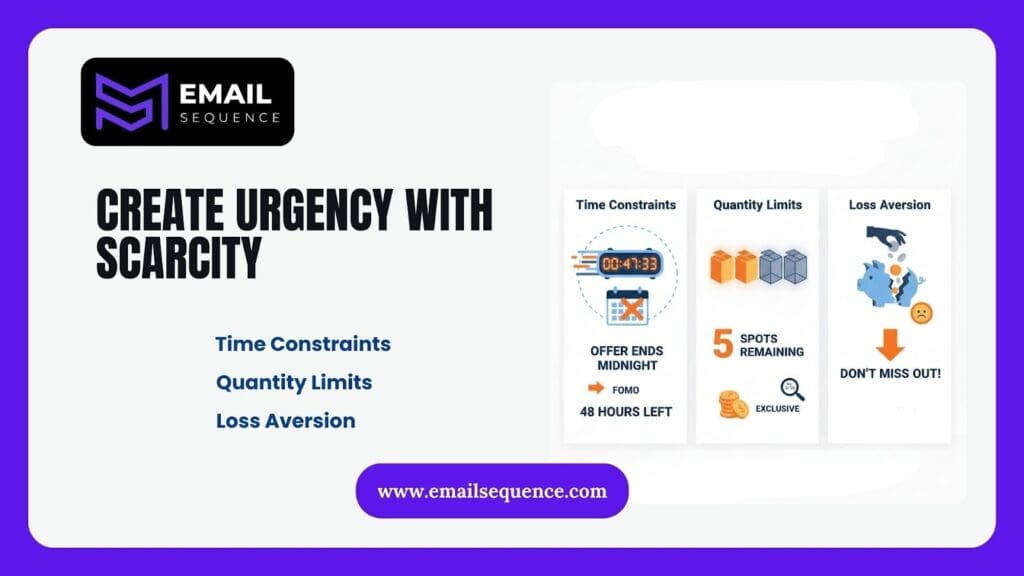
Tip 9: Create Urgency with Scarcity
Your offer should never feel like it will always be available. If the audience believes they can act later, they’ll delay their decision. To drive action, you need to create a sense of urgency.
Use sales copy tips that highlight limited-time offers, exclusive deals, or time-sensitive benefits to encourage immediate engagement and prevent procrastination.
- Time Constraints:
Use deadlines to force a decision. Phrases like “offer ends at midnight” or “48 hours left” trigger a fear of missing out (FOMO). - Quantity Limits:
Highlight scarcity if there is a physical limit to what you sell. “Only 5 spots remaining” is often more powerful than a discount. - Loss Aversion:
Frame the urgency around what they will lose rather than what they will gain. Humans are psychologically wired to avoid loss more than they seek gain.
Conclusion
We have moved from viewing emails as simple notifications to understanding them as strategic assets. Successful email copywriting tips rely on moving away from static lists and adopting a systematic approach built on the three pillars of Clarity, Credibility, and Emotional Resonance.
You do not need to reinvent the wheel every time you open a new draft. By using compelling content formulas, you ensure that every message you send is optimized for persuasion.
Choose one of the three core formulas, PAS, BAB, or FA, and apply it to your next sales email immediately. Do not wait for inspiration to strike; rely on the frameworks that have proven to work time and time again.
As you implement these strategies, you will see that persuasive writing is not an art reserved for the gifted but a skill that can be mastered by anyone willing to follow the blueprint. Ready to take your writing to the next level? Visit emailsequence.com for more tips and resources!
Frequently Asked Questions
What is email copywriting?
Email copywriting is the skill of writing persuasive emails that drive opens, clicks, and conversions. It focuses on message clarity, psychology, and strategic structure.
What makes an email high-converting?
A high-converting email uses clarity, credibility, and emotional triggers to persuade the reader. Strong hooks, proof elements, and a focused CTA make the biggest difference.
How do I write a compelling subject line?
Use curiosity, urgency, or a bold promise to grab attention instantly. Keep it short, direct, and aligned with the value inside the email.
What is the AIDA formula in email copywriting?
AIDA stands for Attention, Interest, Desire, Action. It helps structure your email so the reader flows from the subject line to the CTA naturally.