How to Write an AI Cold Email: Step-by-Step Guide
AI cold email writing tools generate structured outreach messages faster. They help draft subject lines, personalize copy, and write follow-ups. However, AI doesn’t replace strategy; it just speeds up the writing process.
To use AI effectively, start with an AI copywriting or email tool to create your first draft. Provide clear prompts and context about your audience and offer. Then, manually refine the AI-generated text. This ensures the email has a human tone, is relevant to the recipient, and is more likely to get a response.
What AI Actually Does in Cold Email Writing
AI as a Writing Assistant, Not a Replacement
AI does not understand your prospect the way a human does. Instead, it processes patterns and generates structured text based on your instructions. That makes it a writing assistant, not a decision-maker.
You use AI to:
- Speed up drafting
- Generate multiple variations
- Improve sentence clarity
- Structure email flow
You should never rely on AI to decide messaging direction without input.
Key Areas Where AI Helps Most
Certain writing tasks benefit greatly from computational speed. You can generate dozens of subject lines in seconds. Are you wondering exactly which tasks to delegate? Consider these specific areas where algorithms excel.
- Subject line variation generation for split testing
- Email opener ideation based on firmographic data
- Value proposition phrasing simplification
- Call to action formulation
Where AI Fails Without Human Input
AI excels at structured tasks, but it often falls short in areas that require a human touch. Without careful guidance, AI struggles with:
- Real emotional context
- Industry nuance
- Offer positioning
- Trust-building tone
If you copy and paste an AI cold email directly, it will likely sound generic and reduce your reply rates.
Step-by-Step Workflow for Writing Cold Emails Using AI
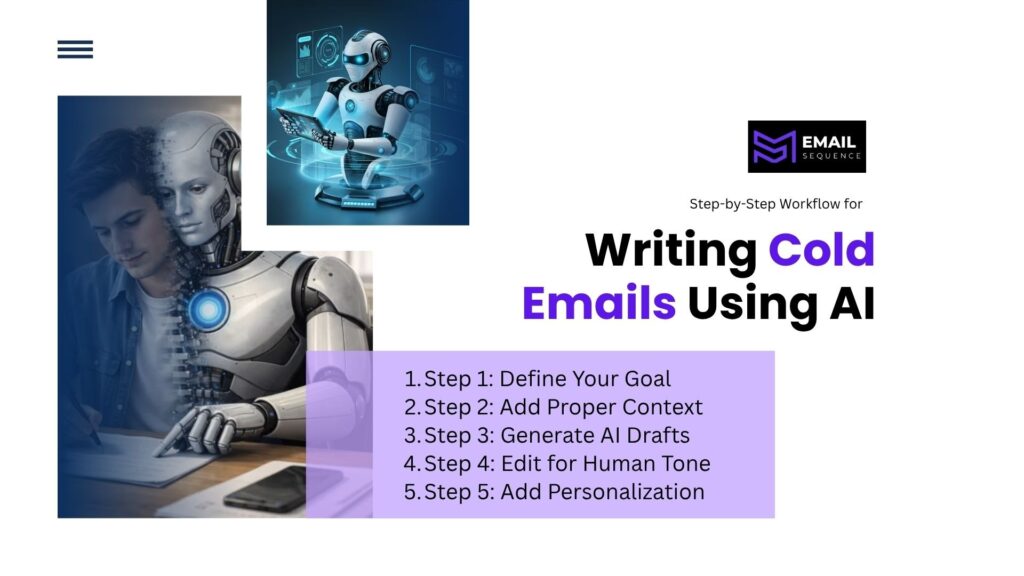
A systematic approach is key to generating better AI cold emails. By strictly controlling your inputs and documenting your workflow, you can prevent formatting errors and protect your domain’s reputation.
Step 1: Define Your Goal Before Using AI
Before opening any AI tool, define what you want:
- Book a meeting
- Generate replies
- Start a conversation
- Introduce a product
Without a clear goal, AI produces unfocused emails.
Step 2: Feed AI Proper Context
Garbage inputs always create garbage outputs. You must specify the exact industry and buyer role. Detail the specific pain point your target experiences daily. Provide a clear summary of your solution.
Always include:
- Industry
- Job role
- Pain point
- Offer summary
- Tone preference
Example input:
“Write a cold email for a marketing manager in SaaS struggling with lead conversion.”
Step 3: Generate First Draft Using AI Tools
Now you initiate the content generation process. Use dedicated platforms to produce structured drafts. Do you want to see exactly how to approach this phase? Review these specific generation steps.
- Input your structured prompt into the software interface
- Request at least three different variations of the message
- Select the variation that matches your desired structure best
- Copy the selected text into your primary text editor
Step 4: Refine for Human Tone
AI drafts often sound too polished or artificial, and this is especially true for an AI cold email. Improve them by making them sound more human. This refinement stage is critical for ensuring your message resonates with the recipient.
Focus on transforming the robotic output into natural, engaging communication that builds trust.
Improve the drafts by:
- Shortening sentences
- Removing filler words
- Making the tone conversational
- Avoiding corporate phrasing
This step transforms robotic text into readable outreach.
Step 5 Final Personalization Touch
Algorithms cannot perfectly nail timing relevance. You must add a specific reference to a recent company event manually. Adjust the call to action to match the specific prospect.
Best AI Use Cases in Cold Email Writing
Using AI for specific micro-tasks in your cold email workflow yields the best results. You isolate the variables you want to optimize, like subject lines or opening hooks.
This focus prevents the AI cold email software from hallucinating irrelevant information.
Writing Subject Lines That Increase Open Rates
Subject lines determine whether your email gets opened. AI can help you brainstorm and test different approaches to see what resonates with your audience.
Some common, effective styles that AI can generate variations for include:
- Direct subject lines
- Curiosity-based lines
- Problem-focused lines
Testing multiple versions improves performance significantly.
Creating Personalized Opening Lines
First impressions determine your success rate. You use algorithms to process public company data.
Curious about how to structure these initial sentences? Implement these specific techniques.
- Reference a recent company funding round directly
- Mention a specific challenge related to their exact job title
- Highlight a mutual connection or shared industry event
- Ask a highly specific question about their current software stack
Structuring the Body of the Email
The system understands standard copywriting frameworks naturally. It builds a logical flow from problem to solution. You maintain a clear messaging hierarchy effortlessly.
A strong cold email follows a simple structure:
- Problem statement
- Value introduction
- Relevance
- Call-to-action
AI helps organize these sections faster, but humans must ensure clarity.
Writing Strong Call to Actions
Your final sentence determines your reply rate. You prompt the software to generate low-friction requests. Soft questions perform better than aggressive meeting demands.
AI can suggest CTAs like:
- “Would you be open to learning more?”
- “Worth a brief chat next week?”
- “Does this align with your current priorities?”
- “What are your thoughts on this?”
You must choose CTAs based on tone and intent.
AI Cold Email Prompts That Actually Work
Prompt engineering is the key to creating effective AI cold emails. You must use precise language to get usable results, as vague instructions will only produce unreadable spam.
Prompt for Subject Lines
You must give the system clear constraints. Type this command into your platform. Write ten cold email subject lines for the logistics industry targeting operations managers with a focus on supply chain delays.
Prompt for Full Cold Email
Building a complete draft requires heavy context. You must include the target role and industry.
Want to see the exact formula for a perfect prompt? Use these precise elements.
- Specify the target job title clearly
- Define the industry and company size
- State your core offer and unique mechanism
- Outline the primary pain point you solve
- Command a casual and brief tone
Use structured inputs:
“Write a cold email for [role] in [industry]. The goal is [goal]. The pain point is [pain]. Keep tone conversational.”
Prompt for Personalization
You can force the software to write custom hooks. Command the system to write three personalized opening lines based on recent hiring activity in the healthcare sector.
Prompt for Follow-ups
Following up requires a delicate balance of persistence and value. Tell the algorithm to write a follow-up email that references the previous message without sounding repetitive or aggressive.
Use:
“Write a follow-up email that continues the previous message without repeating it.”
Common Mistakes When Using AI for Cold Emails
Operators often misuse these tools and ruin their domain reputation. You must understand these failure points to avoid them. Ignorance causes spam filter placements.
Using AI Output Without Editing
Pasting raw output guarantees failure. Unedited text reads like a corporate press release. Buyers delete robotic messages instantly.
Overloading Emails With Information
Algorithms naturally add excessive detail to prove they answered the prompt. You must cut this fluff aggressively.
Are you struggling to keep messages brief? Watch out for these specific bloat issues.
- Paragraphs exceeding three sentences
- Feature dumping instead of focusing on benefits
- Complex vocabulary that slows down the reader
Ignoring Audience Relevance
The software cannot fix a fundamentally flawed strategy. Pitching the wrong product to the wrong person always fails. You must verify your targeting manually.
Sounding Too Generic
Repeated sentence structures bore the reader. The software frequently starts every sentence with a pronoun. You must rewrite the syntax to create a natural rhythm.
How to Make AI Written Emails Sound Human
Editing your AI cold email transforms algorithmic output into compelling copy. You must act as the final quality control filter. This process requires a strict set of editing rules.
Shorten Every Sentence
Long sentences confuse tired readers. You must keep your total word count under one hundred fifty words. Chop compound sentences into two distinct thoughts.
Use Natural Language Patterns
Corporate phrasing signals a sales pitch immediately. You must use a conversational tone.
Need help stripping out the corporate speak? Eliminate these specific elements.
- Formal greetings like “I hope this email finds you well”
- Passive voice constructions that hide the subject
- Synergistic jargon that means absolutely nothing
- Apologetic phrases like “Sorry to bother you”
Add Specific Context Details
You insert the exact company name naturally. You mention a role-specific problem that only an insider would know. You add timing relevance to create urgency.
Remove Overpolished Language
Algorithms try to sound too professional. You want to sound like a colleague sending a quick note. Lower the reading level deliberately.
AI for Cold Email Follow Ups
The majority of your revenue comes from subsequent messages. You must build a sequence that adds value over time. Automation makes this sequencing highly efficient.
Why Follow-Ups Matter More Than First Email
Prospects miss your first message constantly. A simple bump brings your offer back to the top of their inbox. The persistence proves you are a real person.
Using AI to Write Follow-Up Sequences
You prompt the software to create a logical progression of messages. Ensure each step varies in tone and length.
Wondering how to structure this progression? Follow this specific sequencing model.
- Message one delivers the core value proposition
- Message two provides a one-sentence bump
- Message three shares a relevant case study
- Message four asks if priorities have shifted
Smart Follow-Up Timing
Sending messages too close together annoys the prospect. You space the messages out strategically. A simple sequence works best:
- Day 2: First follow-up
- Day 4: Reminder
- Day 7: Value-based follow-up
- Day 12: Final check-in
Benefits of Using AI for Cold Email Writing
- Reduce Content Creation Time: Dramatically cut down the hours spent on writing emails.
- Generate Fresh Ideas: Leverage AI to come up with more creative and engaging concepts than you could alone.
- Enhance A/B Testing: Quickly produce multiple variations of your emails to find out what works best.
- Ensure Team Consistency: Maintain a unified voice and style across your entire sales team’s outreach.
- Lower Mental Load: Simplify the process of launching new campaigns, reducing the mental effort required from your team.
Limitations of AI in Cold Email Writing
- Lacks Emotional Intelligence: AI can’t replicate genuine human emotion, which is crucial for building rapport.
- Limited Contextual Understanding: It struggles to grasp the complex nuances of long enterprise sales cycles or specific business situations.
- Repetitive Structures: Without guidance, AI can produce generic or repetitive content, making your outreach seem formulaic.
- Requires Human Oversight: Every AI-generated output needs a human touch to refine, personalize, and ensure it aligns with your strategy.
Best Practices for AI Cold Email Success
You must always edit the final output. Keep your messages incredibly short. Personalize the text deeply using manual research. Test multiple variations against each other constantly. Focus on clarity over complex vocabulary.
| Feature | Human Writer | Basic Software | Advanced Software | Enterprise Platform | Ideal Use Case |
| Speed | Slow | Fast | Very Fast | Instant | High volume |
| Context | High | Low | Medium | High | Complex sales |
| Tone | Natural | Robotic | Tunable | Perfect | Brand safety |
| Cost | High | Free | Moderate | Expensive | Scale dependent |
| Reliability | Variable | High | High | Maximum | Infrastructure |
Final Thoughts
Building an AI cold email system requires discipline and strict rule enforcement. You use machine learning algorithms to generate the base structure of your outreach. You then apply human logic to refine the tone and relevance. This hybrid approach leverages software for speed while relying on human intelligence for strategy.
Mastering content generation through these tools ensures your messages reach the inbox and actually convert readers into buyers. Maintain your editing standards strictly to protect your domain reputation and maximize your outbound success.
Want to learn how to turn those opens into leads? Read our guide on crafting powerful and effective email sequences.
Frequently Asked Questions
Can AI fully write cold emails for me?
No. AI software generates raw drafts quickly, but human editing is essential to refine the tone, ensure strict relevance, and align the message with your core strategy.
What is the best AI tool for cold email writing?
The best tool is one that supports text and subject line generation and fits your specific workflow. Your choice depends on your team’s needs and existing processes.
How long should AI written cold emails be?
Your outreach messages should be short and concise. Aim for a maximum length of eighty to one hundred fifty words to keep your reader engaged and improve readability.
Does AI improve cold email response rates?
Yes, AI can improve response rates when used correctly. To see results, you must combine the technology with proper audience targeting and thorough manual editing before sending.
Should I automate all cold emails using AI?
No. You should use AI software as a tool to assist your writing process, not to replace it. Never neglect your core strategy or manual personalization for key prospects.