Conversion Funnel Tracking: Map Email Journeys to Revenue
Marketing teams often celebrate the wrong victories. You send a campaign, the open rate spikes to 30%, and the click-through rate looks healthy. The report looks green, and the team feels successful. However, when the finance department reviews the monthly revenue, the numbers do not match the excitement in the marketing meeting.
This disconnect occurs because standard email metrics tell only a fraction of the story. They measure activity inside the inbox but fail to capture what happens after the click. If you cannot see how a subscriber behaves once they land on your site, you are flying blind. You might drive thousands of people to a landing page, but if they drop off immediately, that high open rate is a vanity metric.
To bridge this gap, you must adopt conversion funnel tracking. This approach connects the dots between the initial email engagement and the final purchase. By mapping the full journey, you move from guessing to knowing exactly which emails drive real business growth.
Why Traditional Email Metrics Fail to Show Real Performance
Reliance on surface-level data creates a false sense of security for email marketers. Metrics like opens and clicks only indicate that a subscriber saw your message and found it interesting enough to take action. They do not confirm if the user found value on the destination page or if the traffic quality was high enough to convert.
- This limited view often leads to poor optimization decisions, like focusing on a subject line that gets clicks but from the wrong audience.
- Without sales funnel analytics, it’s impossible to tell if a click resulted in a bounce or a sale.
- True revenue generation depends on what happens after the click, not just within the email.
- The focus is shifting from “email performance” to “journey performance,” which examines the entire customer path.
- To prove the true ROI of your email program, you must use conversion funnel tracking to see how email triggers downstream actions.
Define the Email-to-Customer Funnel: Stages, Events & User Paths
A successful funnel creates a logical flow that guides a stranger toward becoming a loyal customer. You cannot track success if you do not define what success looks like at every step.
Core Funnel Stages (Awareness → Interest → Consideration → Decision)
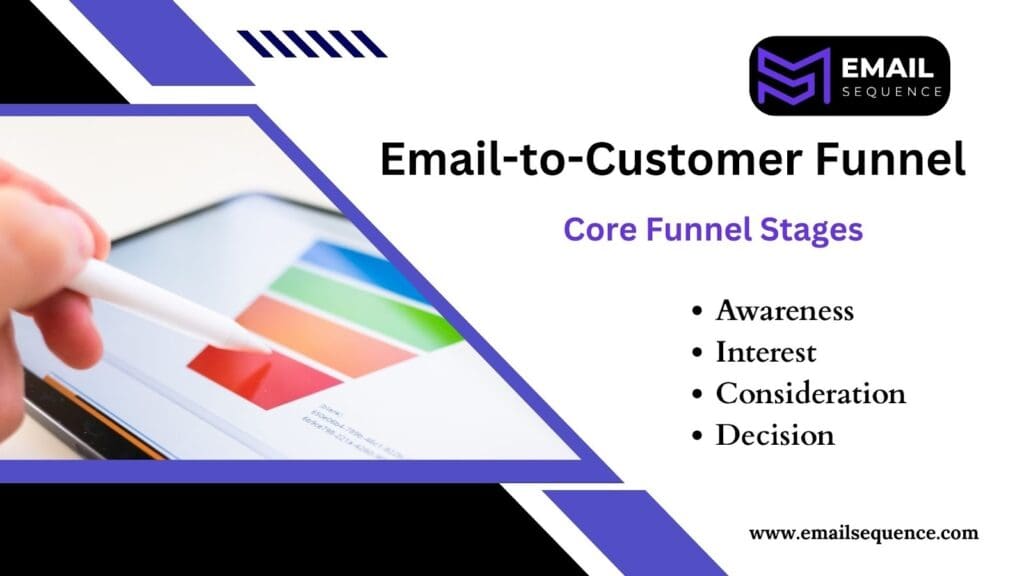
To map your journey mapping strategy effectively, consider these distinct phases that a user must navigate:
- Awareness: The user receives the email and recognizes the value proposition.
- Interest: They click through to the site to learn more about the specific offer.
- Consideration: They engage with high-intent pages, such as pricing or product demos.
- Decision: They complete the final transaction or sign-up form.
You must identify the specific digital events that signal movement between these funnel stages. An “Awareness” event is an email open. An “Interest” event is a landing page view. A “Consideration” event might be adding an item to a cart or viewing a pricing comparison.
Email touchpoints serve as the engine that moves users through these stages. One email might move a user from Awareness to Interest, while a follow-up sequence pushes them from Consideration to Decision.
Instrumentation Blueprint: How to Track Events Across Email → Site → Conversion
Data continuity is the backbone of accurate funnel analysis. If your email data lives in one silo and your website data lives in another, you cannot see the full picture. You need a unified tracking plan that stitches these interactions together.
Essential Events to Track
To ensure your conversion path data is accurate and actionable, focus on capturing these essential data points:
- Send and Open: Logs that the journey has begun.
- Click and Landing View: Confirms the hand-off from inbox to browser.
- CTA Interaction: specific clicks on the website that signal intent.
- Conversion Event: The final form submission, trial start, or purchase.
Recommended Event Parameters
Beyond simple event counting, you must pass specific parameters to add context to the data.
- campaign_id: Identifies which specific email campaign initiated the session.
- step_number: Indicates where the email falls within a sequence.
- session_id: Links the website visit back to the specific email click.
This ensures you do not count one person as two separate users, which would corrupt your conversion funnel tracking data.
Attribution Models That Reveal Email’s True Impact
Assigning credit for a sale is rarely straightforward. A customer might click three different emails and read two blog posts before buying. If you only look at the final click, you miss the influence of the nurturing emails that did the heavy lifting earlier in the journey.
Different models offer different perspectives on value, and choosing the right one is critical for progression tracking:
- Last-Click: Gives 100% credit to the final interaction. This is simple but often undervalues early-stage educational emails.
- Multi-Touch: Distributes credit across multiple interactions. This creates a fairer representation of how a sequence works together.
- Path-Based: Analyzes the most common sequences that lead to conversion, showing which combination of emails works best.
For email sequences, a multi-touch or path-based model usually works best. It allows you to assign progression credit. Even if an email did not result in an immediate sale, you can see if it moved the user from the “Interest” stage to the “Consideration” stage.
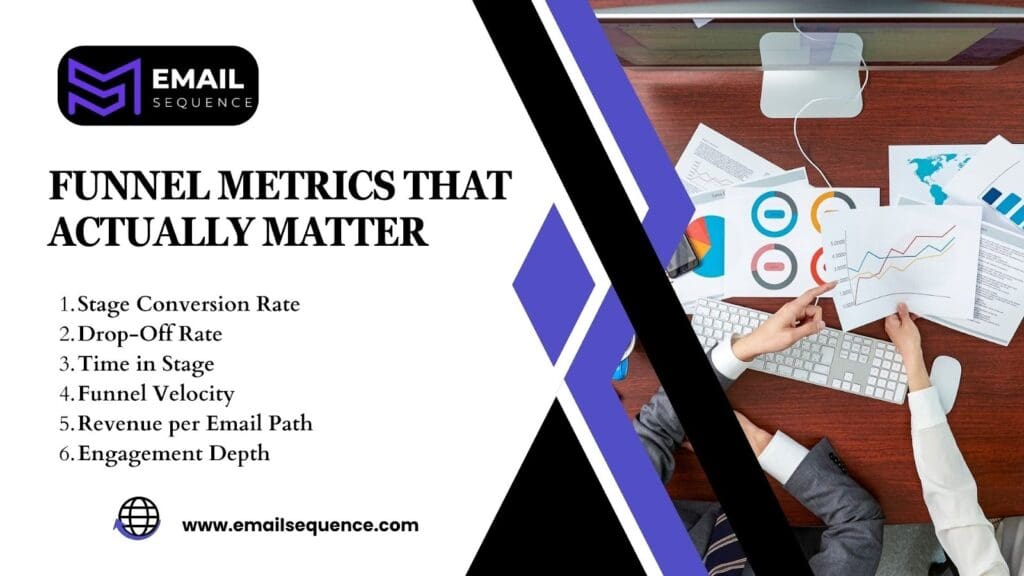
Funnel Metrics That Actually Matter
Vanity metrics make you feel good; funnel metrics help you make money. To truly optimize your revenue, you need to look at the rates of change between steps, not just the raw volume at the top.
To gain a deep understanding of your sales funnel analytics, monitor these key performance indicators:
Stage Conversion Rate
This metric reveals the percentage of users who move from one stage to the next. It isolates friction points. If you have high Interest but low Consideration, your product positioning or pricing might be unclear.
Drop-off Rate
The inverse of the conversion rate, the drop-off rate, highlights exactly where you lose potential customers. A high drop-off rate between the cart and checkout suggests technical issues or unexpected shipping costs.
Time-in-stage
Tracking how long users stay in a specific stage helps predict revenue. If the average time in the Consideration stage increases, your sales cycle is slowing down. You may need more aggressive retargeting or sales enablement content to accelerate the decision.
Funnel Velocity (How Fast Users Progress)
Funnel velocity combines conversion rates and time-in-stage. It measures the speed at which revenue moves through your pipeline. Increasing velocity is often more effective than simply pouring more leads into the top of the funnel.
Revenue Per Email Path
This metric calculates the total value generated by a specific email sequence. It allows you to compare different journeys directly. Does the educational welcome series generate higher lifetime value than the discount-heavy series?
Engagement Depth
Not all traffic is equal. Engagement depth measures how many pages an email visitor views or how long they stay on the site. High engagement depth indicates that your email content aligns well with your landing page experience.
Do email clickers bounce immediately, or do they view five pages? This insight reveals if your email content aligns with your landing page experience.
How to Build Actionable Funnel Dashboards
Data is useless if you cannot visualize it. A well-constructed dashboard turns rows of numbers into a clear narrative about user behavior. It allows you to spot bottlenecks instantly and react before you lose more revenue.
An effective dashboard for journey mapping should include specific visualization components:
- Stage Progression Charts: Visual bars or funnels showing the volume of users at each step.
- Drop-Off Visualization: Highlight exactly where the biggest leaks are occurring.
- Cohort Analysis: Track specific groups of users (e.g., “May Subscribers”) to see how their value matures over time.
You must identify high-value conversion paths. Your dashboard should highlight which specific routes lead to the highest average order value. Use this tool to turn data into a weekly routine.
Experiments & Optimization: Improving Funnel Progression
Once you have data, you must act on it. Optimization is not about guessing; it is about running controlled experiments to see what improves movement through the funnel.
To improve your progression tracking and overall results, implement a rigorous testing framework:
- Holdout Tests: Keep a control group that receives no emails to measure the incremental lift of your campaign.
- Messaging Tests: Experiment with different value propositions to see which one drives deeper funnel engagement.
- Structural Tests: Change the order or timing of emails in a sequence to reduce time-in-stage.
Measure lift beyond the click. When you run a test, do not just look at the open rate. Look at trial starts, demo bookings, or purchases. A subject line might get fewer opens but attract more qualified leads who actually convert. Align your experiment plan with your funnel stages. Test curiosity gaps at the Awareness stage and social proof at the Decision stage.
Common Tracking Errors & How to Fix Them
Watch out for these frequent technical pitfalls that disrupt your conversion path visibility:
Even sophisticated marketing teams make technical mistakes. These errors distort data and lead to incorrect strategic decisions.
Broken UTMs and Inconsistent Naming
Inconsistent tracking parameters split your data. If one email uses utm_source=newsletter and another uses utm_source=news-letter, analytics tools treat them as separate sources. Standardize your UTM naming convention and enforce it strictly.
Missing Click IDs
Without a unique click ID, you lose the ability to tie a specific email click to a downstream conversion accurately. Ensure your Email Service Provider (ESP) automatically appends these IDs to every outgoing link.
Cross-device Identity Mismatch
If you rely solely on cookies, you will miss conversions that happen on different devices. Implement user-ID tracking features in Google Analytics or your customer data platform to bridge this gap.
Double-counted Conversions
If a user refreshes the “Thank You” page, your tracking pixel might fire twice. Configure your tag manager to fire conversion tags only once per session or use order ID deduplication.
Quick Implementation Checklist
Getting started with advanced tracking can feel overwhelming. However, if you break it down into a linear process, you can build a robust system relatively quickly.
Follow this step-by-step guide to modernize your email analytics:
- Define Your Stages: Clearly map out Awareness, Interest, Consideration, and Decision for your specific business.
- Audit Your Links: Ensure every email link has proper UTM parameters and click IDs appended.
- Configure Site Events: Set up your analytics tool to track key actions like “Add to Cart” or “Form Submit.”
- Build the View: Create a dashboard that visualizes the flow between your funnel stages.
- Run a Pilot: Test your journey mapping setup with one specific email sequence to verify data accuracy.
- Optimize: Identify the stage with the highest drop-off and launch an experiment to fix it.
Conclusion
High open rates are satisfying, but they don’t pay the bills. To drive sustainable growth, you need to look beyond vanity metrics and understand the full customer journey. Funnel tracking gives you the clarity to see what’s working, what’s failing, and where your revenue opportunities truly lie.
By defining your funnel stages, auditing your links, and configuring site events, you can transform your email program from a simple communication channel into a powerful performance engine. Stop settling for surface-level data. Start mapping your customer journey today and turn your email insights into a competitive advantage.
Ready to build a high-performance email program? Discover proven strategies to boost your open rates and drive more conversions. Access expert tips and tools designed to optimize every campaign. Visit emailsequence.com now and transform your email marketing today!
Frequently Asked Questions
What is conversion funnel tracking?
Conversion funnel tracking maps a user’s journey from email engagement to final purchase. It measures every stage—Awareness, Interest, Consideration, and Decision—to understand how emails impact revenue.
Why don’t high open rates guarantee revenue?
Open rates only show email engagement, not user actions after clicking. Without tracking the full funnel, high opens may not translate into purchases or qualified leads
What are the core stages of an email-to-customer funnel?
The main stages are:
- Awareness: Email is opened
- Interest: User clicks and visits the landing page
- Consideration: Engages with pricing, demos, or add-to-cart
- Decision: Completes the purchase or form submission
How do attribution models affect email performance measurement?
Attribution models assign credit for conversions:
- Last-Click: Credit to the final interaction
- Multi-Touch: Credit shared across multiple touchpoints
- Path-Based: Shows sequences that drive the most conversions
How do dashboards help in funnel tracking?
Dashboards visualize funnel stages, highlight drop-offs, track cohort behavior, and identify high-value paths. They turn raw data into actionable insights for optimization.