Email Relationship Building: A Guide to Cold-to-Warm Copy
Most sales professionals know the stinging silence of an unanswered inbox. One perfectly crafted cold email rarely closes a deal on its own because asking a stranger for their time or money immediately triggers skepticism. Success in modern outreach requires viewing your copy not as a single transaction but as a sequence designed for email relationship building.
The most effective copywriters engage prospects through a specific journey. They start by generating curiosity, move toward providing value, and only ask for a significant commitment once trust exists. This strategic shift transforms your metrics from low open rates to high-value conversations.
This guide provides a comprehensive framework to help you navigate this transition. You will find practical strategies, paste-ready templates, and a measurement checklist to master the art of moving prospects from cold to warm.
The Transition Mindset: The 3-Stage Cold-to-Warm Email Framework
Many sales development representatives fail because they attempt to propose marriage on the first date. They send a cold email asking for a thirty-minute demo before the prospect even knows who they are.
A successful transition mindset requires a focus on relationship development rather than immediate conversion. You must embrace the concept of micro-value and reciprocity.
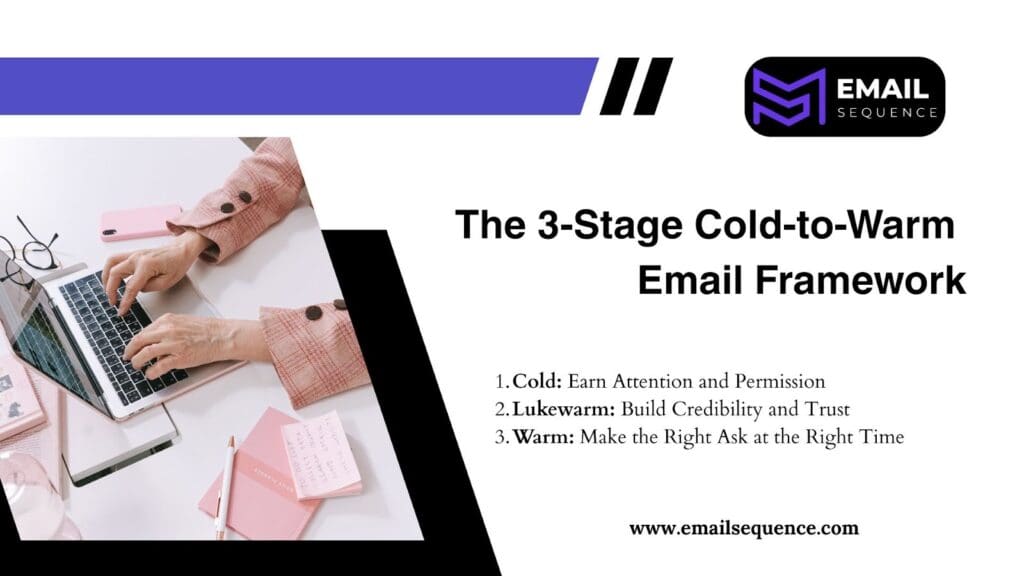
Think of your outreach as a three-stage model: Cold, Lukewarm, and Warm.
- Cold: The prospect does not know you. Your goal is simply to earn permission to continue the conversation.
- Lukewarm: The prospect recognizes your name and associates it with value. You establish credibility here.
- Warm: The prospect trusts you enough to invest their time. This is where you make the ask.
Consider the difference between a failed cold approach and a staged one.
Failed Approach: “Hi [Name], buy our software because it is the best. Can we meet on Tuesday?”
Staged Approach: “Hi [Name], noticed you are scaling your sales team. We just published a guide on onboarding reps in half the time. Do you want to see it?”
The second approach respects the prospect’s time and offers value first. This patience facilitates genuine connection building that pays dividends later in the funnel.
Stage 1: Cold | Open, Be Relevant, Invite a Small Micro-Commitment
The primary goal of the cold stage is not to sell but to earn attention and validate fit. You must prove relevance immediately. Effective prospect nurturing begins here by respecting the recipient’s inbox and avoiding heavy demands.
Your copy must follow a strict formula to succeed. The subject line needs to balance curiosity with relevance to the recipient’s role. The opener should be a single line that signals you have done your research.
Follow this with a one-sentence value proposition that addresses a specific pain point. Finally, end with a tiny ask. Do not ask for a meeting. Ask for a “yes” or “no” reply, or offer a piece of content.
Does your current outreach follow this structure?
- Subject: Question for [Company Name] team
- Body: Hi [Name], I saw you are currently hiring for [Role]. Typically, teams at this stage struggle with [Pain Point]. We help companies like [Competitor] solve this by [Solution].
- CTA: Are you interested in seeing how they did it?
This approach works because it requires almost zero effort from the prospect. Personalization tokens are critical here. Use variables like {{Company_Name}}, {{Job_Title}}, or {{Recent_News}}. If data is missing, ensure you have safe fallbacks so the email does not read “Hi there.”
Stage 2: Lukewarm | Build Trust with Useful, Low-Friction Value
Once a prospect opens your initial email or replies with interest, they enter the lukewarm stage. Your goal now is to surface engagement signals and deepen relevance. This stage centers on trust establishment through generosity.
Your copy tactics should shift from curiosity to utility. Share a short case snippet that mirrors their situation. Offer a quick insight into their industry trends. Provide a micro-resource, such as a one-page checklist or a template. The tone must remain helpful and devoid of sales pressure.
Consider using this structure to provide value without friction.
- Subject: The checklist you requested
- Body: Hi [Name], here is the [Resource] I mentioned. It outlines how [Company X] reduced their churn by 15%. I thought the section on [Specific Topic] was particularly relevant to your current goals.
- CTA: Let me know if you have any questions.
Stage 3: Warm | Move to a Meaningful Ask with Social Proof & Clear Benefit
The prospect has engaged with your email content or replied to your messages. You have successfully moved them to the warm stage. The goal is now to secure a meeting, demo, or trial. You must leverage social proof and explicit ROI framing to justify the request.
Your copy needs to instill a sense of urgency without applying pressure. Use a short transformation story. For example, “Customer X saved Y hours per week using this method.” Be clear about the agenda for the call.
Does your ask look like this?
- Subject: exploring [Topic] for [Company]
- Body: Hi [Name], since you found the guide helpful, it makes sense to walk through how this applies specifically to [Company Name]. We helped [Customer] achieve [Result] in three months.
- CTA: Do you have time for a brief 15-minute walkthrough on Thursday or Friday?
Effective rapport creation involves showing the prospect that you understand their specific challenges and have a proven solution. By the time you send this email, the meeting should feel like the natural next step, not a jarring sales pitch.
Multi-Channel Warming: Integrating LinkedIn, Content & Retargeting
Email does not exist in a vacuum. A robust strategy integrates other channels to reinforce your message. Connection building accelerates when a prospect sees your name across different platforms, validating your credibility.
You must sequence your social touches carefully. Do not bombard the prospect. If you send an email on Tuesday, view their LinkedIn profile on Wednesday. Like a post on Thursday. Send a connection request the following week.
Your messages on social platforms should differ from email.
- LinkedIn Comment: “Great point about [Topic], [Name]. I agree that…”
- LinkedIn DM: “Hi [Name], just sent you an email regarding [Topic]. No need to reply here, just wanted to put a face to the name.”
- Retargeting Copy: “See how [Company] solved [Pain Point].”
Keep the frequency balanced. Over-contacting leads to blocking. The goal is to be omnipresent but unobtrusive. This multi-channel approach supports your email relationship-building efforts by keeping you top-of-mind.
Personalization Rules That Scale
Personalization proves you are human, but manual research does not scale. You need a system that balances efficiency with authenticity. Prospect nurturing relies on the recipient feeling that the message was written specifically for them.
We recommend a standard set of tokens for every campaign.
- {First_Name}
- {Company_Name}
- {Job_Title}
- {Trigger_Event} (e.g., funding round, new hire)
- {Content_Viewed}
You must establish safety rules for when data is missing. If {First_Name} is blank, the fallback should not be empty space. It should be “Hi there” or omitted entirely if the sentence structure allows.
Human quality assurance (QA) is non-negotiable. Review the first fifty emails of any automated sequence. Look for awkward phrasing or tokens that look “creepy.”
- Bad: “I saw you live in [City] and like football.”
- Good: “I saw [Company] just opened an office in [City].”
Small details matter. Relationship development stalls if the prospect feels like a row in a spreadsheet.
Measurement: What to Track at Each Stage
You cannot improve what you do not measure. Moving beyond vanity metrics requires tracking micro-KPIs at each stage of the funnel. This data confirms whether your relationship development strategy is working.
Track these specific metrics to gauge health at each stage.
- Cold Stage: Reply rate and open rate. Are you earning attention?
- Lukewarm Stage: Content clicks and resource downloads. Are you building trust?
- Warm Stage: Meetings booked, trials started, and downstream conversion. Are you closing?
We strongly suggest running a holdout test. Keep 10–20% of your prospects in a control group that receives a standard, non-staged sequence. Compare the incremental lift. You will likely see higher trust establishment metrics in the staged group.
Create a simple dashboard to report these findings. Track progression rate (how many move from cold to lukewarm), time-to-conversion, and revenue per qualified lead. These numbers prove the ROI of relationship-based copywriting.
5 Proven Cold-to-Warm Email Templates
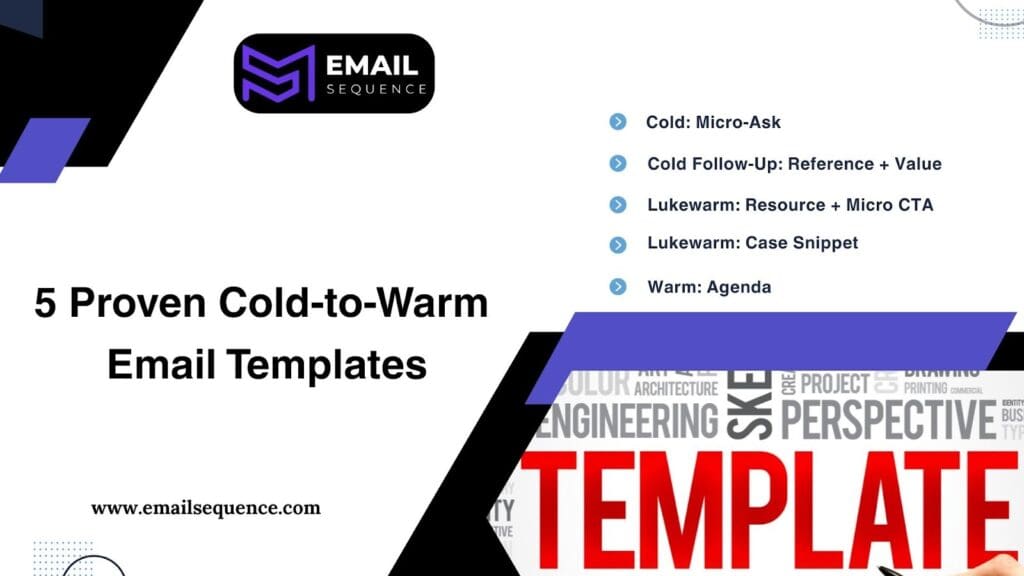
Use these templates as a baseline for your campaigns. Adjust the variables to fit your industry, but maintain the structure to ensure consistent trust establishment.
1. Cold: Micro-Ask
Subject: Question about {Company_Name} marketing
Hi {First_Name},
I noticed {Company_Name} is expanding its content team.
Most leaders I speak with struggle to scale production without sacrificing quality.
We built a workflow that solves this. Open to seeing how it works?
2. Cold Follow-Up: Reference + Value
Subject: Re: Question about {Company_Name} marketing
Hi {First_Name},
Bringing this to the top of your inbox.
I also wanted to share this report on content scaling trends for 2025.
Let me know if you want the link.
3. Lukewarm: Resource + Micro CTA
Subject: The scaling guide
Hi {First_Name},
Here is the report I mentioned.
Page 4 has a great breakdown of team structures that might apply to {Company_Name}.
What do you think of the “hub and spoke” model they describe?
4. Lukewarm: Case Snippet
Subject: How {Competitor} did it
Hi {First_Name},
Our client {Competitor} faced the same bottleneck you mentioned.
They implemented our workflow and doubled output in three weeks.
Is this a priority for you right now?
5. Warm: Agenda
Subject: Content workflow for {Company_Name}
Hi {First_Name},
Given your interest in the report, I would love to show you the specific tool that drives those results.
Agenda: 5 mins on your goals, 10 mins on the platform.
Are you free Tuesday at 2 PM or Wednesday at 10 AM?
Common Mistakes & Quick Fixes
Even the best copywriters stumble. Rapport creation is fragile, and a single mistake can send your email to the spam folder. Avoid these common pitfalls to keep your sequence healthy.
Identify these errors in your current drafts.
- Over-personalization: Referencing personal family details found on Facebook.
- Asking too soon: Demanding a meeting in the first email.
- No value: Checking in “just to check in.”
- Inconsistent cadence: Emailing five times in one week, then silence.
Fix these issues immediately. Use generic fallbacks if the uncertain is unsure. Always add value before making an ask.
Quick 7-Step Playbook to Ship a Cold→Warm Sequence Today
Ready to launch? Follow these steps to execute a flawless campaign.
- Research Prospect: Identify the decision-maker and their likely pain points.
- Craft Cold Email: Write a low-friction opener with a micro-ask.
- Follow-Up Plan: script a value-add follow-up for non-responders.
- Add Lukewarm Resource: Select a relevant case study or whitepaper.
- Social Touch: Plan a LinkedIn like or comment to increase familiarity.
- Warm Ask: Draft the meeting request focusing on ROI.
- Measure & Iterate: Review metrics weekly and adjust your email copy accordingly.
Conclusion
Building rapport with potential clients requires more than just a clever subject line; it’s about the disciplined art of email relationship building. By ditching transactional pitches for a value-first, staged approach, you cultivate the trust needed to close deals.
This strategy involves researching prospects, crafting low-friction openers, and planning value-add follow-ups. Incorporating social touches and lukewarm resources like case studies helps warm up the lead before you make the final ask.
Remember to consistently track your progress, measure key metrics, and refine your copy based on what the data tells you. This iterative process is key to improving your outreach effectiveness over time.
Ready to transform your outreach strategy? Visit emailsequence.com to access more templates and tools that will help you turn cold leads into lasting business relationships.
Frequently Asked Questions
What is a cold-to-warm email sequence?
A cold-to-warm email sequence is a staged outreach strategy that gradually builds trust. Instead of pitching immediately, it moves prospects from awareness to engagement using value-driven emails before making a sales ask.
Why do cold emails fail to get replies?
Cold emails fail because they ask for too much, too soon. Lack of relevance, poor personalization, and immediate sales pressure trigger skepticism and cause prospects to ignore or delete the message.
How many emails does it take to warm up a prospect?
Most prospects warm up within 3–6 emails when value is consistently delivered. The exact number depends on relevance, timing, and how well each message aligns with the prospect’s needs.
What is a micro-commitment in email copywriting?
A micro-commitment is a low-effort action, such as replying “yes,” downloading a resource, or reading a guide. It reduces friction and helps start a relationship without pressure.
How long should a cold-to-warm email sequence run?
A typical sequence runs 14–30 days, allowing enough time for value delivery, follow-ups, and trust development without overwhelming the prospect.