Mastering Email Attribution Modeling in 2025
You send a campaign. Revenue spikes. Your boss asks, “Did the email cause that sale, or was it going to happen anyway?”
Most marketers freeze at this moment. They point to open rates or click-through rates. However, vanity metrics do not pay the bills. This brings us to the “Attribution Gap.” Statistics suggest that nearly 70% of marketers struggle to attribute revenue to specific marketing efforts.
If you cannot prove the value of your email list, you cannot scale it.
This guide bridges the gap between sending emails and generating traceable profit. We will explore email attribution modeling, moving beyond simple metrics to true influence tracking. It is time to prove your real revenue.
The Core Framework: Understanding Touchpoint Analysis
Before we dive into the technical models, we must define the framework. Attribution is not just about the final click. It is about understanding the entire story behind a purchase.
Defining the Touchpoint
A customer rarely buys the moment they see your brand. They might read a blog, sign up for a newsletter, ignore three emails, click the fourth, and then finally buy two days later.
Touchpoint analysis identifies these interactions. You must distinguish between:
- Direct Conversions: The user clicks an email link and buys immediately.
- Assisted Conversions: The email reminded the user of your brand, but they purchased later via a Google search.
Source Attribution Integrity
Data integrity is the backbone of source attribution. Your customers are mobile. They read on phones during their commute but often purchase on desktop computers at work.
You must maintain data consistency across mobile apps, web browsers, and desktop clients. If your tracking breaks when a user switches devices, your ROI data becomes flawed.
Conversion Mapping
Think of conversion mapping as visualizing a path. You are drawing a line from your initial “Welcome Series” automation all the way to the final checkout page. When you map this journey, you see which emails serve as introductions and which ones act as closers.
Comparative Guide: Which Model Fits Your Business?
Not all attribution models work for every business type. A high-ticket consultant requires a different view than a flash-sale fashion retailer.
Here is a breakdown of the primary models to help you decide.
| Model Type | Logic | Best For | Pros | Cons |
| First-Touch | 100% credit to the first email clicked | Lead Gen / Awareness | Highlights top-of-funnel drivers | Ignores the “closing” email |
| Last-Touch | 100% credit to the final link clicked | Flash Sales / E-commerce | Simple to track and implement | Undervalues nurturing sequences |
| Linear | Equal credit to every email in the flow | Long Sales Cycles | Values the entire Email Automation Roadmap | Can overvalue “low-intent” emails |
| Time-Decay | Credit increases as the user nears conversion | High-Ticket Items | Realistic view of the buying momentum | Technical to set up in GA4 |
| U-Shaped | 40% to first, 40% to last, 20% to middle | B2B SaaS | Balances discovery and closing | Complex Multi-Channel Automation logic |
Technical Implementation: Influence Tracking in 2025
Choosing a model is strategic. Implementing it is technical. To ensure accurate conversion attribution, you must modernize your tracking stack.
The UTM Strategy
You cannot track what you do not label. Standardize your UTM parameters immediately. Every link in every email should carry tags for:
- utm_source (e.g., newsletter)
- utm_medium (e.g., email)
- utm_campaign (e.g., spring_sale_2025)
Consistency is vital. “Email,” “email,” and “e-mail” will show up as three different sources in Google Analytics, ruining your data.
GA4 Integration
Google Analytics 4 (GA4) has changed how we view conversions. They are now called “Key Events.” You must configure GA4 to recognize email as a primary traffic source.
Ensure your session timeout settings match your sales cycle. If a user clicks an email but buys 4 hours later, standard settings might not attribute that sale to the email session.
First-Party Data and Privacy
We operate in a privacy-first era. Third-party cookies are disappearing. Apple Mail Privacy Protection (MPP) obscures open rates.
To combat this, leverage server-side tracking. By using first-party data, you bypass many browser restrictions. This allows you to track user behavior accurately without violating privacy norms.
Identifying Gaps: What Most Marketers Miss
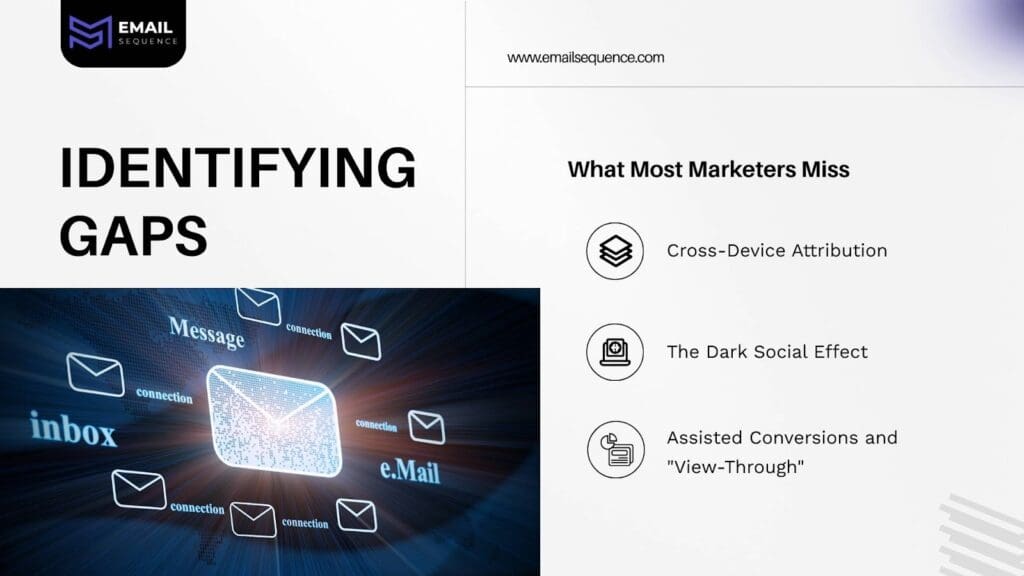
Even with great models, blind spots exist. Addressing these gaps separates average marketers from data experts.
Cross-Device Attribution
This is the “Read on Phone, Buy on Laptop” dilemma. If you do not have a user logged in across devices, this path breaks. Encourage users to log in early in their journey. This connects the mobile view to the desktop purchase.
The Dark Social Effect
“Dark Social” refers to private sharing. This happens when a subscriber forwards your email to a colleague or shares a link in a private Slack group or WhatsApp chat. Analytics tools often misclassify this as “Direct Traffic.” While difficult to track perfectly, unique referral codes can help illuminate this hidden influence.
Assisted Conversions and “View-Through”
Do not ignore the power of visibility. A user might read your email, digest the information, and then type your URL directly into their browser. They did not click, but the email caused the action. Monitoring “View-Through” metrics helps you understand this silent influence.
Strategic Integration: Building the Foundation
Your attribution model should dictate your strategy, not the other way around.
If you discover that your “Welcome Series” has a high first-touch value but a low last-touch value, do not change it to sell harder. Recognize its role is to educate, not to close.
As you scale, move from email-only tracking to sophisticated Multi-Channel Automation. This allows you to see how email influences SMS, social ads, and organic search. You will begin to see the ecosystem rather than just the channel.
Conclusion & Action Plan
You do not need to build a perfect system overnight. Follow this maturity model:
- Start with Last-Click: Get your UTMs in order and track direct revenue.
- Move to Linear: begin to understand how nurturing plays a role.
- Aim for Data-Driven: Use advanced algorithms to weigh credit dynamically.
Use this data to make hard decisions. Kill the segments that do not perform. Double down on the sequences that show strong influence.
Your next step: Audit your current attribution window today. Check our email sequence consistency and ensure your analytics platform recognizes your email traffic correctly. The data is there; you just need to claim it.
Frequently Asked Questions
What is email attribution modeling?
Email attribution modeling is a method to track and analyze how email campaigns contribute to conversions. It helps marketers understand the role of emails in the customer journey, from awareness to purchase.
Why is email attribution modeling important?
It is important because it provides insights into which emails drive revenue, allowing marketers to optimize campaigns, allocate budgets effectively, and prove ROI.
What are the common types of email attribution models?
The common email attribution modeling models include:
- First-Touch: Credits the first email interaction.
- Last-Touch: Credits the final email before conversion.
- Linear: Distributes credit equally across all emails.
- Time-Decay: Gives more credit to emails closer to the conversion.
- U-Shaped: Balances credit between discovery and closing emails.
How does email attribution modeling improve marketing strategies?
It improves strategies by identifying high-performing emails, optimizing touchpoints, and aligning email campaigns with customer behavior for better engagement and conversions.
How can I implement email attribution modeling effectively?
To implement it effectively:
- Use standardized UTM parameters for tracking.
- Integrate with tools like Google Analytics 4 (GA4).
- Leverage first-party data to maintain accuracy in a privacy-first era.