Voice Search Email: The Ultimate 2025 Optimization Guide
Over 40% of adults now use voice search every day. They are not just asking for the weather forecast. They are commanding their devices with phrases like, “Siri, what is my first meeting today?” and “Alexa, read my latest emails.” The inbox is no longer a purely visual space. This shift marks the beginning of a new era for email marketers.
Welcome to the world of voice search email. This is the process of optimizing your email content so artificial intelligence assistants can accurately find, read, and interact with your messages. Being “voice-first” in the inbox is the next great frontier. It presents a fresh opportunity to connect with your audience and guide them through your conversion funnel in a completely new way.
How Voice Assistants “See” Your Emails
To optimize for voice, you first need to understand how a machine “reads.” Voice assistants do not see your emails; they interpret them. This happens through a sophisticated process involving Natural Language Processing (NLP). NLP is the technology that translates the written text of your email into the spoken words your audience hears.
Beyond simple reading, there is a crucial searchability factor. Effective voice SEO allows a user to find a specific message using a simple spoken query, like, “Hey Google, find the email with my flight ticket to Boston.”
The assistant sifts through the user’s inbox, looking for the most relevant message based on the query’s intent. This is where audio search optimization becomes critical. We must move beyond thinking in terms of single keywords and start optimizing for conversational key phrases that mirror how people actually speak.
The Voice Search Email Comparison
Optimizing for the ear requires a different approach than optimizing for the eye. The goals and methods diverge significantly from traditional email marketing.
| Feature | Traditional Text Email | Voice-Optimized Email |
| Primary Goal | High Click-Through Rate (CTR) | High “Hearability” & Actionability |
| Subject Lines | Eye-catching, often uses Emojis | Concise, context-heavy, question-based |
| Copy Style | Formal, scannable blocks of text | Conversational, rhythmic, storytelling |
| CTA Type | Buttons and Hyperlinks | Verbal commands (e.g., Reply, Delete, Archive) |
| Technical Requirement | Responsive Design (HTML/CSS) | Schema Markup (JSON-LD) & Alt-Text |
Writing for the Ear: Using Email Storytelling
When an email is read aloud, its flow and rhythm become paramount. Email storytelling provides the perfect framework for creating a positive listening experience. If a sentence sounds clunky or unnatural when you read it aloud, a user will likely command their assistant to “Skip.”
To write for the ear, focus on these elements:
- Conversational Rhythm: Use a natural, spoken cadence. Your copy should feel like one side of a conversation, not a dense block of text.
- Sentence Structure: Prioritize short, punchy sentences. Avoid complex sentence structures with multiple clauses or nested parentheticals, as these can confuse voice synthesis engines and listeners.
- The “Summary” Paragraph: Place a concise summary, or a “too long; did not read” (TL;DR), at the very top of your email. Voice assistants often grab this section as a “featured snippet” to give the user a quick overview of the email’s content.
Technical Optimization: The “Invisible” Voice SEO
Much of what makes an email successful for voice search happens behind the scenes. This technical optimization is the invisible engine that powers a great voice assistant email experience.
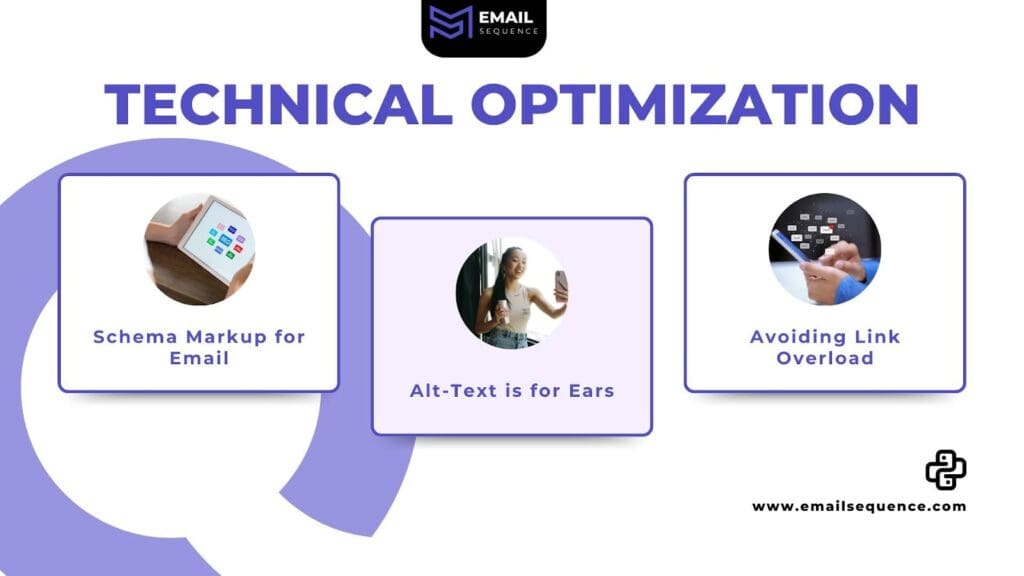
- Schema Markup for Email: Use Schema.org markup, specifically JSON-LD, to tag key information in your emails. This code highlights specific “Actions” and entities, such as package delivery updates, event RSVPs, or invoice details. It gives the voice assistant structured data to understand the email’s purpose immediately.
- Alt-Text is for Ears: We often think of alt-text as a tool for screen readers and image SEO. In the context of voice, it is essential. A voice assistant uses alt-text to describe images to the user. A blank or non-descriptive tag creates a jarring gap in the audio experience.
- Avoiding Link Overload: An email filled with hyperlinks is a nightmare for a voice assistant. It will attempt to read out each long, messy URL, creating a terrible user experience. Group necessary links under a single, clear call-to-action, or use shortened URLs when you must include them.
Local Voice Search & The Email Connection
Voice search is deeply connected to local intent. Phrases like “find a coffee shop near me” are incredibly common. Businesses can use email to tap into this behavior and drive foot traffic. For example, a promotional email can be optimized for queries like, “Alexa, are there any deals at my favorite bookstore?”
You can also use geofencing to send targeted emails that trigger voice notifications. Imagine a user receiving an email for a special in-store offer. You could program it to trigger a device reminder when that user is within a one-mile radius of your physical location, seamlessly connecting digital marketing to a real-world action.
Measuring Success in a Screenless World
How do you track success when a “click” is no longer the primary goal? Measuring the impact of voice search email requires a new set of metrics. The attribution challenge is real, but not impossible to overcome.
We must learn to track a “listen” versus a “click.” This involves integrating your conversion funnel tracking with audio-based interactions. The goal is to understand how a spoken engagement leads to a desired outcome. You can also design your calls-to-action for voice. Instead of “Click Here,” encourage users to “Reply Yes” to confirm an appointment or “Call Now” to be connected directly with your sales team through their voice assistant.
Challenges and Data Privacy
The rise of voice technology is not without its hurdles. The accuracy of speech recognition can vary, especially when handling different accents and dialects. This can lead to misinterpretations and frustrating user experiences.
Furthermore, the “always listening” nature of smart devices brings up valid data privacy concerns. Marketers must navigate complex regulations like GDPR and CCPA. It is your responsibility to be transparent about how personal email data is processed and to ensure your practices are compliant and respectful of user privacy.
Conclusion: The Future of Spoken Content
Optimizing for spoken search in the inbox is no longer a futuristic trend. It is a present-day requirement for accessibility and user productivity. As more people integrate voice assistants into their daily lives, the demand for audible content will only grow.
Do not just focus on building an email list. Instead, build a voice search email strategy that your customers recognize, trust, and want to listen to. Start implementing these voice search email optimization techniques today to secure a unique and powerful presence in your audience’s daily routines, and lead the way in modern email marketing with an email sequence.
Frequently Asked Questions
What is Voice Search Email?
Voice Search Email refers to the process of optimizing email content and metadata so voice assistants can accurately find, read, and interact with emails through spoken commands.
How does Voice SEO improve email performance?
Voice SEO enhances email discoverability by optimizing for conversational phrases, making it easier for users to locate emails using voice queries like, “Find my flight confirmation email.”
Why is audio search optimization important for emails?
Audio search optimization ensures that emails are easily understood and actionable when read aloud by voice assistants, improving user engagement in a screenless environment.
What are the key elements of a voice-optimized email?
Key elements include concise subject lines, conversational copy, schema markup for structured data, and descriptive alt-text for images.
How can businesses benefit from voice search email optimization?
Businesses can improve accessibility, enhance user experience, and increase engagement by making their emails compatible with voice technology, tapping into the growing trend of voice assistant usage.